
An asset-light business earns its revenue without owning much physical property, equipment or inventory. It leans on people, software, brands, contracts and partners instead. For investors, the appeal is simple: less money tied up in factories and fleets can mean higher returns on the capital that is invested. The catch is that "light" is a spectrum, and some companies only look light on the surface.
This guide explains the model in plain terms, gives real examples, shows how to measure "lightness" from financial statements, and covers the risks that come with it.
TL;DR
- An asset-light company shifts fixed costs into variable costs by relying on partners, licensing, franchising, platforms or software instead of owning assets.
- Typical benefits are better returns on assets, steadier profits and faster scaling. Typical risks are weaker control and leakage of intellectual property.
- Check the numbers: fixed asset turnover, return on assets and return on invested capital over several years, compared with peers in the same industry.
- Ownership is a spectrum. Ask how much of the underlying asset the company actually owns versus simply orchestrates.
- Asset-light does not automatically mean better. Cash flow, margins and competitive position still decide the quality of the business.
Table of Contents
- What an asset-light business is
- The main asset-light models
- Examples of asset-light companies
- Asset-light vs. asset-heavy
- Why investors like asset-light models
- The risks and trade-offs
- How to tell whether a company is asset-light
- Putting the model in a broader analysis
- Our perspective
- Screen stocks faster with Oracle
- FAQ
- Sources
What an asset-light business is
EY describes an asset-light strategy as transferring capabilities (people, process and technology) to "better owners". The goal is to turn fixed costs into variable ones, gain agility and focus resources on what the company does best. EY also frames the model as a set of partnerships across an ecosystem, where each party concentrates on the capabilities it manages best.
In practice, that means a company decides what it must own to win and rents, licenses, outsources or lets others own the rest. A software firm rents cloud servers instead of building data centers. A hotel brand collects fees from owners who hold the buildings. A ride-hailing app connects riders with drivers who bring their own cars.
The business is not necessarily small. Some of the largest companies in the market are asset-light by design. What they share is a low ratio of physical assets to revenue.

The main asset-light models
BCG has identified nine asset-light archetypes: outsourcing, pay per use, marketplace, licensing in, rebranding, asset sharing, franchising, licensing out, and product-to-service transitions. Most real companies fit one or two of these, and the table below groups the ones investors meet most often.
| Model | How it works | What the company keeps |
|---|---|---|
| Outsourcing | Buys components or manufacturing from others | Design, brand, distribution |
| Franchising | Independent owners run locations under the brand | Royalties and fees, brand standards |
| Licensing out | Others pay to use patents, characters or technology | Intellectual property, royalty income |
| Marketplace | Connects supply and demand without owning the asset | Matching, payments, trust |
| Asset sharing | Customers or partners share underused assets | The platform and the data |
| Product to service | Sells outcomes or subscriptions instead of equipment | Recurring revenue, customer relationship |
BCG gives a U.S. example of outsourcing: Vizio became the U.S. market leader in LCD TVs by buying panels from several sources instead of making them, after concluding that panels were not a source of differentiation. The lesson is that the company chose which assets mattered for its edge and let suppliers carry the rest.
Examples of asset-light companies
The best-known examples are platforms. Uber and Lyft rely on independent contractors and their existing vehicles rather than owning a fleet. Grubhub and Uber Eats use restaurant partnerships and technology without heavy infrastructure spending.
A TechCrunch analysis of marketplaces makes the core point clearly: platforms can earn money by facilitating introductions and payments between supply and demand without buying the underlying asset. Uber does not buy the car, and Airbnb does not buy the house.
That last example is worth a closer look, because the same idea shows up on the other side of the transaction. An individual who owns a short-term rental is asset-heavy, with a property to finance and maintain, while the platform that lists it is asset-light. If you want to see what the owner's side looks like in numbers, this Airbnb investment analysis walks through underwriting a short-term rental.
Other common categories include:
- Franchisors. Hotel and restaurant brands that collect fees while franchisees own the buildings and equipment.
- Software and internet companies. Their main assets are code, data and customer relationships.
- Brand-led consumer companies. They design and market products that contract manufacturers produce.
- Licensing businesses. They monetize patents, formats or characters.
Momenta notes that these models are common in digital, retail, hospitality and transportation, where speed to market matters and partners can supply capacity.
Asset-light vs. asset-heavy
An asset-heavy business owns the means of production: refineries, railroads, steel mills, hospitals, power plants, large retail footprints. Its revenue depends on keeping expensive equipment busy. An asset-light business owns less and rents or shares more.
| Factor | Asset-light | Asset-heavy |
|---|---|---|
| Capital spending | Usually lower relative to sales | Usually high and recurring |
| Cost structure | More variable | More fixed |
| Profit swings in downturns | Typically smaller | Typically larger |
| Control over quality and supply | Shared with partners | Direct |
| Barriers to entry | Often lower, so moats must come from elsewhere | Often higher because of capital needs |
| Return on assets | Often higher | Often lower |
Each model makes sense in different circumstances. Owning assets is rational when the asset itself is the competitive advantage: a pipeline network, a scarce piece of land, a manufacturing process nobody else can match. Going light is rational when the physical asset is a commodity input that others can supply as well as you can, which was the Vizio logic.
So the right question is never "which is better?" It is "which assets create the advantage, and does this company own those?"
Why investors like asset-light models
BCG lists better returns on assets, lower profit volatility, greater flexibility and scale-driven cost savings as the main benefits.
The volatility point deserves a plain explanation. BCG attributes it to costs that are more variable relative to revenue. When sales fall, an asset-light company can shed some of its costs. A company with a big fixed cost base cannot, so its profits fall faster. If this idea is new to you, our guide on operating leverage risk shows how fixed costs magnify swings in earnings.
The return math is straightforward. If two companies earn the same profit, but one needs half the capital to do it, the lighter one produces a higher return on that capital. Our return on invested capital guide explains how to calculate and read that figure.

The risks and trade-offs
The same BCG research notes that asset-light models can be harder to manage and carry a risk of IP leakage or reduced value. Understanding these helps you judge a company's quality.
- Dependence on partners. If a franchisee, supplier or driver base is unhappy, the company has less direct control over the customer experience.
- Thin differentiation. When assets are cheap to rent, competitors can copy the model. The moat has to come from brand, network effects, data or switching costs. Our moat analysis scoring guide gives a structured way to check this.
- Knowledge leakage. Handing know-how to partners can help them become competitors.
- Hidden obligations. Leases, guarantees and purchase commitments can carry real financial weight even if they sit differently on the balance sheet.
These are points to weigh when choosing a company, not reasons to avoid the category. A strong asset-light business pairs low capital needs with a durable edge.
How to tell whether a company is asset-light
You do not need a spreadsheet model to get a first read. Four steps are enough.
1. Check fixed asset turnover
Investopedia explains that fixed asset turnover shows how effectively management uses fixed assets to generate revenue. A higher number means more sales per dollar of property, plant and equipment. The same page advises comparing turnover over several periods and against similar companies in the same industry. A software company and a utility are not comparable, but two hotel brands are.
2. Look at return on assets
Investopedia describes ROA as a profitability ratio showing how much net income is earned from total assets, and notes it works as an asset-performance metric because fixed assets take significant capital to buy and maintain. A high and stable ROA over many years is a classic sign of a capital-efficient business. For a broader view of margin and return measures, see our explainer on profitability ratios.
3. Compare capital spending with sales
Open the cash flow statement. Divide capital expenditures by revenue for the last five years. A consistently low percentage suggests the model does not need heavy reinvestment. A rising percentage is a signal to ask why. Our guide on profitability versus cash flow explains why capex matters when reported earnings look attractive.
4. Ask how much the company really owns
The TechCrunch discussion frames lightness as a spectrum of ownership, access and control. So read the business description and notes: does the company own the vehicles, buildings or inventory, or does it orchestrate others who do? A marketplace that begins buying inventory, or a franchisor that buys back its restaurants, is moving along that spectrum.
As a worked example of the logic, imagine two companies with $1 billion in revenue and $100 million in net income. Company A has $2 billion in total assets, so its ROA is 5%. Company B has $500 million, so its ROA is 20%. The figures are illustrative, not real companies, but they show why the lighter model can be so attractive: same profit, a quarter of the asset base.
Putting the model in a broader analysis
Asset-light is one trait, not a verdict. Before you buy, run the company through the same basic questions you would ask of any stock: Is it profitable? Is it fairly valued? Is the balance sheet sound? Our 10-step fundamental analysis checklist covers the order to work in, and the income statement checklist helps you read margins and cost structure.
Also check debt. Some asset-light companies, especially franchisors, carry meaningful borrowing even though they own few properties. The interest coverage ratio guide shows how to test whether earnings comfortably cover interest.
Our perspective
Asset-light is one of the most useful lenses in value investing, and also one of the easiest to misuse. The label gets applied to anything with a clever app. The real question Buffett, Munger and Lynch kept returning to is whether a business earns high returns on the capital it needs, year after year, and whether something protects those returns.
That is why we built Oracle Investments around reported fundamentals rather than guesses. Our ratings are rule-based, grounded in company financials, and we show the scoring inputs so you can see exactly why a company scores the way it does. Profitability, valuation and financial health sit side by side for more than 260 stocks, so a capital-efficient business stands out without any spreadsheet work.
Our advice: use the asset-light idea to generate candidates, then let the numbers confirm. If returns are high, cash flow is real and the balance sheet is sound, you have found something worth studying.
Matt
Screen stocks faster with Oracle
If you want to see how companies stack up on profitability, valuation and financial health, Oracle Investments scores more than 260 stocks on those fundamentals and lets you compare them side by side. It also tracks your portfolio and includes lessons drawn from Buffett, Munger and Lynch. The app is sold as a subscription through the Apple App Store.
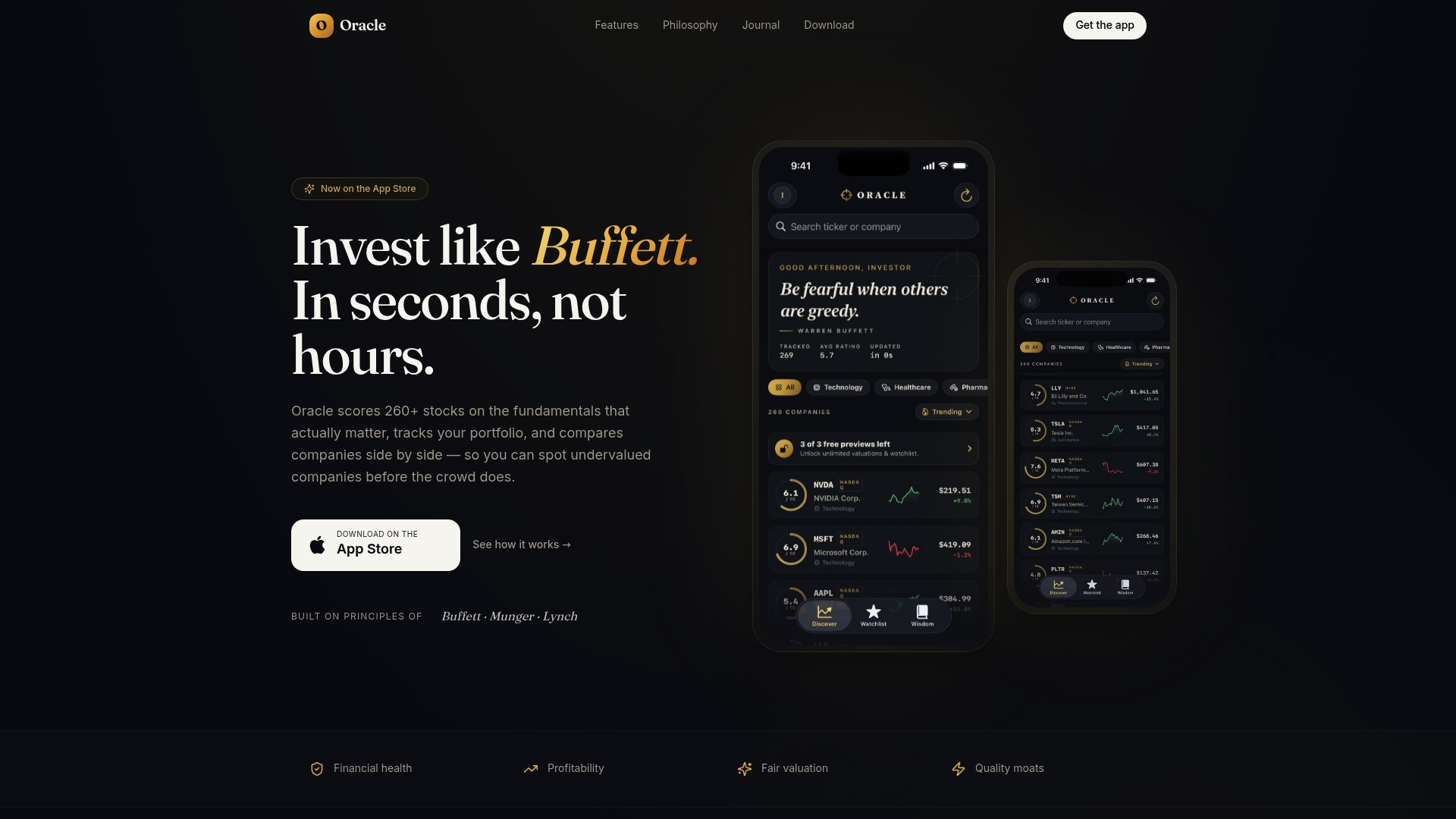
See Oracle Investments Premium Annual and start comparing capital-efficient businesses in seconds.
FAQ
What is an asset-light business?
It is a company that generates revenue while owning relatively few physical assets. It relies on people, technology, intellectual property, brands and partners. EY describes the strategy as moving capabilities to better owners so fixed costs become variable.
What are some examples of asset-light companies?
Ride-hailing and delivery platforms such as Uber, Lyft and Grubhub are common examples. Franchise-driven hotel and restaurant brands, software companies and brand-led firms that outsource manufacturing also fit. Each earns money from a brand, network or technology rather than from owning the underlying assets.
Is asset-light always better than asset-heavy?
No. The better model depends on where the competitive advantage sits. If a physical asset is the advantage, owning it makes sense. If it is a commodity input, renting or outsourcing it can lift returns. Judge each company on its returns, cash flow and moat.
Which ratios show a company is asset-light?
Start with fixed asset turnover, return on assets and capital spending as a share of sales. Compare each over several years and against peers in the same industry. Return on invested capital adds a view of how well all capital is used.
Sources
- EY: How asset-light strategies and models can boost business growth
- BCG: When "Asset Light" Is Right
- Momenta: The Power of Asset-Light
- TechCrunch: The unbearable lightness of being asset-light
- Investopedia: Assessing a Company's Balance Sheet
- Airbnb investment analysis: how to underwrite a Sedona STR