
A compounder stock is a company that earns high returns on the money it invests in its own business and keeps doing so for years, so each year's profit builds on a larger base than the year before. You find one by checking a few numbers that show whether the business really earns those returns, whether it turns profit into cash, whether its balance sheet can take a downturn, and whether the price you pay leaves room for the compounding to work. Oracle scores 260+ stocks on profitability, valuation and financial health from reported fundamentals, so you can run that check in minutes instead of building spreadsheets.
TL;DR
- A compounder is a business that reinvests profits at high returns for many years, so its value grows on an ever-larger base.
- The traits to look for: high return on invested capital, strong free cash flow, a durable competitive advantage, low debt and management that allocates capital well.
- Quality is not enough. Overpaying for a great business can cancel years of compounding, so valuation belongs in the same checklist.
- Compounding takes time and does not remove risk. Diversify and match the holding to your own time horizon.
- Oracle puts profitability, valuation and financial health scores for 260+ stocks side by side, with the inputs shown.
Table of Contents
- What a compounder stock is
- Why compounding matters so much over decades
- The traits that make a compounder
- A five-question checklist for a potential compounder
- Valuation: a great business can still be a bad purchase
- A worked comparison
- Compounding does not remove risk
- Where Oracle fits
- Our perspective
- Put the checklist to work
- FAQ
- Sources
What a compounder stock is
Start with the idea underneath. The U.S. Department of Labor describes compounding as earnings that are added to your original money, so the next round of earnings is figured on a bigger pool. You earn on your savings and on the earlier earnings too.
A compounder stock applies that idea to a business. The company earns a profit, puts it back to work at a high return or pays it out to you, and the cycle repeats. Morgan Stanley Investment Management defines compounders as high-quality franchise businesses, ideally with recurring revenue, built on durable intangible assets, with pricing power and low capital intensity.
Translate that into plain words:
- Franchise means a business customers keep coming back to, such as a strong brand or a service people rely on.
- Intangible assets are things you cannot touch: brand recognition, customer loyalty, copyrights, distribution networks.
- Pricing power means the company can raise prices without losing its customers.
- Low capital intensity means it does not need to pour huge sums into factories and equipment to grow.
The same Morgan Stanley paper argues that relatively few companies have compounded shareholder wealth at superior rates over the long run. Most are erratic or inferior creators of wealth. That is why the label deserves a test, not a hunch.
Why compounding matters so much over decades
The CFA Institute's 2026 investor brief, Exponential Wealth, calls compounding the engine of long-term wealth and notes that small differences in annual returns produce enormous differences over decades.
Here is a simple worked example using our own arithmetic, not a forecast. Put $10,000 into an investment that grows 8% a year and leave it for 30 years: it becomes about $100,600. At 10% a year, the same $10,000 becomes about $174,500. Two percentage points a year nearly doubles the result. That gap is the whole reason investors hunt for businesses that can keep earning high returns on their capital.
Two cautions keep the math honest. The CFA brief's preferred 2026 to 2050 forecast for U.S. equities is about 8.0% nominal and 5.6% real (after inflation), and it warns that the U.S. experience has been unusually strong, so you should not count on one country, one asset class or one return premium. It also advises treating forecasts as planning tools, not promises.

The traits that make a compounder
No single number identifies a compounder. A handful of traits, taken together, do.
High and sustainable return on invested capital
Morgan Stanley's paper says the key financial characteristic is sustainably high return on invested capital (ROIC). ROIC measures how much operating profit a company earns for each dollar put into the business. A company earning 20 cents on every dollar it reinvests grows far faster than one earning 5 cents. Our guide to return on invested capital shows how to calculate it, and the return on capital employed guide covers a close cousin of the same idea.
The word that matters is sustainable. One great year is not a compounder. Look at several years of returns and ask what protects them.
Strong free cash flow
According to the same paper, recurring revenue, high gross margins and low capital intensity support strong free cash flow, and that cash must then be reinvested or distributed. Free cash flow is the cash left after the company pays to run and maintain the business. Profit on paper can be flattering. Cash is harder to dress up. Read free cash flow explained if the term is new, and see how owner earnings, the Buffett-style version of the idea, adjusts for the spending a business needs just to stand still.
A durable competitive advantage
Investors call a lasting advantage a moat. Morgan Stanley's In Praise of Tortoises… and Compounders says the essence of a compounder is powerful, hard-to-replicate intangible assets, such as brands or networks, that deliver pricing power, with decent growth and predictable, often recurring, sales. Our moat analysis guide walks through how to score one.
The same paper says compounders are typically not found in banks, utilities, telecoms, miners and energy companies, which are low-return, cyclical price-takers. It names consumer staples and software and IT services as the richest hunting grounds. That is a starting map, not a rule, but it tells you where the odds of finding high, steady returns are better.
Resilience in downturns
Morgan Stanley's compounders paper notes that these companies tend to hold up in downturns, with steady operating cash flow and no excess leverage, because customers keep buying everyday products at high margins and brand loyalty keeps demand stable. Check debt against cash flow. A business that must refinance in a recession cannot reinvest at leisure.
Management that allocates capital well
Berkshire Hathaway's Owner's Manual states Warren Buffett's preference for owning businesses that generate cash and consistently earn above-average returns on capital. The company's own wording makes the standard clear: what matters is what management does with the cash. Morgan Stanley's tortoises paper warns that management can foil compounding through underinvestment or poor capital allocation.
The clearest test is how the company treats acquisitions. Morgan Stanley's example: a company generating 30% ROIC can damage its compounding potential by buying a business that earns only 5% to 10% ROIC just to lift earnings per share. Position sizing and the financial decisions behind returns also matter once you own the stock, and risk-adjusted returns for position sizing gives one view of how to weigh return against the risk taken.
A five-question checklist for a potential compounder
Use this list on any company you are considering. It takes a few minutes once you have the numbers in front of you.
- Does it earn a high return on capital year after year? Look at ROIC or ROCE over five or more years. A steady line beats a spike.
- Does profit turn into cash? Compare free cash flow with net income. If cash keeps lagging profit, ask why.
- What protects the returns? Name the specific advantage: a brand, a network, switching costs. If you cannot name it, you have not found a moat.
- Can it survive a bad year? Check debt, interest coverage and how revenue behaved in the last downturn.
- What does management do with the cash? Check whether money goes into projects, buybacks, dividends or acquisitions, and whether returns on that spending hold up.
Then move to the question that trips up most investors: price.
Valuation: a great business can still be a bad purchase
Morgan Stanley warns that investors risk overpaying for a high-quality franchise. Its suggested yardstick is the equity free cash flow yield, which is free cash flow divided by the company's market value. In that paper, 5% to 6% yields looked attractive against a sovereign bond yielding around 2.5%. Those numbers date from 2016 and rates have moved since, so treat them as an illustration of the method: compare what the business earns in cash for each dollar you pay against what safer assets pay at the time you buy.
What can interrupt a compounder's growth? The same paper lists the main threats:
- Fading franchises: patents or licenses expire, or new technology, fashion or regulation disrupts the business.
- Acquisitive management: deals that earn less than the company's own returns drag the average down.
- Poor governance: underinvestment or weak capital allocation.
The tortoises paper frames the hardest part of the job as judging whether high returns and growth will continue or fade. Identify the key intangible assets first, then analyze threats to them, then check governance. Our valuation metrics checklist covers the price-side ratios in about ten minutes.
A worked comparison
Imagine two fictional companies, A and B, each with $1 billion of invested capital. This is an illustration, not real data.
| Company A | Company B | |
|---|---|---|
| Return on invested capital | 25% | 8% |
| Operating profit on $1 billion | $250 million | $80 million |
| Free cash flow vs. net income | Close to equal | Well below |
| Debt | Low | High |
| What protects returns | Strong brand, repeat purchases | Few clear advantages |
If both reinvest profits at their own rates, Company A's capital base grows much faster. After a decade A is a far larger business, and the gap widens every year. Company A looks like the compounder. But if you could only buy A at a price that leaves you a thin cash yield, a patient wait for a better price may beat buying at once. The business and the price are two separate decisions.
Compounding does not remove risk
Owning a handful of compounders is still a concentrated bet. Investor.gov's asset allocation guide says the right mix depends largely on your time horizon and your tolerance for risk. It recommends diversifying at two levels: between asset categories such as stocks, bonds and cash, and within each category. It also says rebalancing keeps the portfolio from overweighting any one asset category.
Time horizon is the amount of time you dedicate to reaching a goal. Investor.gov's Introduction to Investing says a retirement goal 30 years away gives you time to manage market fluctuations. That is why compounding suits long goals best.
How this plays out depends on who you are:
- Beginners and students: Start with the five questions above on two or three companies you already understand. Learning the method matters more than the first pick.
- Retired professionals: A shorter horizon and a need for income call for a bigger share in bonds and cash. A compounder can be one part of the stock portion, not the whole plan. For your own situation, a licensed financial adviser can help you set the mix.
- Experienced investors: Compounders tend to be expensive in good markets. Use a valuation yardstick, set your own rules for market declines in advance and rebalance.
The CFA brief adds practical habits: start early, save consistently, reinvest dividends, stay invested, measure results after inflation, keep costs and taxes low and decide how you will respond to market declines before they happen. None of this guarantees a return, and past results do not predict future ones.
Where Oracle fits
The checklist is simple. Doing it by hand for dozens of companies is not. Oracle scores 260+ stocks on profitability, valuation and financial health from reported company fundamentals. The ratings are rule-based, not AI or model-driven guesses, and the scoring inputs are shown, so you can see why a company scored the way it did.
That maps directly onto the compounder questions. Profitability scores speak to returns on capital, financial health speaks to resilience, and valuation tells you whether the price leaves room. Compare companies side by side, read how to read a value rating in under a minute, and follow the six-step stock comparison checklist when you want a repeatable routine. If you want to know what "quality" means in score form, quality factor investing explains it.
Our perspective
We built Oracle because the compounder idea is easy to say and tedious to check. Everyone agrees a great business at a fair price is a good thing to own. Few people want to rebuild the same spreadsheet every time they look at a new company.
Our view is that you do not need a forecast to find a compounder. You need reported facts: how profitable the business is, how healthy its balance sheet is and what you are paying for it. That is why Oracle's ratings are rule-based and grounded in reported fundamentals, and why we show the inputs behind each score. You can see what drives a rating instead of taking it on faith.
We also think the investors who shaped this field, Warren Buffett, Charlie Munger and Peter Lynch, left lessons worth keeping within reach. So the app pairs scores with their ideas, to help you learn the reasoning as you compare companies.
Start with a handful of companies you know. Compare them side by side and ask the five questions. The habit will serve you longer than any single pick.
Matt
Put the checklist to work
Oracle's Premium Annual plan adds real-time portfolio tracking and in-depth stock analysis to the scores, so you can watch how the companies you hold stack up on the same fundamentals. It is available through the Apple App Store, and you can see the details on the Oracle Investments site.
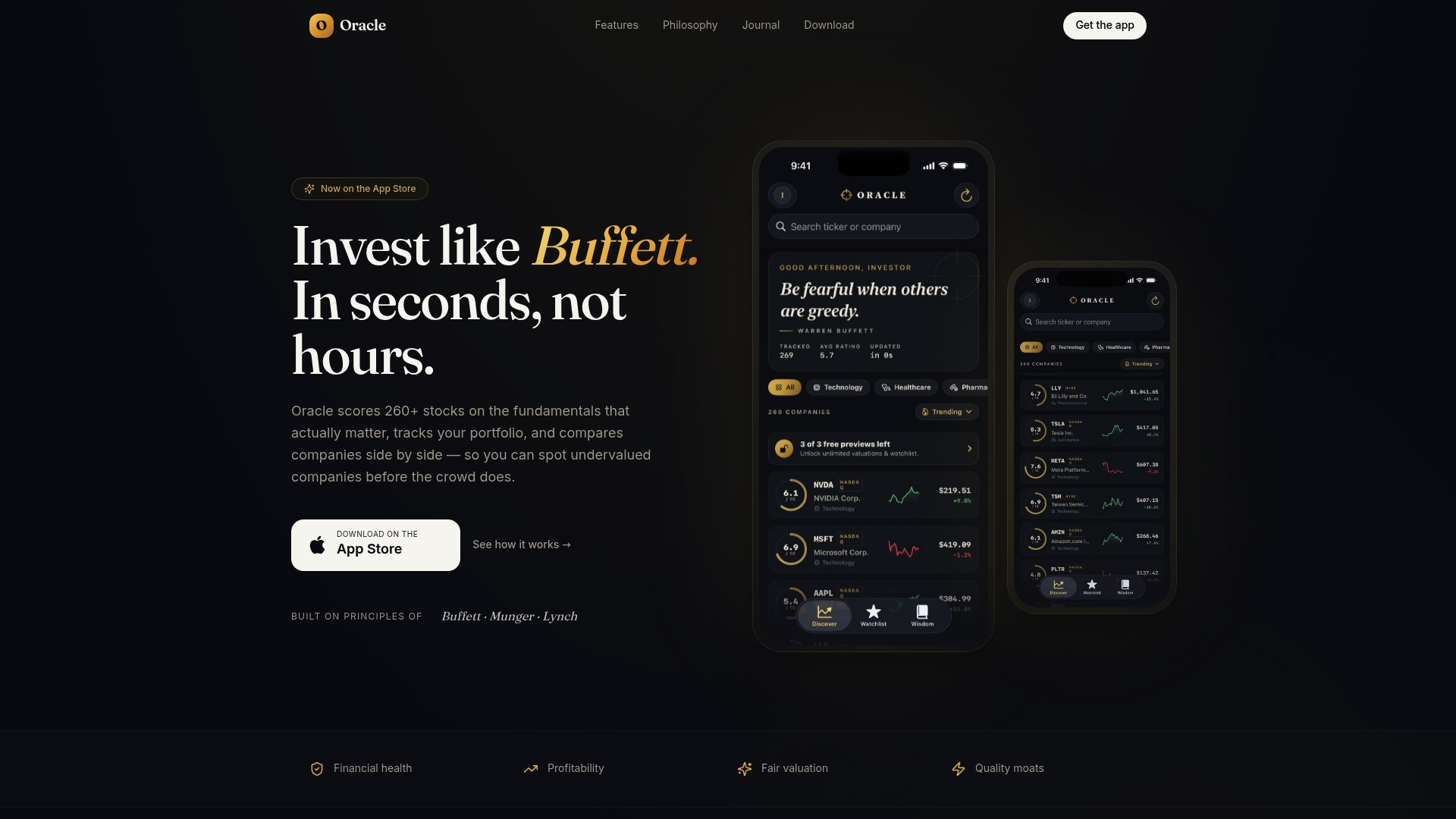
Open the app, pick two companies, and compare their profitability, valuation and financial health side by side. In a few minutes you will know which one looks more like a compounder and which one is simply popular.
FAQ
What is a compounder stock?
It is a stock of a business that earns high returns on the capital it reinvests and can keep doing so for many years. Earnings build on an ever-larger base, so the company's value can grow faster than average over long periods. Durable advantages such as brands or networks usually sit behind those returns.
Are compounder stocks safe?
No stock is safe, and compounders can fall in price like any other. Morgan Stanley's research notes that quality franchises tend to hold up better in downturns thanks to steady cash flows and low debt, but paying too much or a fading advantage can still hurt returns. Diversifying across and within asset classes, as Investor.gov recommends, is the main protection.
How long should I hold a compounder?
Compounding needs time. Investor.gov describes your time horizon as the time you dedicate to a goal, and long goals such as retirement decades away leave room to ride out market swings. Hold as long as the business keeps earning high returns on capital and your goal has not changed.
How do I find compounders?
Screen for high, steady return on invested capital, strong free cash flow, low debt and a clear competitive advantage, then check that the price is reasonable. Morgan Stanley points to consumer staples and software and IT services as common hunting grounds. A tool like Oracle lets you compare scored fundamentals for 260+ stocks side by side to narrow the list.
Do compounders pay dividends?
Some do and some do not. Morgan Stanley's paper says a compounder's free cash flow must be either reinvested or distributed, so a company may plow cash back into the business or pay it out. What matters is that returns on that cash stay high.
Sources
- The Magic of Compounding, U.S. Department of Labor
- The Equity "Compounders": The Value of Compounding, Morgan Stanley Investment Management
- In Praise of Tortoises… and Compounders, Morgan Stanley Investment Management
- Owner's Manual, Berkshire Hathaway
- Exponential Wealth: Centuries of Stock and Bond Returns, CFA Institute
- Introduction to Investing, Investor.gov
- Beginners' Guide to Asset Allocation, Diversification, and Rebalancing, Investor.gov
- Risk-adjusted returns for position sizing