
Insider buying is one of the few public clues about what a company's own leaders think their stock is worth. The strongest signals come from open-market purchases, made with the insider's own cash, by several insiders at once, in a company that is not already on your radar for other reasons. Every U.S. insider purchase is disclosed on SEC Form 4, so you can see it and check it yourself.
This guide shows what an insider purchase may tell you, which kinds carry more weight, how to read the filing, how to track it and where the signal fails.
TL;DR
- Insider buying is generally read as a bullish sign, because insiders usually buy for one reason: they expect the price to rise. Sales are far noisier.
- Cluster buying (several insiders buying close together) and open-market purchases (Form 4 code P) are the more informative cases.
- U.S. insiders must report trades on Form 4 within two business days, so the data is public and fast.
- Treat a purchase as a reason to research a stock, never as a buy order. Check profitability, valuation and financial health next.
- Routine grants, option exercises and tiny token buys are not signals.
Table of Contents
- What an insider purchase can tell you
- What research says about performance
- Which insider buys carry the most weight
- How to read a Form 4
- How to track insider buying in the United States
- Confirm the signal before you act
- Mistakes that turn the signal into noise
- A simple workflow you can repeat
- Where Oracle fits
- Our perspective
- FAQ
- Sources
What an insider purchase can tell you
Insider buying is the legal purchase of company shares by directors, officers or executives. It differs from illegal insider trading because it relies on information that is publicly reported. Investors generally read it as a sign of confidence, a hint that those closest to the business think the shares are undervalued or will rise.
The asymmetry matters. Insider selling is a weaker predictor because insiders sell for many personal reasons, such as taxes, a house purchase or diversification. Peter Lynch put the logic well: insiders sell for many reasons, but they buy for only one. That is why a buy deserves more attention than a sale of the same size.
What a purchase does not tell you is timing or magnitude. An executive may be early by a year. They may also simply be wrong. The signal narrows your search; it does not finish it.

What research says about performance
Academic work supports the idea that insider trades carry information, with caveats. An NBER study covering 1975 to 1995 found insider purchases more informative than sales, and found that insiders predict differences in returns across stocks. The effect was driven mostly by smaller firms.
That last detail is worth remembering. Large, heavily covered companies are analyzed by hundreds of professionals, so an insider's edge is smaller. Smaller companies have thinner coverage, so a purchase by someone inside can tell you more.
The data is also historical. These studies measure averages over many trades, not what will happen after the one you are looking at. Use them as a reason to pay attention, not as a forecast.
Which insider buys carry the most weight
Not every purchase is equal. Four traits are worth checking every time.
Open-market purchases with personal money
The cleanest signal is an insider buying shares on the open market at the going price. Nobody handed them those shares and no plan forced the trade. On Form 4, the code P marks a purchase on an exchange or from another person. Codes A (a grant or award from the company) and M (exercise or conversion of a derivative received from the company) are compensation mechanics, not conviction.
Clusters of buyers
Research on insider trades finds that cluster trades, especially purchases, are more informative than isolated ones. When the CEO, the CFO and a director all buy within a few weeks, it is harder to explain away as one person's personal view. One purchase is an anecdote. Three is a pattern.
Who is buying
Role matters. A large-scale study of 12 million SEC transactions from 1986 to 2012 found that insider trading patterns vary by role and by company sector. Another academic study using 1986 to 2003 data found that independent directors' open-market purchases generated abnormal returns comparable to those of executive officers. So do not dismiss a board member just because they are not in the day-to-day team.
Size relative to the insider
A $20,000 purchase by a CEO paid tens of millions in stock is a gesture. A $500,000 purchase by a director who has never bought before is a statement. Compare the purchase with the insider's existing holdings and prior behavior, not just the dollar amount.
| Trait | Stronger signal | Weaker signal |
|---|---|---|
| Transaction type | Open-market purchase (code P) | Grant, award or option exercise (codes A, M) |
| Number of buyers | Several insiders in a short window | One insider, one time |
| Size | Large relative to their holdings | Token amount relative to pay |
| History | First purchase in years, or a break from a selling pattern | Buys every quarter on a schedule |
| Company size | Smaller, thinly covered firms | Mega-caps with heavy analyst coverage |
How to read a Form 4
Federal securities law requires officers, directors and holders of more than 10% of a class of a company's securities, in most cases, to file Form 4 within two business days after a transaction. That speed is why this data is more useful than most ownership data, which arrives quarterly and late.
When you open one, work through it in this order:
- Who filed. Check the name and the relationship to the company: director, officer (with title) or 10% owner.
- Transaction code. Look for P. If you see A, M or other codes, the filing is mostly paperwork.
- Price and share count. Multiply them to get the dollar value, then compare with the insider's total holdings after the transaction.
- Direct or indirect ownership. Shares held through a trust or family entity can still be informative, but note the difference.
- Footnotes. This is where filers disclose whether a trade was made under a pre-arranged Rule 10b5-1 plan and other context. A purchase made on a preset schedule says less about current conviction than one made on a day the insider chose.
The habit that pays off most is reading the code before anything else. A headline like "CEO acquires 200,000 shares" can describe a stock award that cost the executive nothing.
How to track insider buying in the United States
Because every Form 4 is a public filing, you have three practical routes.
The SEC's own database. Every Form 4 is filed with the SEC, so you can look up a company's filings in EDGAR and check them against the source. It is slower than a dashboard, but it is the original record, and it settles any doubt about what an insider actually did.
Screeners and aggregators. Many financial websites and brokerage platforms summarize insider activity and let you filter by purchases only, by dollar value or by cluster. They save time, but check the transaction code behind any headline number.
Alerts on stocks you already follow. The most efficient way to track is not to watch the whole market. Make a short watchlist of companies you have already studied, then watch for insider buying in those names. A purchase in a business you understand is far easier to judge than one in a stranger.
Whichever you choose, build a routine. Check weekly, log purchases that meet your criteria (code P, meaningful size, more than one buyer) and note the date, price and insider. Over a few months you will see which kinds of buys actually led you to good research.

Confirm the signal before you act
An insider purchase answers one question: do people inside the company like the price? It does not answer whether the business is sound. Run the same checks you would on any stock.
- Profitability. Are margins and returns on capital healthy, or is the company burning cash?
- Valuation. Is the stock cheap against its own history and its peers? Our guide to the price to sales ratio shows how to avoid value traps, where a low multiple is cheap for a reason.
- Financial health. Check debt and cash flow. Look at dilution as well: insiders may buy while the company issues new shares that erode your stake.
- Capital allocation. Compare buybacks and dividends to see whether management also returns cash to owners.
If you want a side-by-side process, the six step stock comparison checklist and the guide on how to compare stocks with a few core metrics turn a tip into a decision. Lynch's approach to evaluating a business is laid out in our Peter Lynch investing checklist.
Some investors also look at price action around the purchase. If you do, a rule-based approach keeps you honest, for example the volume spike scan rules traders use to flag unusual activity. Treat volume as a secondary check, never a replacement for fundamentals.
Mistakes that turn the signal into noise
The advice from experienced analysts is consistent: treat insider trades as one piece of a larger puzzle, not as a definitive call, and be skeptical of routine transactions such as stock received as compensation. In practice that means avoiding these errors:
- Counting compensation as conviction. Awards and option exercises are not purchases. Filter to code P.
- Chasing one buy. A single small purchase after a big drop may be a signal to the market rather than a bet. Look for clusters and a pattern.
- Ignoring the price you pay. The insider may have bought weeks ago at a lower price. Check how far the stock has moved since.
- Reading selling as the mirror image. Sales are driven by taxes, diversification and scheduled plans. Do not treat them as the opposite of a buy.
- Skipping the business. A confident insider at a weak company is still at a weak company.
- Overlooking size of company. The evidence is strongest in smaller firms, where outsiders know less. Adjust expectations for large caps.
If the stock is a large part of your retirement savings, also consider timing risk. Our piece on sequence of returns risk explains why a single bad stretch matters more as you start drawing on your portfolio.
A simple workflow you can repeat
- Build a watchlist of 10 to 20 companies you understand.
- Once a week, check for new Form 4 filings with code P.
- Keep only purchases that are meaningful relative to the insider's holdings, ideally by more than one person.
- Score the business on profitability, valuation and financial health.
- Compare it against two or three similar companies.
- Decide your position size and what would make you wrong before you buy.
The point of the routine is that insider buying gets you to the right stocks sooner, while fundamentals decide whether you keep them.
Where Oracle fits
Insider activity tells you where to look. Oracle Investments helps with what comes next. The app scores over 260 stocks on profitability, valuation and financial health, so you can check whether a company with insider buying also has fundamentals that hold up, and compare it with others side by side.
Our ratings are rule-based and grounded in reported company fundamentals, and the scoring inputs are shown, so you can see why a stock scored the way it did. The app also brings in lessons from Warren Buffett, Charlie Munger and Peter Lynch.
If you want to run your next insider-buying idea through a consistent checklist, try Oracle Investments Premium Annual.
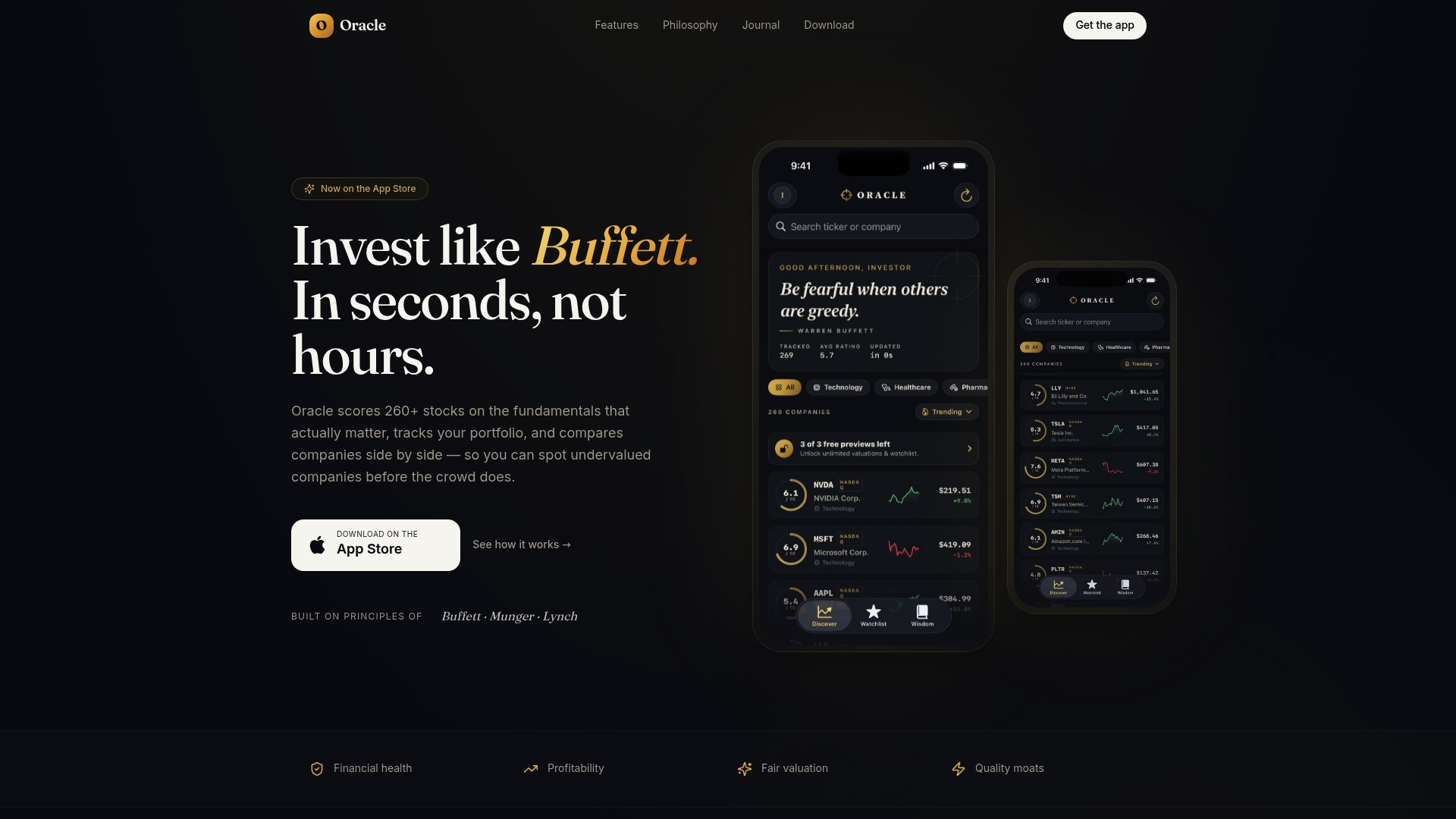
The subscription is purchased through the Apple App Store, and it includes portfolio tracking and in-depth stock analysis.
Our perspective
Insider buying is useful because it is a fact, not a forecast. Someone with a close view of the business put their own money in. That deserves your attention.
But we have seen the same mistake repeatedly: investors treat it as the answer. A purchase is a prompt to do the work. The work is reading the fundamentals, with no guesswork about what the numbers say.
That is why we built Oracle on rules instead of model-driven hunches. Every score is built from reported fundamentals, and every input is visible. When a stock shows up on your insider-buying list, you should be able to check profitability, valuation and financial health in seconds, with no spreadsheet, and compare it with alternatives. Value investors such as Buffett, Munger and Lynch built careers on that discipline. Insider signals work best when they sit on top of it.
Matt
FAQ
Is insider buying a reliable buy signal?
It is a useful signal, not a reliable one. Research finds that insider purchases carry more information than sales, particularly in smaller firms, but the results are averages across many trades. Use a purchase to start your research and confirm it with the company's fundamentals.
How quickly do insider purchases become public?
In most cases, officers, directors and holders of more than 10% of a class of securities must file Form 4 within two business days of the transaction. That makes the data timely, though you still see the trade after the insider has made it.
What is the difference between insider buying and insider trading?
Insider buying is the legal purchase of shares by executives and directors, reported publicly. Illegal insider trading involves trading on material information that has not been made public. A Form 4 filing describes the first kind.
Should I ignore insider selling?
Do not ignore it, but do not weigh it the same as buying. Insiders sell for personal reasons such as taxes or liquidity, so a sale on its own says little. A pattern of heavy selling by several insiders at once is a reason to look closer at the business.
Sources
- Insider Buying Insights: How it Works and What to Know
- Insider Buying vs. Selling: Which Signals Stock Market Moves
- Are Insiders' Trades Informative? (NBER)
- Insider Transactions and Forms 3, 4, and 5 (SEC)
- Insiders (academic study on cluster trades)
- Inside Insider Trading: Patterns and Discoveries
- What Do Independent Directors Know?
- Volume spike scan rules