
Neither share buybacks nor dividends is universally better. The right choice depends on your tax situation, your need for cash now versus later, and whether the company's management can actually be trusted to spend your money well.
That's not a dodge. It's the conclusion you reach once you look at how the SEC requires companies to disclose repurchase activity, how McKinsey frames the value question, and how the CFA Institute teaches the mechanics to working analysts. Three things drive the real-world decision:
- Tax timing. Dividends get taxed the year you receive them. Buybacks let you defer taxes until you actually sell.
- Cash need versus growth. If you need income to pay bills, a dividend check beats waiting for a stock price to (maybe) rise.
- Management discipline. A buyback only helps you if the company repurchases shares below their real worth. A dividend just shows up, no judgment call required.
Everything else in this comparison of share buybacks vs dividends flows from those three points.
Key Takeaways
The right payout choice between buybacks and dividends depends on your tax bracket, your need for income, and whether management shows real valuation discipline.
| Point | Details |
|---|---|
| Match the payout to your tax situation | Dividends are taxed the year received; buybacks defer taxes until you sell, which favors taxable accounts and longer holding periods. |
| Judge buybacks by valuation discipline | A buyback only helps you if shares are repurchased below intrinsic value, not simply because a program was authorized. |
| Prefer dividends for income needs | Retirees and income-focused investors typically favor the predictability of a scheduled cash payment over deferred gains. |
| Check filings, not press releases | Review 10-Q and 10-K disclosures to see actual repurchase amounts and whether debt funded the buyback. |
| Use a comparison tool to score quality | Oracle Investments rates payout quality alongside profitability and financial health so you can flag debt-funded or overvalued buybacks before you invest. |
Table of Contents
- Share Buybacks vs Dividends: A Side-By-Side Comparison
- How Do Share Buybacks Actually Work?
- How Do Dividends Work, and What Should You Track?
- Are Buybacks and Dividends Really Equivalent on Paper?
- How Are Buybacks and Dividends Taxed Differently in the U.S.?
- What Are the Real Pros and Cons for Companies and Shareholders?
- When Should You Prefer Buybacks vs Dividends?
- What Red Flags Signal a Harmful Payout Policy?
- What Does the Research Actually Say?
- An Editorial Take on Reading Payout Signals
- Score Payout Quality Before You Trust the Headline
- Where to Read More on Buybacks and Dividend Strategy
- Sources
Share Buybacks vs Dividends: A Side-By-Side Comparison
The two payout methods look similar on a balance sheet. They behave very differently once taxes, timing, and shareholder psychology enter the picture.
| Dimension | Share Buybacks | Dividends |
|---|---|---|
| Tax efficiency / timing | Tax deferred until shares are sold | Taxed in the year received |
| Cash flow to shareholders | Indirect, only for sellers | Immediate, paid to every holder |
| Management flexibility | High. Can pause anytime without backlash | Low. Cuts signal distress |
| Impact on EPS | Mechanically boosts EPS by shrinking share count | No direct effect on EPS |
| Who benefits | Sellers realize gains; holders get a smaller, more valuable slice | All shareholders receive cash equally |
| Risk profile | Can be debt funded or timed poorly at high valuations | Can strain cash flow if payout isn't sustainable |
| Transparency | Disclosed in 10-Q/10-K filings, less predictable in timing | Announced on a fixed public schedule |
| Transaction costs / timeline | Ongoing, executed over months or years | Scheduled quarterly or annual events |
A few things jump out once you see it laid out this way.
- Buybacks reward patience and tax efficiency; dividends reward predictability and income needs.
- EPS growth from a buyback doesn't necessarily mean the business got more valuable. It might just mean the pie got sliced into fewer pieces.
- Retirees and income-focused investors tend to lean dividend. Growth-focused investors chasing after-tax returns tend to lean buyback, according to Investopedia's breakdown of the tradeoff.
How Do Share Buybacks Actually Work?
Companies repurchase their own stock through three main channels, and the mechanics matter more than most investors realize.
Open market repurchases are the most common. A company authorizes a buyback program, often worth hundreds of millions or billions of dollars, and then buys shares gradually on the open market over months or sometimes years. There's no fixed schedule. Management can accelerate purchases when the stock looks cheap and pull back when it doesn't, subject to trading window restrictions and blackout periods tied to earnings releases.
Tender offers work differently. The company sets a fixed price (or a price range in a Dutch auction) and invites shareholders to sell a specific number of shares directly back to the company within a short window, typically a few weeks. Shareholders who tender get immediate liquidity at a defined price. This matters for tax purposes: a tender offer often qualifies as a sale for tax treatment, while an open market repurchase you don't participate in has zero tax impact on you.
Privately negotiated repurchases happen less often and usually involve buying a large block from a single institutional holder or insider. These raise governance questions, since a big buyer negotiating one-on-one with a large seller can create pricing that ordinary shareholders never see.
All three approaches shrink the share count, which mechanically lifts EPS and often book value per share, even if the company's actual earnings power hasn't changed at all. The CFA Institute notes that repurchases give management far more operational flexibility than dividends do, since a buyback program can be paused or scaled back without the market punishment that typically follows a dividend cut.
Buyback Program Snapshot: Most large-cap buyback authorizations typically run over several months to a few years, and companies rarely disclose in advance exactly when they'll buy. That gap between authorization and execution is exactly where valuation discipline either shows up or doesn't.
How Do Dividends Work, and What Should You Track?
Dividends come in three flavors, and confusing them can lead to bad assumptions about a company's health.
- Regular dividends are the recurring quarterly (or sometimes monthly) cash payments most people think of when they hear the word.
- Special dividends are one-time payouts, often tied to a windfall like an asset sale, and shouldn't be mistaken for a new baseline.
- Stock dividends pay shareholders in additional shares rather than cash, diluting per-share value while leaving your proportional ownership unchanged.
The mechanics run on a strict calendar, and missing a date can cost you the payment entirely. There's the declaration date, when the board announces the dividend. Then the record date, which determines who's officially eligible. The ex-dividend date typically falls one business day before the record date under current settlement rules, and you must own the stock before that date to collect the payment. Finally, the payment date, when cash actually lands in your account.
Every dividend dollar paid reduces the company's cash and shareholders' equity by that same amount, the same basic accounting effect as a buyback, according to Corporate Finance Institute's comparison. The difference is distribution, not magnitude: a dividend pays every shareholder proportionally, while a buyback only pays the shareholders who choose to sell.
Quick glossary: Trading ex-dividend means the stock trades without the right to the upcoming payment. The payout ratio is dividends paid divided by net income. A payout ratio creeping toward or past 100% is worth watching closely, since it suggests the company is stretching to maintain a payment it may not be able to sustain.
Are Buybacks and Dividends Really Equivalent on Paper?
In a textbook world with no taxes and no friction, yes, they're identical. Here's the math that proves it.
Imagine a company worth $1,000 total, with 100 shares outstanding, so each share trades at $10. The company has $100 in excess cash it wants to return to shareholders.
Option A: Pay a dividend. Each shareholder gets $1 per share. The company's cash drops by $100, so its remaining value is $900, spread across the same 100 shares. Each share is now worth $9, plus you're holding $1 cash. Total value per share: $10. Unchanged.
Option B: Buy back shares. The company uses its $100 to repurchase shares at the current $10 price, buying back 10 shares. Now there are 90 shares outstanding, and the company's remaining $900 in value is split among them. Each share is still worth $10. Nothing changed for the shareholders who didn't sell, and the ones who sold got their $10 per share in cash.
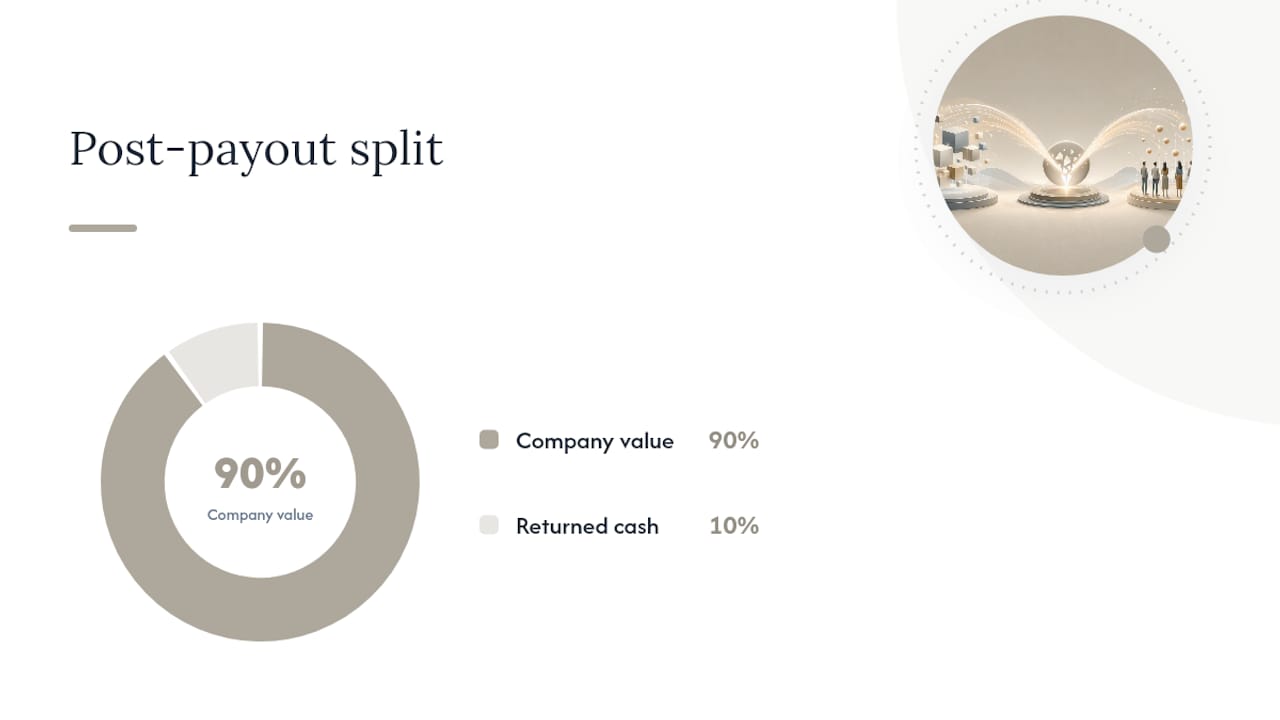
Same starting value, same ending value, two different mechanisms. That's the equivalence McKinsey describes: for a fairly valued company, there's no intrinsic difference in value created between the two approaches, and an EPS bump from a smaller share count doesn't automatically mean the business improved.
Real markets break this clean equivalence in several ways:
- Taxes hit dividend recipients immediately, while buyback holders defer taxes until they sell.
- Market microstructure matters. Buying 10% of a company's shares over months, rather than all at once, can itself move the price.
- Signaling differs sharply. A dividend increase says "we're confident in steady cash flow." A buyback says "we think our stock is cheap," which is a much more specific and riskier claim.
- Selective participation means buybacks only return cash to whoever chooses to sell, while dividends reach every shareholder whether they want the cash or not.
How Are Buybacks and Dividends Taxed Differently in the U.S.?
Timing is the whole story. Qualified dividends are taxed as income in the year you receive them, full stop, regardless of whether you wanted the cash or would rather have reinvested it. Buybacks create no taxable event at all for shareholders who don't sell. Your gain sits there, unrealized and untaxed, until you decide to cash out, a point Corporate Finance Institute confirms is one of the clearest practical advantages buybacks hold for taxable investors.
Here's how that plays out with real numbers. Say you own stock and the company distributes $1 per share either way.
Investor A gets a $1 dividend. If they're in a 15% qualified dividend tax bracket, they owe $0.15 in tax that same year, leaving $0.85 after tax, whether they wanted the cash or not.
Investor B holds shares that appreciate by $1 because the company repurchased stock instead. If they don't sell, they owe nothing this year. If they eventually sell and pay a 15% long-term capital gains rate, they still net $0.85, but only when they choose to trigger it, potentially years later, and potentially never if they hold until death and get a stepped-up cost basis.
Same 15% rate, wildly different control over when the tax bill arrives. The IRS treats holding period and account type as the two biggest variables in how much tax you'll ultimately pay on either type of gain.
Pro Tip: In a tax-advantaged account like an IRA or 401(k), this whole distinction disappears. Dividends and capital gains inside those accounts aren't taxed annually, so the tax-deferral edge of buybacks only matters in a taxable brokerage account. Check your account type before assuming buybacks are automatically the smarter tax move.
What Are the Real Pros and Cons for Companies and Shareholders?
Every payout decision involves tradeoffs that look different depending on which side of the transaction you're on.
For companies, buybacks offer flexibility. Management can turn the spigot on or off without the market punishing them the way it does for a dividend cut, since buybacks don't create the same recurring expectation, according to the CFA Institute's analysis. They also let management signal a belief that shares are undervalued. The downside: a large buyback program can signal the opposite of what management intends. It can suggest the company has run out of good ideas for growth, or worse, that it's using debt to fund purchases it can't really afford.

For shareholders, dividends deliver certainty. You get cash on a schedule, no decisions required. Buybacks give you optionality instead: sell now for liquidity, or hold and let your tax bill wait. The tradeoff is that buybacks only help you if management buys at sensible prices. A dividend arrives at the same value regardless of what the stock is trading at that day.
Most healthy companies don't pick one exclusively. A mature business with steady cash flow might pay a modest dividend and layer buybacks on top when the stock looks cheap, giving income-focused and growth-focused shareholders something each can appreciate.
Pro Tip: Don't judge a buyback by its size. Judge it by its timing. A $2 billion buyback executed when a stock trades well below its calculated intrinsic value is a very different decision than the same dollar amount spent when shares are trading at a stretched multiple.
When Should You Prefer Buybacks vs Dividends?
The decision comes down to a short list of concrete questions, both for investors evaluating a stock and for managers deciding how to allocate cash.
If you're an investor, run through this checklist:
- What's your marginal tax bracket, and is this a taxable account or a tax-advantaged one?
- Do you need income now to cover living expenses, or can you afford to let gains compound untaxed?
- What's your expected holding horizon? Longer horizons favor the deferral advantage of buybacks.
- Do you value predictable cash flow enough to accept the tax hit that comes with it?
- Does the company you're evaluating have a track record of buying back stock at sensible prices, or does it buy indiscriminately regardless of valuation?
If you're thinking about it from the company's side, the calculus involves different variables:
- Is the excess cash flow sustainable, or a one-time windfall that shouldn't be committed to a recurring dividend?
- Are there high-return internal investments competing for that same capital?
- Is the stock trading below management's honest assessment of intrinsic value, or is a buyback just financial engineering at an inflated price?
- How much debt sits on the balance sheet, and would funding a buyback with more debt violate any covenants or endanger the credit rating?
Companies typically weigh the sustainability of their free cash flow against these variables before committing, according to Dimensional's research on the decision.
Pro Tip: Before trusting a buyback announcement, check the actual repurchase activity in the company's 10-Q or 10-K filings. An authorization is just a permission slip. What matters is whether the company actually executed purchases, and at what average price.
What Red Flags Signal a Harmful Payout Policy?
Not every buyback or dividend serves shareholders well. Some signal genuine trouble underneath a shiny press release.
- Debt-funded buybacks where a company borrows specifically to repurchase stock, especially while organic cash flow is flat or declining, deserve scrutiny.
- Buybacks executed at or above intrinsic value repeatedly, with no apparent valuation framework, suggest management is repurchasing on autopilot rather than judgment.
- Sudden dividend cuts after years of stable payments almost always signal deeper financial stress than management's public statements admit.
- Insider selling that clusters right before or during a buyback announcement raises obvious conflict-of-interest questions.
- Vague or absent commentary on valuation in earnings calls and filings, when a company should be explaining why it thinks its own stock is a good use of capital.
Analysts caution against treating any buyback as an automatic vote of confidence. The smarter approach is to evaluate it alongside the company's full capital allocation history, including whether debt financed the purchases and whether management has a track record of buying low rather than buying because it seems expected.
What Does the Research Actually Say?
The academic and practitioner consensus lands in a specific place: theoretically equivalent, practically different. McKinsey's analysis confirms that for a fairly valued firm, there's no inherent value difference between the two mechanisms, and that mechanical EPS gains from a shrinking share count shouldn't be mistaken for genuine value creation.
But "equivalent on paper" doesn't mean "equivalent in practice." A 2025 empirical study published in Springer's finance research found that buybacks can actually push firm prices higher than dividends would, because reducing the supply of tradable shares makes the remaining shares more attractive under certain market constraints. That's a real-world friction the classroom math doesn't capture.
Regulatory evidence backs this up too. SEC filings give investors the tools to verify what companies actually did, not just what they announced, by disclosing buyback authorizations and execution details. Anyone comparing buybacks vs dividends seriously should be reading those filings, not just press releases.
The takeaway from the research: buybacks and dividends transfer the same total wealth from company to shareholder in a frictionless world. Taxes, market mechanics, and signaling are what create the practical gap, and that gap is where informed investors find an edge.
An Editorial Take on Reading Payout Signals
Most coverage of buybacks vs dividends treats the question like a math problem with a clean answer. It isn't. The equivalence argument is correct as far as it goes, but it assumes management makes rational, disciplined decisions about when to buy back stock. In practice, plenty of companies repurchase shares because it's expected, because executives' compensation is tied to EPS, or because it's easier than admitting they have no better use for the cash.
That's the piece I'd want every investor to internalize before getting excited about a big buyback headline. A dividend requires no judgment call on your part. It just shows up. A buyback requires you to trust that management is buying its own stock the way a disciplined value investor would buy anyone else's stock: below what it's worth, not at whatever price happens to be convenient that quarter. Checking that discipline means actually reading filings, tracking repurchase prices against a reasonable valuation estimate, and being willing to call out a company that's buying back shares simply to prop up per-share numbers ahead of an earnings report.
Running that kind of check by hand across a portfolio of stocks is tedious, which is exactly the gap a tool like Oracle Investments is built to close, scoring valuation discipline alongside profitability and financial health so you can spot the difference between a smart buyback and a self-serving one. The primary sources cited throughout this piece, particularly the SEC filings and the McKinsey and CFA Institute research, are worth bookmarking if you want to go deeper than any single article can take you.
Score Payout Quality Before You Trust the Headline
A buyback announcement or a dividend increase tells you almost nothing about whether the underlying business deserves your money. What matters is whether the company is disciplined about capital allocation, and that requires digging into valuation, cash flow, and debt levels most investors don't have time to check by hand.
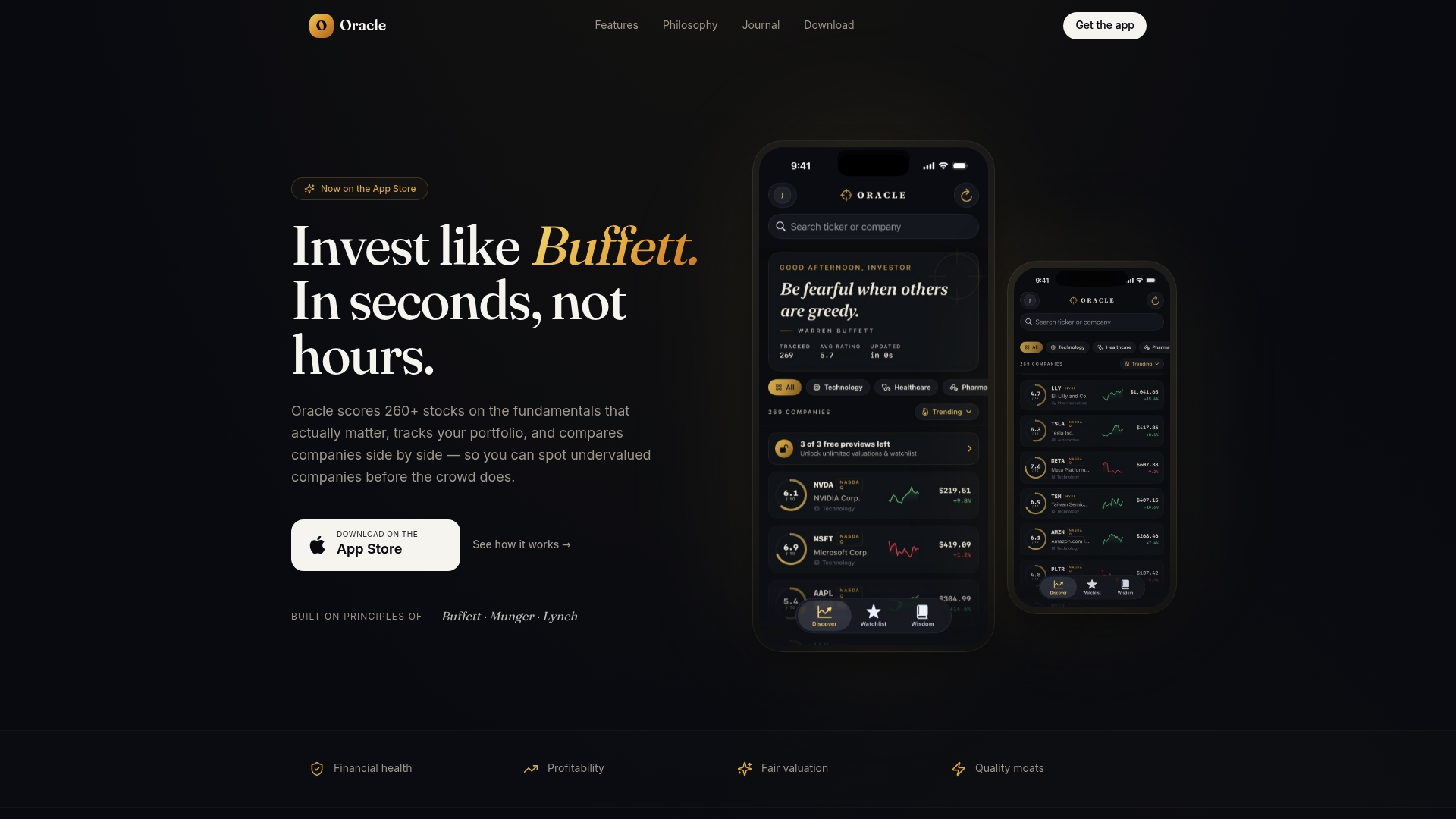
Oracle Investments scores over 260 stocks on the fundamentals that actually separate a smart buyback from a wasteful one: profitability, valuation, and balance sheet health, all in one comparison view. You get a quick payout-quality read instead of guessing from a press release, filters that help you weigh tax-efficient buyback candidates against steady dividend payers, and screening built to flag the same red flags covered above, like debt-heavy repurchase programs or stretched payout ratios. The app also layers in the capital allocation principles that investors like Warren Buffett and Charlie Munger have used for decades to judge whether a company is buying back stock wisely or just going through the motions.
If you want to stop taking buyback and dividend announcements at face value, try Oracle Investments and run the numbers yourself before your next trade.
Where to Read More on Buybacks and Dividend Strategy
The technical mechanics behind this comparison come primarily from McKinsey's corporate finance research and the CFA Institute's professional curriculum, both aimed at readers who want the theory explained rigorously.
- SEC filing disclosure example for verifying actual buyback execution against authorizations.
- Corporate Finance Institute's dividend vs buyback breakdown for the accounting mechanics side by side.
- CNBC's practical look at what buybacks mean for investors for a more accessible, investor-facing read.
- Springer's 2025 empirical study on buybacks and firm prices for readers who want the academic evidence behind the practical divergence from theory.
- Dimensional's research on the buyback-or-dividend decision for the corporate side of the calculus.
For technical depth, start with McKinsey and the CFA Institute. For a faster, more practitioner-focused read on what to actually watch for, CNBC and Dividend.com both cover the investor-preference angle without requiring a finance degree to follow.
This article is general information, not a substitute for advice from a qualified financial advisor. Consult a qualified financial professional about your own circumstances before acting on anything here.
Sources
- Share repurchases and dividends: Which create more value? (McKinsey)
- Analysis of Dividends and Share Repurchases | CFA Institute
- Dividend vs Share Buyback (Repurchase) - Key Differences & Examples