
A working undervalued stocks strategy is a repeatable process, not a hunch about a low P/E ratio. Screen the market for cheap statistical outliers, run a quality check to weed out companies that deserve their discount, confirm a catalyst that could close the valuation gap, write the thesis down with a clear invalidation line, then size the position to survive being wrong. Do all five and you've turned "this looks cheap" into an idea you can actually defend.
TL;DR:
- A stock must be significantly below its intrinsic value based on earnings, assets, and cash flow rather than just low multiples or peer comparison.
- The five-step screening process includes defining an investment universe, applying quantitative and quality filters, identifying a catalyst, and documenting a clear invalidation event.
- Avoid value traps by ensuring revenue, margins, and ROIC are stable or improving, and watch for warning signs like declining revenue or rising debt.
- A well-constructed thesis with a defined catalyst, timeline, and invalidation criteria is essential for disciplined, long-term value investing.
- Position size should be conservative and diversified, with gradual entry and clear alerts tied to thesis milestones to manage risk effectively.
Table of Contents
- What Does "Undervalued" Actually Mean?
- Key Financial Metrics And How To Read Them In Context
- A Repeatable Five-Step Screening Process
- How To Avoid Value Traps
- Building A Buy Thesis You Can Actually Test
- Position Sizing And Risk Management For Value Ideas
- How Oracleinvestments Fits This Workflow
- Does A Value Investing Strategy Actually Outperform?
- The Behavioral Biases Value Investors Are Actually Exploiting
- Value Investing Versus Growth And Momentum Strategies
- Tax Considerations For Value Investors
- Why Discipline Beats Conviction In Value Investing
- Screen Faster, Track Theses Without The Spreadsheet
- Sources
- FAQ
What Does "Undervalued" Actually Mean?
A stock is undervalued when its market price sits meaningfully below what the business is worth based on its earnings power, assets, and cash generation, not just below its own history or its peers' multiples. Cheap and undervalued are different things. A stock can trade at a low multiple because the market has it wrong, or because the market has it exactly right and the business is genuinely deteriorating.
FINRA frames value investing as buying securities below their intrinsic worth, and it flags P/E and P/B as common measures while warning that a low multiple alone proves nothing. That warning is the whole game. Margin of safety, the buffer between what you pay and what you believe the business is worth, exists precisely because your estimate of value is never perfect. Investopedia's explanation of the concept ties it directly to patience: you need fundamental analysis to back up the discount, and you need time for the market to agree with you.
Undervaluation tends to show up after specific triggers:
- A broad market selloff drags down good and bad companies together.
- A single bad quarter spooks short-term traders even when the long-term story hasn't changed.
- Thin analyst coverage leaves a small or mid-cap stock mispriced simply because nobody's watching closely.
- A sector-wide scare (regulatory, macro, or headline-driven) punishes every name in the group, including the ones with clean balance sheets.
None of those triggers guarantee a bargain. They just tell you where to look first.
Key Financial Metrics And How To Read Them In Context
Ratios only mean something next to a peer group and a growth rate. Here's the toolkit worth knowing:
- Trailing P/E uses reported earnings; it's reliable for stable, mature businesses but lags during turnarounds.
- Forward P/E uses estimated earnings; more useful for a recovery story, but only as good as the estimate behind it.
- P/B (price-to-book) works best for asset-heavy businesses like banks and insurers, less so for asset-light software companies.
- PEG ratio divides P/E by expected growth, catching stocks that look expensive on P/E alone but are actually cheap relative to how fast they're growing.
- EV/EBITDA strips out capital structure differences, making it a fairer cross-company comparison than P/E.
- Price/sales helps when a company has no earnings yet but real revenue.
- Free cash flow yield (free cash flow divided by market cap) tells you how much real cash the business throws off relative to what you're paying.
- ROIC and ROE measure how efficiently management turns capital into profit, and comparing ROIC against the cost of capital is one of the clearest tests of whether a discount is deserved.
Pro Tip: A stock trading at a P/E of 8 in a sector that averages 15 isn't automatically cheap. Check whether that sector's median P/E has drifted lower for structural reasons (rising rates, regulatory pressure) before assuming the discount is a mispricing rather than a re-rating.
Practitioner guidance from Wall Street Prep treats ROIC versus cost of capital as one of the fastest ways to separate a genuinely undervalued business from one that's cheap for a reason. A bank with a P/B under 1 might be a bargain, or it might be pricing in loan losses nobody's disclosed yet. Context decides which.
A Repeatable Five-Step Screening Process
The single biggest mistake in an undervalued stock analysis is stopping after step one: the screen that spits out cheap names. A systematic five-step process filters out most of the false positives before you risk real money.
- Define your universe. Set boundaries on market cap, sector, and average daily trading volume so you're not staring at 8,000 tickers or stuck holding something you can't exit.
- Apply a quantitative filter. Screen for multiples below sector medians, P/E, P/B, EV/EBITDA, but require a growth floor too. Zero growth plus a low multiple is often a trap, not a bargain.
- Run a quality screen. Check the three-year revenue trend, whether ROIC exceeds the cost of capital, and whether debt is rising or falling relative to EBITDA.
- Identify a catalyst. A cheap stock with no path to re-rating can stay cheap for years. You need a plausible reason and rough timeline for the gap to close.
- Document the thesis. Write down the valuation gap, the catalyst, and the specific condition that would prove you wrong.
Pro Tip: Set a calendar reminder tied to your catalyst's expected timeline, not just a price alert. If the catalyst was "Q3 earnings recovery" and Q3 comes and goes with no recovery, that's your cue to revisit the thesis, not to wait another quarter hoping.
Skipping steps 3 and 4 is how screeners end up owning a portfolio of slow-motion declines that happened to look statistically cheap on the day of purchase.
How To Avoid Value Traps
A value trap is a stock that looks statistically cheap and stays that way, or gets cheaper, because the underlying business is actually shrinking. The red flags tend to cluster together:
- Revenue declining for three or more consecutive years, not just one rough quarter.
- ROIC falling steadily below the cost of capital rather than dipping temporarily.
- Net debt to EBITDA climbing while free cash flow shrinks.
- Gross or operating margins compressing quarter after quarter, signaling pricing power is eroding.
- Capital expenditures running well below depreciation, a sign the business is underinvesting in its own future.
Quick, practical checks catch most of these without a full model. Pull the three-year revenue trend from the income statement, compare capex to depreciation on the cash flow statement, and read management's own commentary in the latest earnings call transcript for hedged language about competitive pressure or margin risk. Auditor notes about going-concern language or material weaknesses are a hard stop, not a nuance to weigh.
Practitioner guides consistently recommend pairing those quantitative flags with a qualitative read on competitive position, whether the company still has pricing power, a moat, or brand loyalty. A 15 minute value trap screen exists around exactly this combination, because the numbers alone rarely tell the full story fast enough.
Building A Buy Thesis You Can Actually Test
A thesis without an invalidation condition isn't a thesis, it's a hope. The discipline that separates a working undervalued stocks strategy from a coin flip is writing down, before you buy, exactly what would prove you wrong.
- Quantify the valuation gap. Compare the stock's multiple against its sector median, then sanity-check that against a simple intrinsic value proxy. One accessible method: estimate owner earnings, normalized free cash flow adjusted for one-time items, and apply a conservative discount with a 20% to 50% margin of safety built in.
- Name the catalyst. Common ones include an earnings recovery, a planned divestiture, a buyback program, new analyst coverage initiating on the stock, or index inclusion that forces passive buying.
- Set a timeline. Most catalysts play out over several quarters. If your catalyst has no reasonable timeframe attached, it's not a catalyst, it's a wish.
- Define invalidation criteria. Pick specific numbers or events, margin dropping below a threshold, guidance cut twice in a row, that would tell you the thesis failed.
Writing the thesis down forces a decision before emotion gets involved. A documented, falsifiable thesis with a clear invalidation trigger is what keeps a legitimate value idea from quietly becoming a value trap you're emotionally attached to.
Position Sizing And Risk Management For Value Ideas
Even a well-researched undervalued stock analysis can be wrong, so position size has to reflect that uncertainty rather than your conviction level. A common rule of thumb for retail portfolios: cap any single value position at a small percentage of total portfolio value, and lean toward the lower end when the catalyst timeline is longer or less certain.
- Diversify across at least 15 to 20 positions if concentrated value investing is your main approach, so one broken thesis doesn't sink the portfolio.
- Scale in gradually rather than deploying full size at once, especially with a catalyst that's 12 or more months out.
- Set price and news alerts tied to the specific milestones in your thesis, not just arbitrary percentage moves.
- Factor in liquidity before buying, a small-cap value stock can be easy to buy and hard to sell in a downturn.
Pro Tip: Review holding periods against your tax situation before adding to a position. A stock approaching its one-year mark might be worth waiting on if selling early would push a gain into short-term rates.
How Oracleinvestments Fits This Workflow
Running five steps manually across dozens of candidates is slow. Oracleinvestments scores more than 260 stocks on profitability, valuation, and financial health, which compresses steps 2 and 3 of the screening process into a single side-by-side comparison.
- Instant comparisons let you check a candidate's multiples against sector peers in seconds instead of building a spreadsheet.
- Portfolio tracking and alerts help monitor the milestones tied to your documented catalyst.
- Educational content, including the P/E ratio guide and intrinsic value walkthrough, supports the parts of the process that still require judgment.
The scoring speeds up discovery. Writing the thesis and setting the invalidation line is still on you.
Does A Value Investing Strategy Actually Outperform?
Value investing has a long empirical track record, though its edge shows up over full market cycles rather than every single year. Academic work going back to Fama and French's factor research in the 1990s documented that stocks with low price-to-book ratios delivered higher average returns than growth stocks over multi-decade periods, a pattern that held across multiple international markets, not just the U.S.
That doesn't mean value wins every stretch. Value strategies went through a rough decade relative to growth for much of the 2010s, as a handful of large technology companies drove index returns that value screens tended to exclude by design. Investors who abandoned value investing strategies during that stretch missed the rotation back toward value that followed. The pattern repeats historically: value underperforms for years, then closes the gap sharply in a short window, often tied to rising rates or a shift away from speculative growth names.
The practical takeaway isn't that value always wins. It's that the strategy requires a holding period measured in years, not quarters, and a willingness to look wrong for uncomfortably long stretches before being proven right. That's precisely why the documented thesis matters more than the screen itself: a written catalyst and timeline keep you anchored during the stretches when value investing looks like it's stopped working.
The Behavioral Biases Value Investors Are Actually Exploiting
An undervalued stocks strategy works, when it works, because it exploits predictable human behavior, not because markets are inefficient in some abstract sense. A few biases show up again and again.
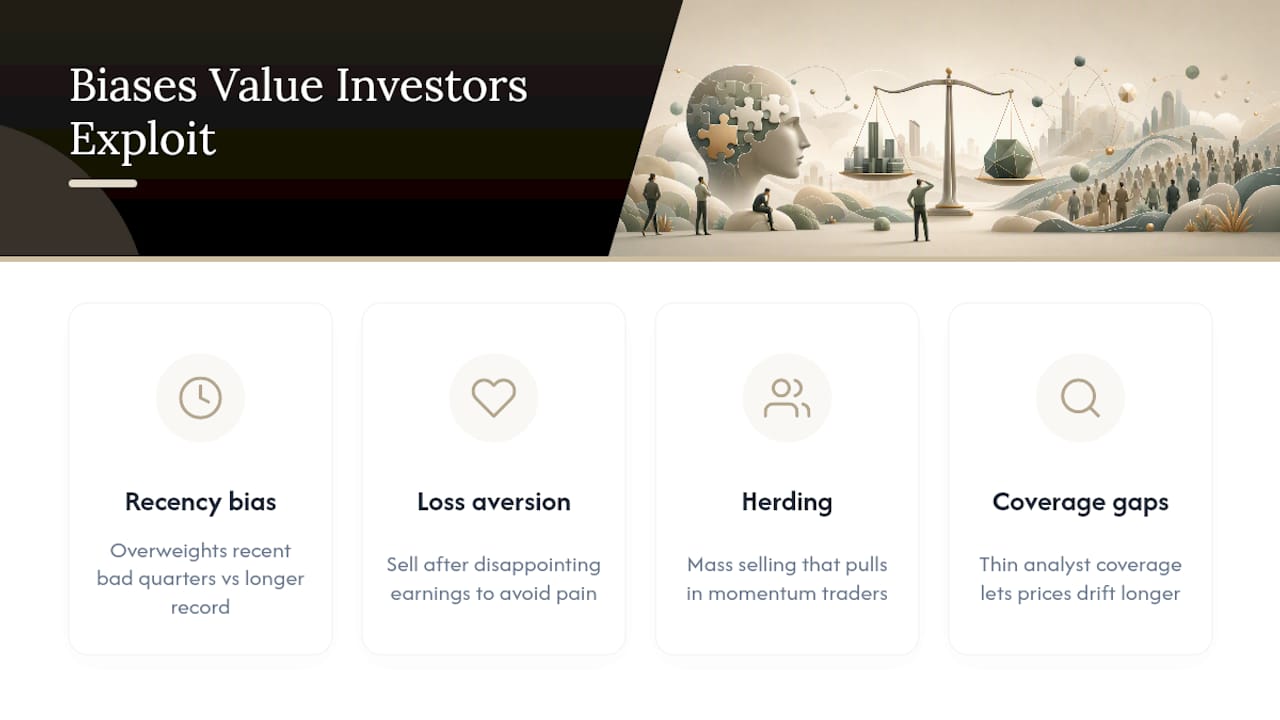
Recency bias makes investors overweight the last few quarters of bad news and underweight a company's longer track record, pushing prices below what the fundamentals justify. Loss aversion causes shareholders to dump a stock after a disappointing earnings report simply to stop the pain of watching it fall, regardless of whether the long-term thesis changed. Herding amplifies both: when enough investors sell for emotional reasons at once, the selling itself becomes the story, dragging in momentum traders who have no view on fundamentals at all.
There's also a structural inefficiency that has nothing to do with psychology: coverage gaps. Small and mid-cap stocks often carry thin analyst coverage, sometimes just one or two firms publishing estimates, which means fewer eyes are checking the math and prices can drift from fair value for longer before anyone corrects it.
Value investors are, in effect, betting that these overreactions are temporary and that price eventually reconnects with fundamentals. That bet doesn't always pay off on a predictable schedule, which is exactly why the catalyst step in the screening process matters. A stock mispriced due to recency bias needs something, a clean quarter, a management change, a sector rotation, to remind the market that the business didn't actually get worse. Without that trigger, the mispricing can persist far longer than a spreadsheet suggests it should.
Value Investing Versus Growth And Momentum Strategies
Value, growth, and momentum investing all try to beat the market, but they're betting on different things. Value investing strategies bet that the market has mispriced a business too low relative to its current fundamentals. Growth investing bets that a company's future earnings will expand fast enough to justify a price that looks expensive today. Momentum investing skips fundamentals almost entirely and bets that stocks already trending up will keep trending up, at least for a while.
The practical difference shows up in what each approach requires from an investor. Value investing strategy demands patience and a strong stomach for looking wrong, since the catalyst that closes a valuation gap can take quarters or years to arrive. Growth investing demands confidence in forecasting, since you're paying today for earnings that don't exist yet, which makes it more vulnerable to a single disappointing quarter. Momentum demands speed and discipline around exits, since the strategy's entire premise disappears the moment the trend reverses.
None of the three is objectively superior across all market conditions. Growth and momentum tend to lead during low-rate, high-liquidity environments when investors are willing to pay up for future promise. Value tends to lead when rates rise, credit tightens, and the market starts pricing businesses on what they earn today rather than what they might earn in five years.
Many disciplined investors blend the approaches rather than picking one exclusively, using value screens to build a defensive core position and allowing selective growth exposure for upside. The metrics differ (value leans on P/E, P/B, and free cash flow yield; growth leans on revenue and earnings growth rates; momentum leans on price trend and relative strength) but the underlying discipline, having a documented reason for the position and a rule for when you're wrong, applies to all three equally.
Tax Considerations For Value Investors
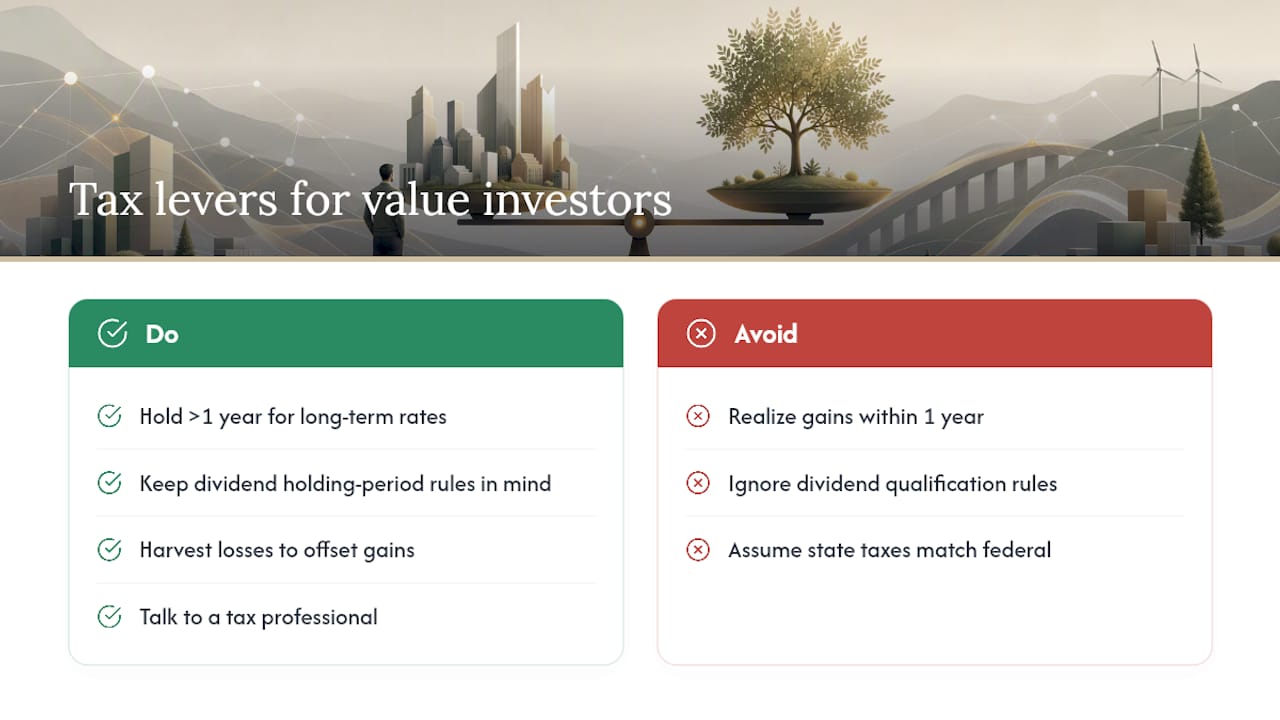
Holding period is the single biggest tax lever in a value investing strategy, and it interacts directly with the patience the approach already demands. Gains on a stock held for more than one year qualify for long-term capital gains rates, which are lower than the ordinary income rates applied to short-term gains on positions held a year or less. Since value theses often take several quarters or longer to play out anyway, the strategy naturally aligns with the tax code's preference for patience.
Dividend-paying value stocks add another layer. Qualified dividends, generally those from U.S. corporations held for the required minimum period, are taxed at the same favorable long-term capital gains rates rather than as ordinary income. Value screens frequently surface mature, dividend-paying businesses precisely because they trade at lower multiples than high-growth names, so dividend tax treatment matters more here than it does for a portfolio built around non-dividend growth stocks.
Tax-loss harvesting is worth understanding if a thesis breaks and you sell at a loss. That realized loss can offset capital gains elsewhere in the portfolio, and up to $3,000 of net losses can offset ordinary income in a given tax year, with any excess carried forward. Selling a broken value thesis isn't just a risk management decision, it can also be a deliberate tax move if timed within the same tax year as gains you want to offset.
None of this is a substitute for advice from a tax professional who knows your full financial situation, particularly around state tax treatment, which varies widely and isn't covered by any of the federal rules above.
Why Discipline Beats Conviction In Value Investing
The investors who actually make undervalued stocks strategies work aren't the ones with the best stock picks. They're the ones who write the thesis down before buying and set the invalidation line before they're emotionally attached to being right.
Most people skip that step because it feels like paperwork. It isn't. A written thesis with an alert tied to it is the only thing standing between "I still believe in this" and an honest look at whether the catalyst actually showed up.
— Matt
Screen Faster, Track Theses Without The Spreadsheet
Running the five-step process by hand across dozens of candidates eats hours you'd rather spend on the two steps that actually require judgment: the catalyst and the thesis. Oracleinvestments scores over 260 stocks on profitability, valuation, and financial health side by side, so the quantitative filter and quality screen that usually take an evening take minutes instead.

The app also pulls in investing principles from Warren Buffett, Charlie Munger, and Peter Lynch, so newer investors get context alongside the numbers rather than a bare list of ratios. Portfolio tracking and alerts handle the monitoring side, tied to milestones instead of arbitrary price swings, which is the piece most manual trackers get wrong. If a repeatable screening workflow sounds like what your portfolio's been missing, visit the Oracleinvestments landing page and run your current watchlist through it to see where the real gaps are.
This article is general information, not a substitute for advice from a qualified financial advisor. Consult a qualified financial professional about your own circumstances before acting on anything here.
Sources
- Value investing | FINRA
- Value investing definition and guide | Investopedia
- How to Find Undervalued Stocks: A 5-Step Systematic Process | StockAlarm
- Value Investing 101 | Wall Street Prep
FAQ
What Are The Five Most Undervalued Stocks Right Now?
Specific rankings change daily with price moves and earnings updates, so there's no fixed list. A screener that filters by low multiples relative to sector medians, then applies a quality and catalyst check, is the reliable way to generate your own current shortlist.
What Is The 7% Rule In Stocks?
If you've seen it referenced as a stop-loss or valuation threshold, treat it as one trader's heuristic rather than an established industry standard.
Is Buying Undervalued Stocks A Good Strategy?
It can be, but only when paired with a quality screen and a documented catalyst, buying purely on low multiples without those steps is how investors fall into value traps. Historical data shows value investing strategies have outperformed over long cycles, though with stretches of underperformance that test patience.
What Are Some Strategies For Finding Undervalued Stocks?
The most reliable approach combines a quantitative filter (P/E, P/B, EV/EBITDA below sector medians) with a quality screen for revenue trends and ROIC, then requires a specific catalyst before buying. Tools like Oracleinvestments can speed the screening and comparison steps, but the catalyst and documented thesis still require your own judgment.