
Dilution happens when a company increases its total shares outstanding, shrinking the percentage of the business each existing shareholder owns. Your stake doesn't shrink because you sold anything. It shrinks because the pie got cut into more pieces. Whether that hurts you economically depends on the price the new shares were sold at and what the company did with the cash.
TL;DR:
- Dilution occurs when a company issues new shares through offerings, options, or convertibles, reducing existing shareholders' ownership percentage.
- Calculating ownership loss involves comparing your shares to the total shares outstanding before and after new issuance, highlighting potential dilution effects.
- Modeling fully diluted scenarios helps investors assess risks from options, warrants, and convertibles, guiding position sizing against worst-case dilution.
- Shareholders can offset dilution through mechanisms like preemptive rights, share buybacks, or anti-dilution clauses, but issuing above market value minimizes damage.
- Monitoring scheduled filings and real-time platform data ensures timely awareness of dilution events, enabling better risk management and decision-making.
Table of Contents
- What Is Stock Dilution and Why Does It Happen?
- How Do You Calculate the Ownership Loss from Dilution?
- How Do You Model Fully Diluted Scenarios Before You Invest?
- Can Companies Limit or Offset Dilution?
- Why Diluted Shares Belong in Every Valuation
- Run Your Dilution Checks Faster with Oracle Investments
- Sources
- FAQ
What Is Stock Dilution and Why Does It Happen?
New shares enter the market through a handful of well-worn paths. Each one has its own speed and its own warning signs. Recognizing them in a filing is half the battle of protecting your position.
Primary and secondary offerings are the most visible: a company sells new shares directly to the public or to institutions, and the share count jumps overnight. Employee stock options and RSUs dilute more slowly. Grants vest over years, and each exercise or vesting event quietly adds shares to the count, often without a headline. Convertible debt and convertible preferred stock delay dilution until a trigger, usually a set price or date, converts the security into common stock. As Investor, convertibles let companies borrow cheaply now in exchange for handing over equity later.
Two other mechanisms deserve special attention:
- ATM (at-the-market) programs: the company drips new shares into the market gradually, often through a broker, to raise cash without a splashy announcement.
- PIPEs (private investments in public equity): a single investor or small group buys a large discounted block directly from the company, creating a sharp, concentrated jump in share count.
ATM dilution is a slow leak. PIPE dilution is a single puncture. Both end with the same result: more shares outstanding and smaller slices for everyone else.
How Do You Calculate the Ownership Loss from Dilution?
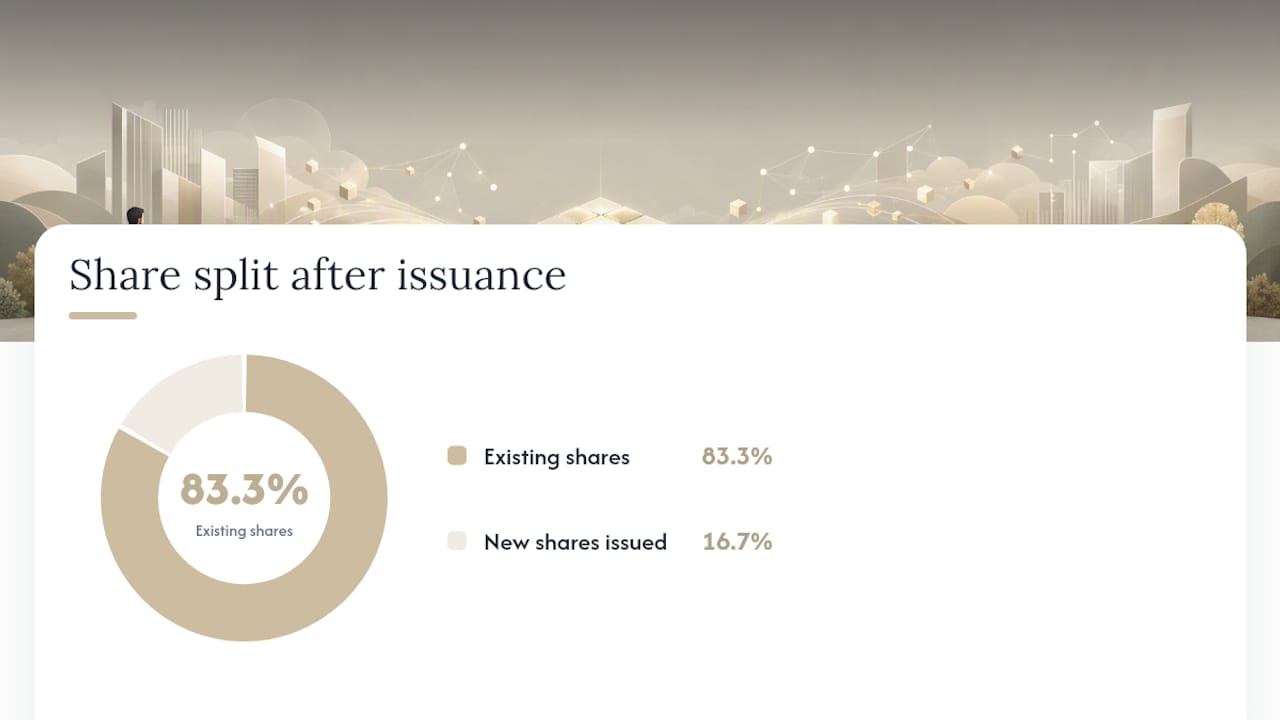
Ownership percentage is the simplest formula in investing, and it's the one most investors never actually run: your shares divided by total shares outstanding, as Visible. Own 10,000 shares of a company with 100,000 total shares outstanding and you hold 10%. Issue 20,000 new shares and that same 10,000-share block now represents 8.3% of a 120,000-share company. You lost 17% of your ownership stake without selling a single share.
Here's the sequence to run whenever a company announces new issuance:
- Find current ownership %. Your shares ÷ current total shares outstanding.
- Add the new shares to the denominator. Total shares outstanding after the deal.
- Recalculate ownership %. Your shares ÷ new total shares outstanding.
- Compute the percentage drop. (Old % minus new %) ÷ old %.
Earnings per share follows the same logic but with two accepted GAAP methods, per Investopedia. The Treasury stock method applies to options and warrants: it assumes the company uses option-exercise proceeds to buy back shares at the current market price, which softens the dilutive hit. The if-converted method applies to convertible debt and preferred stock: it assumes every convertible security converts to common stock, adding both the new shares and reversing the associated interest expense (net of tax) back into net income.
Statistic to remember: if a company's market cap holds steady through an offering, the theoretical new share price equals the old market cap divided by the new total share count, a relationship DilutionWatch uses to model ATM and PIPE outcomes. It's a useful floor for modeling, but real markets rarely hold cap constant. A company that raises capital to fund a genuinely profitable project can see its market cap rise faster than the share count, leaving per-share value intact or even higher.
How Do You Model Fully Diluted Scenarios Before You Invest?
"Fully diluted" share count means every instrument that could eventually become common stock gets added to the base: outstanding options, unvested RSUs, warrants, convertible notes, and, for earlier-stage companies, SAFEs. Skip this step and you're valuing a company on a share count that's already outdated the moment you check the filing.
Build three scenarios before you size a position:
- Base case: current diluted share count from the latest 10-Q or 10-K, no new issuance assumed.
- Moderate case: add shares from an active ATM program running at its disclosed pace over the next few quarters.
- Stress case: model a PIPE or convertible conversion at a discounted price, plus any options that go in-the-money.
For risk management, size your position against the stress-case diluted price, not the headline price you see on the ticker. Set exit triggers tied to share-count milestones (a registration statement going effective, a new ATM filing, a convertible hitting its conversion threshold) rather than vague price targets, a discipline Investopedia's risk guidance reinforces. Convertible notes with resettable conversion prices deserve extra caution: as the stock price falls, the conversion price can reset lower, creating more shares at each step, a pattern often called a "death spiral." Cap your position size specifically against companies carrying these toxic convertibles, and treat any in-the-money convertible as equity in your models rather than debt, since it will behave like stock long before it matures.
Pro Tip: Set a calendar reminder for a company's next scheduled shelf registration or ATM renewal date. Dilution rarely arrives as a surprise. It arrives on a schedule buried in the filings most investors never open.
Can Companies Limit or Offset Dilution?
Several mechanisms exist to protect shareholders or reverse dilution's effects, though none eliminate it outright.
- Anti-dilution clauses, common in venture and preferred-stock agreements, come in two flavors: full ratchet, which resets an investor's conversion price to match any lower future round, and weighted average, which blends the new lower price with the existing one for a gentler adjustment.
- Preemptive rights and rights offerings let existing shareholders buy new shares before outsiders can, preserving their percentage stake if they choose to participate.
- Share buybacks work in reverse, shrinking the share count and directly offsetting dilution from options and RSUs, a tactic explored in our breakdown of buybacks versus dividends.
The Price & Accountants glossary on anti-dilution terms is worth bookmarking if you're reading a term sheet and hit unfamiliar language. One distinction matters more than any clause: issuing shares at or above fair market value doesn't destroy shareholder value, since the pie simply gets bigger along with the number of slices. Issuing well below market value is where real economic damage happens.
Why Diluted Shares Belong in Every Valuation

Most retail investors run their valuation math on basic shares outstanding and wonder later why the stock never hits their price target. I always start with the fully diluted count, not the headline number, because that's the share base the market eventually prices against anyway.
The checklist is short: flag every convertible, option pool, and warrant in the filings; run the base, moderate, and stress scenarios; and size the position against the diluted downside, not the current quote. If you're already doing owner earnings work or running a DuPont breakdown, plug the diluted share count into those models too, since return-on-equity and per-share value both bend around it. The scoring system of such platforms surfaces this kind of fundamental data instantly, designed to flag dilution risk as part of the standard comparison, not an afterthought you dig for separately.
— Matt
Run Your Dilution Checks Faster with Oracle Investments
Hand-modeling three dilution scenarios for every stock on your watchlist gets old fast. Some investment platforms score hundreds of stocks on profitability, valuation, and financial health, and surface diluted EPS and share-count trends as part of that score, so you're not digging through a 10-Q footnote to find the convertible debt buried on page 40.

The app's instant side-by-side comparisons let you check whether a company's growth is outpacing its dilution or getting swallowed by it, pulling in the same value-investing frameworks used by Warren Buffett, Charlie Munger, and Peter Lynch. If you're tracking a position through an active ATM program or a pending convertible conversion, real-time portfolio tracking flags the change as it happens rather than a quarter later. Start comparing stocks with Oracle Investments and see your holdings' diluted picture before your next trade.
Sources
This article is general information, not a substitute for advice from a qualified financial advisor. Consult a qualified financial professional about your own circumstances before acting on anything here.
FAQ
What Is the Simplest Way to Calculate Dilution?
Divide your shares by total shares outstanding before and after the new issuance, then compare the two percentages. A 10% stake diluted by a 20% share increase drops to roughly 8.3%.
Does Dilution Always Hurt Existing Shareholders?
Not necessarily. Shares issued at or above fair market value don't destroy value since existing holders simply own a smaller slice of a proportionally larger company; shares issued well below market value are where real economic harm occurs.
What's the Difference Between Basic and Diluted EPS?
Basic EPS uses only currently outstanding shares, while diluted EPS assumes options, warrants, and convertibles are exercised or converted using the Treasury stock method or if-converted method.
Where Do I Find a Company's Dilutive Instruments?
Check the notes to the financial statements in the 10-K or 10-Q, specifically the sections on stock-based compensation, convertible debt, and warrants; Oracle Investments also surfaces these figures directly in its stock scoring data.
How Fast Can Dilution Happen After a Company Announces It?
It varies widely: a single PIPE deal can dilute shareholders within days of signing, while an ATM program spreads dilution gradually over months as the company sells shares in small increments.