
Sequence of returns risk is the danger that negative investment returns early in your withdrawal phase can permanently shrink your portfolio, even if long-term average returns look fine on paper. The single most effective near-term action: set aside one to three years of living expenses in liquid assets before you begin withdrawing, so you never have to sell growth positions into a downturn.
- Sequence risk vs. volatility: Volatility measures how much returns swing. Sequence risk is what happens when those swings collide with withdrawals. A portfolio that never pays out is barely affected by bad early returns. One that withdraws regularly is exposed to permanent capital impairment from early bad years.
- Path dependence: Two portfolios can share an identical 30-year average return and arrive at completely different ending balances, purely because one experienced losses in year two and the other experienced them in year twenty-eight.
- Who it hits hardest: Retirees and anyone drawing down a portfolio. Accumulators who keep contributing actually benefit from early dips, buying more shares at lower prices.
Pro Tip: Write down your first withdrawal date before you touch asset allocation. That date is where sequence risk begins, and everything else flows from it.
Table of Contents
- Why does the order of returns matter so much?
- Two identical averages, two very different outcomes
- How sequence risk breaks the 4% rule
- Practical strategies to reduce sequence of returns risk
- How to model sequence risk for your own portfolio
- How Oracleinvestments helps you manage sequence risk
- Investor checklist: what to do this week
- Key Takeaways
- The part most retirement guides get wrong
- Oracleinvestments: scenario testing without the spreadsheet
- Useful sources
Why does the order of returns matter so much?
GMO frames sequence risk as a form of financing risk: return order is irrelevant when no money moves in or out. The moment withdrawals start, you become a net seller, and that changes everything.
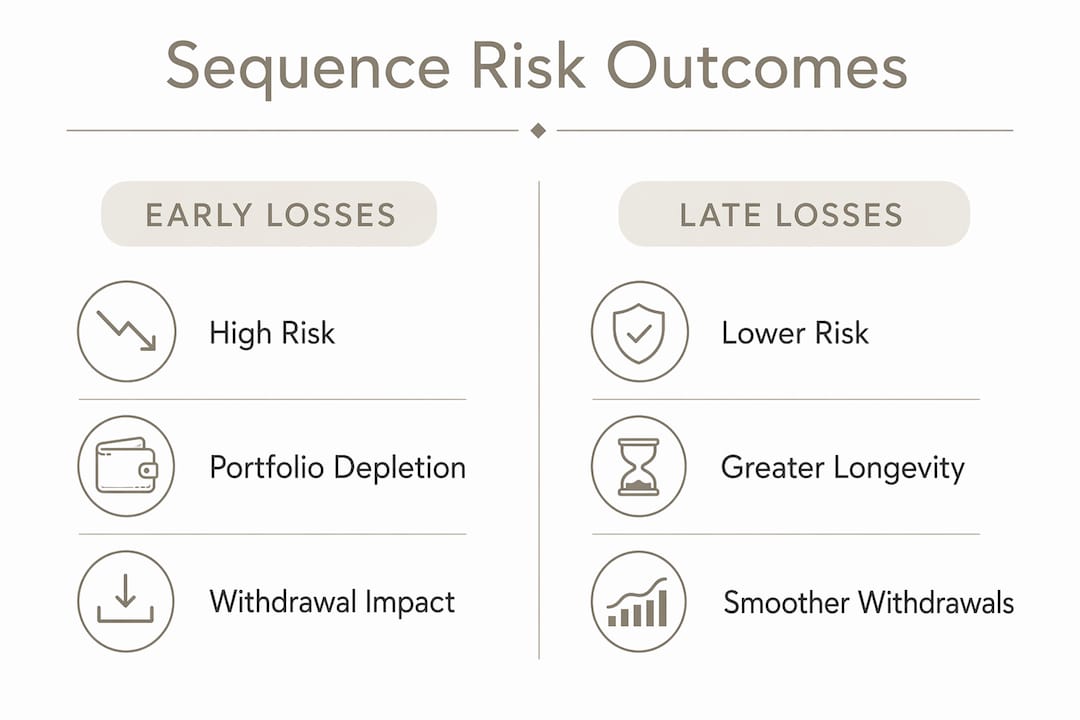
Here is the core mechanic. When markets fall and you still need $40,000 for living expenses, you sell shares at depressed prices. Those shares are gone. When markets recover, you compound a smaller base, so the recovery lifts you less than it would have if you had held the full position. Early losses do not just hurt in the moment; they permanently reduce the capital that future gains can work on.
The net-seller vs. net-buyer contrast:
- Net buyer (accumulation): Poor early returns mean you buy more shares cheaply. A recovery multiplies a larger share count. Bad timing is actually an advantage.
- Net seller (withdrawal): Poor early returns force you to liquidate at lows. A recovery multiplies a smaller share count. Bad timing is a structural disadvantage.
Rebalancing interacts with this directly. Selling assets that have run up to buy those that have fallen keeps your allocation intact and reduces the behavioral pull toward panic selling. Disciplined rebalancing during volatile periods tends to outperform reactive exits, partly because the market's best days often cluster right next to its worst ones.
Pro Tip: Never rebalance by selling your cash buffer. Rebalance within your growth bucket so the buffer stays intact for near-term withdrawals.

Two identical averages, two very different outcomes
Assume a $1,000,000 starting portfolio, a $40,000 annual withdrawal (4%), no fees, and annual rebalancing. Two investors each earn an average 6% annual return over 10 years, but in opposite order.
| Year | Sequence A returns | Sequence A balance | Sequence B returns | Sequence B balance |
|---|---|---|---|---|
| 1 | — | $1,000,000 | — | — |
| 2 | — | — | −10% | — |
| 3 | — | — | +6% | — |
| 4 | +6% | — | — | — |
| 10 | +4% | — | — | — |
| 6 | −2% | — | — | — |
| — | −6% | — | — | — |
| — | −10% | — | — | — |
| — | — | $825,837 | — | $1,095,549 |
| 10 | +6% | $835,387 | +4% | $1,099,371 |
The gap after 10 years is substantial, despite both portfolios averaging the same annual return. Sequence B's early losses forced larger proportional withdrawals from a shrinking base, compressing every subsequent recovery.
Assumptions: $1,000,000 starting balance, $40,000 annual withdrawal taken at year-start, returns applied after withdrawal, no fees, no taxes. This is a simplified illustration, not a projection.
How sequence risk breaks the 4% rule
The 4% rule is sensitive to when bad returns arrive. A withdrawal rate that looks sustainable under average-return assumptions can exhaust a portfolio in 20 years if the first decade is rough.
The main variables that amplify exposure:
- High withdrawal rate: The higher the percentage you pull annually, the larger the forced sale during downturns.
- High equity volatility: Concentrated single-stock positions swing harder than diversified funds, magnifying the damage.
- No cash buffer: Without liquid reserves, every withdrawal comes from whatever the market is currently pricing your holdings at.
- Long retirement horizon: A 35-year retirement gives bad early returns more time to compound their damage.
Target-date funds and glide paths reduce equity exposure as retirement approaches, but they do not eliminate sequence risk. A bad market in the first two years of retirement can still impair a conservatively allocated portfolio if withdrawals are large relative to the balance. Longevity models that assume smooth average returns consistently overestimate how long a portfolio survives under realistic path-dependent conditions.
Pro Tip: Re-run your withdrawal plan under three scenarios: average returns, a 2000–2002-style early decline, and a 2008-style shock in year one. If any scenario exhausts capital before age 90, adjust now.
Practical strategies to reduce sequence of returns risk
No single tactic eliminates this risk. The most resilient plans layer several approaches matched to spending needs and risk tolerance.
- Cash buffer (1–3 years of expenses): The most direct fix. Liquid reserves mean you fund living costs from cash during downturns and leave growth assets untouched to recover.
- Laddered short-duration bonds: A bond ladder covering years two through fives gives you a predictable income stream without forcing equity sales.
- Dynamic withdrawal rules (guardrails): Reduce withdrawals by 10–15% when the portfolio drops below a trigger threshold. Spending flexibility is one of the most powerful levers available.
- Partial annuitization: Converting a portion of assets to guaranteed income through an annuity or maximizing Social Security covers essential expenses and reduces required portfolio withdrawals, directly lowering sequence risk exposure.
- Tax-aware withdrawal sequencing: Drawing from taxable accounts first, then tax-deferred, then Roth preserves tax-advantaged compounding and can reduce the total dollars needed from volatile positions.
- Diversification beyond equities: Adding assets with low correlation to stocks, such as short-term Treasuries or TIPS, smooths the portfolio's path during equity downturns.
For homeowners in or near retirement, a reverse mortgage can serve as a liquidity backstop, providing cash during down markets without forcing the sale of investment positions.
Pro Tip: Do not shift entirely to bonds or cash to avoid sequence risk. That trade eliminates inflation and longevity risk protection. The goal is a buffer, not a retreat.
How to model sequence risk for your own portfolio
Model sequence of returns risk by running path-dependent simulations, not just average-return projections.
- Define your inputs: Starting balance, annual withdrawal amount, expected return distribution, volatility estimate, rebalancing rules, tax treatment, and fees.
- Run deterministic sequence tests: Use historical rolling windows (e.g., every 30-year period since 1926) and worst-sequence scenarios (2000–2009, 1966–1974) to see how your plan holds up under real historical paths.
- Examine failure metrics: What percentage of historical sequences exhaust capital? What is the median portfolio balance at year 20? What does the bottom 10% of outcomes look like?
- Stress-test concentrated positions separately: High equity concentration amplifies sequence risk because large single-stock declines force proportionally larger sales. Model a 40–60% drawdown in your largest holding in year one.
Pro Tip: Use Oracleinvestments to run instant scenario checks on individual holdings. Its stock scoring on profitability, valuation, and financial health helps you identify which positions to trim first when reducing equity exposure before withdrawals begin.
How Oracleinvestments helps you manage sequence risk
Oracleinvestments provides real-time portfolio tracking and stock-level scoring that directly supports sequence-risk analysis for investors who hold individual stocks.
- Instant stock comparisons: Score holdings on profitability, valuation, and financial health side by side to identify which positions carry the most downside risk heading into a withdrawal phase.
- Concentrated-position flagging: Spot single-stock overweights before they become forced-selling problems during a downturn.
- Scenario and sensitivity checks: Run hypothetical drawdown scenarios on specific holdings to see how a bad early sequence would affect your overall balance.
- Rebalancing support: Use scoring data to prioritize which positions to trim when building a cash buffer or shifting toward a more conservative allocation.
A practical workflow: score your top ten holdings in Oracleinvestments, identify the two or three with the weakest financial health scores, and consider trimming those first to fund your cash buffer. That approach is more disciplined than selling whatever has the smallest unrealized gain, and it aligns with the value investing principles that underpin the platform.
Pro Tip: Run an Oracleinvestments scenario check quarterly in the two years before your planned first withdrawal. Catching a deteriorating position early gives you time to rebalance without urgency.
Investor checklist: what to do this week
- Calculate your current withdrawal rate (annual withdrawal ÷ portfolio value). If it seems high, flag it as high risk.
- Set aside one to three years of living expenses in a money market account or short-term Treasuries.
- Run at least two deterministic sequence tests using historical bad periods (2000–2002 or 2008).
- Identify any single stock that represents more than 10–15% of your portfolio and model a 50% drawdown in that position.
- Draft a written flexible withdrawal rule: define the trigger (e.g., portfolio drops 15%) and the response (e.g., reduce withdrawals by 10%).
- Consult a fee-only advisor about partial annuitization and tax-efficient withdrawal ordering.
Pro Tip: Review your tax-lot records before year-end. Harvesting losses in a down year can offset gains elsewhere and reduce the after-tax cost of rebalancing into your cash buffer.
Key Takeaways
Sequence of returns risk is a path-dependent financing risk: identical average returns produce vastly different outcomes when withdrawals force sales during early downturns, and a cash buffer of one to three years of expenses is the most direct way to limit that damage.
| Point | Details |
|---|---|
| Order beats average | Two portfolios with the same average return can differ by roughly $264,000 after 10 years if one faces early losses during withdrawals. |
| Cash buffer is the first line of defense | One to three years of liquid expenses prevents forced selling of growth assets during downturns. |
| The 4% rule is not guaranteed | Early deep losses can make a previously sustainable withdrawal rate unsustainable; stress-test under historical bad sequences. |
| Concentration amplifies the risk | A single stock representing a large portion of a portfolio can force disproportionately large sales during a drawdown. |
| Oracleinvestments supports scenario testing | Use its stock scoring and scenario checks to identify which holdings to trim first and model drawdown impacts before withdrawals begin. |
The part most retirement guides get wrong
Most sequence-risk articles treat this as a problem you solve once, at retirement, by shifting to bonds. That framing misses two things.
First, the real danger for individual-stock investors is not asset class allocation in the abstract. It is the specific path your largest positions take in the first three years of withdrawals. A diversified bond allocation does not protect you if 30% of your portfolio is in one stock that drops 60% in year one. The mechanics are the same: forced selling at the worst possible price, permanent reduction in compounding base.
Second, the standard fix, moving to cash or bonds early, trades one risk for two others: inflation erosion and longevity shortfall. A 30-year retirement at 3% inflation cuts purchasing power roughly in half. Solving sequence risk by abandoning growth is not a solution; it is a slower version of the same problem.
The better frame is liquidity engineering. Keep enough in safe, liquid assets to fund two to three years of withdrawals without touching equities. Let the rest stay invested. When markets recover, replenish the buffer. That approach, combined with disciplined rebalancing and a written withdrawal policy, handles sequence risk without sacrificing the growth you need to last 30 years. Reactive selling into a downturn, by contrast, locks in losses and misses the recovery days that often follow the worst ones.
Document the rules before the market drops. Decisions made in a downturn are almost always worse than decisions made in advance.
Oracleinvestments: scenario testing without the spreadsheet
Investors who hold individual stocks face a version of sequence risk that generic retirement calculators simply cannot model accurately. Oracleinvestments was built for exactly this situation: scoring over 260 stocks on profitability, valuation, and financial health, then letting you run instant comparisons and scenario checks on your actual holdings.

Before your first withdrawal, use Oracleinvestments to identify which positions carry the most concentrated risk, model how a 40–60% drawdown in your top holdings would affect your portfolio balance, and prioritize what to trim when building your cash buffer. The platform's real-time tracking means you are not working from last quarter's data when markets move fast. Visit Oracleinvestments to run a sample scenario on your portfolio today.
Useful sources
- Sequence of Returns Risk — Thrivent: Supports the core definition, cash buffer recommendation, 4% rule sensitivity, and concentrated-equity risk.
- Investing for Retirement III — GMO: Source for the financing-risk framing, net-seller vs. net-buyer contrast, and cashflow-aware modeling.
- Sequence Risk — American Century: Covers glide path limits and target-date fund vulnerabilities.
- Perils of Timing Volatile Markets — Wells Fargo Advisors: Supports the case against reactive selling and for disciplined rebalancing.
- What Is Sequence of Returns Risk? — Northwestern Mutual: Covers partial annuitization and guaranteed income as sequence-risk hedges.