
You control emotional investing by deciding in advance what you will buy, hold and sell, and by basing those decisions on a company's reported fundamentals instead of on how the market feels today. Fear and greed show up in everyone, including professionals, so willpower alone is a weak defense. A written plan, steady contributions, a scheduled review and a consistent way to judge a stock are much stronger. This guide walks through what emotions do to investors, the mistakes to watch for, and a routine you can start this week.
TL;DR
- Emotional investing means letting fear, greed or excitement drive buy and sell decisions. It tends to produce buying high and selling low.
- Research from the SEC and the CFA Institute shows these errors are predictable and repeat across investors, so you can plan for them.
- Overconfidence is one of the costliest biases: it is linked to more frequent trading and to bigger mistakes.
- The best defenses are a plan tied to your goals, regular investing, diversification, infrequent rebalancing and a fixed method for judging stocks.
- Oracle Investments scores over 260 stocks on profitability, valuation and financial health, so your decisions rest on a rule instead of a mood.
Table of Contents
- What emotional investing actually is
- The emotional investing mistakes that cost the most
- Overconfidence: the bias that feels like skill
- Rule 1: Tie every decision to a plan and a goal
- Rule 2: Invest on a schedule
- Rule 3: Diversify so no single event decides your mood
- Rule 4: Rebalance on a calendar, not on a feeling
- Rule 5: Judge every stock with the same checklist
- Rule 6: Track results without watching prices
- A simple routine you can start this week
- How Oracle Investments helps you keep emotion out
- Our perspective
- FAQ
- Sources
What emotional investing actually is
Emotional investing is making a financial decision because of how you feel, not because of what the numbers and your plan say. The classic pattern is panic selling after a drop and chasing a stock after it has already run up.
This is not a character flaw. The SEC's report on behavioral patterns and pitfalls of U.S. investors describes behavioral finance as the study of observable, systematic and very human departures from the idea that investors act as perfectly rational return maximizers. In other words, people make the same kinds of mistakes again and again, which is exactly why the mistakes can be anticipated.
Even experienced traders are affected. In a National Bureau of Economic Research study, Andrew Lo and Dmitry Repin measured physiological responses of professional traders in a sample of 10 and found significant correlations between skin conductance and market events, and between cardiovascular changes and volatility. The response patterns differed with experience, but emotion was present in all of them. If it shows up in people who trade for a living, it will show up in you.
The CFA Institute adds that research over the past 20 years links bad investment decisions to emotions, and that the more complex and uncertain a choice is, the more emotions influence it. A falling market is complex and uncertain by definition, which is why it is the hardest time to think clearly.

The emotional investing mistakes that cost the most
The SEC report lists the habits that damage portfolios, and they read like a catalog of everyday investor behavior. Many investors, it says, underdiversify, trade frequently, follow the herd, favor familiar stocks, sell winners while holding losers, and give in to optimism, short-term thinking and overconfidence. Here is what each looks like in practice.
Selling low and buying high
When prices fall, fear tells you to get out. When prices climb, greed tells you to get in. Both urges push you to do the opposite of what a long-term investor wants. The result is that you lock in losses near the bottom and pay the most near the top.
Following the crowd
Herding feels safe because everyone else is doing the same thing. At a 2023 meeting of the SEC's Investor Advisory Committee, a presentation cited research showing that "top mover" lists induce attention-driven trading and that herding leads to negative returns. A stock appearing on a trending list tells you it is popular. It tells you nothing about whether the business is sound or fairly priced.
Selling winners and holding losers
This is the disposition effect named in the SEC report. Selling a winner feels good, so you do it early. Selling a loser means admitting a mistake, so you hold on and hope. The better question is always forward looking: would you buy this stock today at this price? Our guide to loss aversion in investing covers why losses sting roughly more than gains please, and how to manage that. If your issue is the sell decision itself, when to sell stocks gives practical triggers.
Treating money differently depending on where it came from
House money after a big gain, or a "safe" pile you refuse to touch even when it should be reallocated, are signs of what is called mental accounting. We explain how it quietly distorts returns in mental accounting in investing.
Concentration in what feels familiar
Owning mostly your employer's stock or the one industry you know feels comfortable. It also means a single bad event can hit most of your savings at once.
Overconfidence: the bias that feels like skill
Overconfidence deserves its own section because it does not feel like an emotion. It feels like competence. The CFA Institute classifies it as an emotional bias alongside loss aversion, self-control, status quo, endowment and regret aversion. These biases come from impulse and intuition, which makes them harder to correct than simple knowledge gaps.
The evidence on what it does is consistent:
- Researchers Brad Barber and Terrance Odean document that both the "better than average" and the overestimation forms of overconfidence are correlated with higher levels of trading.
- A study by Graham, Harvey and Huang found that a one standard deviation rise in perceived competence raises the probability of trading frequently by about one-half.
- A 2018 SEC working paper using 2015 survey data found that only 15% of margin traders answered a basic margin question correctly, against 31% of non-margin traders, and suggested that overconfidence in knowledge helps explain why lower-literacy traders gravitate toward margin.
- The SEC's behavioral report notes that in the worst case, overconfidence can make investors victims of fraud such as Ponzi schemes.
How do you spot it in yourself? Watch for these signs: you trade much more after a few winning picks, you can't explain why a stock is cheap in two sentences, or you size a position larger because you "just know." The CFA Institute's advice is that detecting a bias is the first step, after which you adapt to it or moderate it. The practical way to moderate overconfidence is to make yourself justify each decision against the same written criteria every time.
Rule 1: Tie every decision to a plan and a goal
FINRA's guidance for turbulent markets starts with clarifying financial goals tied to a long-term plan. It also points out that stock market fluctuations are outside your control, so your attention belongs on what you can control, such as asset allocation and diversification.
Write one page that answers four questions:
- What is this money for, and when will you need it?
- What mix of stocks, bonds and cash fits that timeline?
- What would make you buy a stock, and what would make you sell one?
- How often will you review the portfolio?
When the market drops, you do not ask how you feel. You open the page. If you are close to needing the money, the risk of selling into a decline matters more, and our explainer on sequence of returns risk shows why that is especially relevant for retirees.
Rule 2: Invest on a schedule
FINRA lists dollar-cost averaging, investing equal portions at regular intervals, as a strategy that can reduce or remove emotion from decisions. You do not have to decide whether today is a good day to buy, because the schedule decides for you. A fixed amount buys more shares when prices are low and fewer when they are high, and it keeps you participating.
It also fits with the evidence on staying invested. Our piece on time in the market looks at how long holding periods have favored individual investors.
Rule 3: Diversify so no single event decides your mood
A portfolio that can lose half its value on one headline will produce emotional decisions. FINRA recommends diversifying across and within major asset classes: holding stocks, bonds and cash equivalents, spreading stocks across sectors, and diversifying bonds by issuer and type, such as corporate, municipal and Treasury. Concentration in one investment or segment amplifies the loss from a significant market move.
The SEC's investor.gov guide explains the logic: historically, stocks, bonds and cash equivalents have not moved up and down at the same time, so holding more than one reduces the risk of loss and smooths returns. A calmer ride is easier to stay on.
Rule 4: Rebalance on a calendar, not on a feeling
Over time, winners grow and your mix drifts from the plan. Rebalancing brings it back. Investor.gov says many experts suggest doing it at a regular interval such as every six or twelve months, or only when an asset class moves beyond a preset percentage, and that it works best when done relatively infrequently.
That last point matters for emotional control. Checking constantly invites reacting constantly. Put the review dates in your calendar and leave the portfolio alone between them. If you want to see how far you have drifted, portfolio drift explains how to spot it and fix it.
Rule 5: Judge every stock with the same checklist
Most emotional mistakes begin with a story: a hot tip, a scary headline, a friend's win. The fix is to replace the story with the same questions asked of every company:
- Is it profitable, and consistently so?
- Is the valuation reasonable compared with its earnings and assets?
- Is the balance sheet healthy enough to survive a bad year?
These are the fundamentals that value investors have used for decades. If you want to go deeper on how they differ from price-chart signals, read screening with fundamentals and timing with technicals. Beginners often stumble on the same few errors, collected in five value investing mistakes beginners make.
A second layer is to question your own reasoning. Charlie Munger's mental models give you twelve prompts for testing an idea before you act on it, which is a direct counter to overconfidence.
Rule 6: Track results without watching prices
Looking at your portfolio every hour feeds anxiety. Looking at it on a set schedule, with the right measures, feeds judgment. Our guide to tracking portfolio performance like a pro shows what to measure so that a bad week does not look like a broken plan.
A simple routine you can start this week
- Write the one-page plan. Goals, timeline, target mix, buy and sell criteria.
- Automate contributions. Pick an amount and an interval and stick to it.
- Set two review dates a year. Rebalance only then, unless a pre-set threshold is crossed.
- Score before you buy. Run a candidate through the same fundamentals every time, and compare it side by side with something you already own.
- Pause before you sell. Ask whether the company's fundamentals have changed or only the price has.
- Keep a decision note. One sentence on why you acted. Reading it later is the fastest way to see your own biases.
None of this requires predicting the market. It requires deciding once and following through.
How Oracle Investments helps you keep emotion out
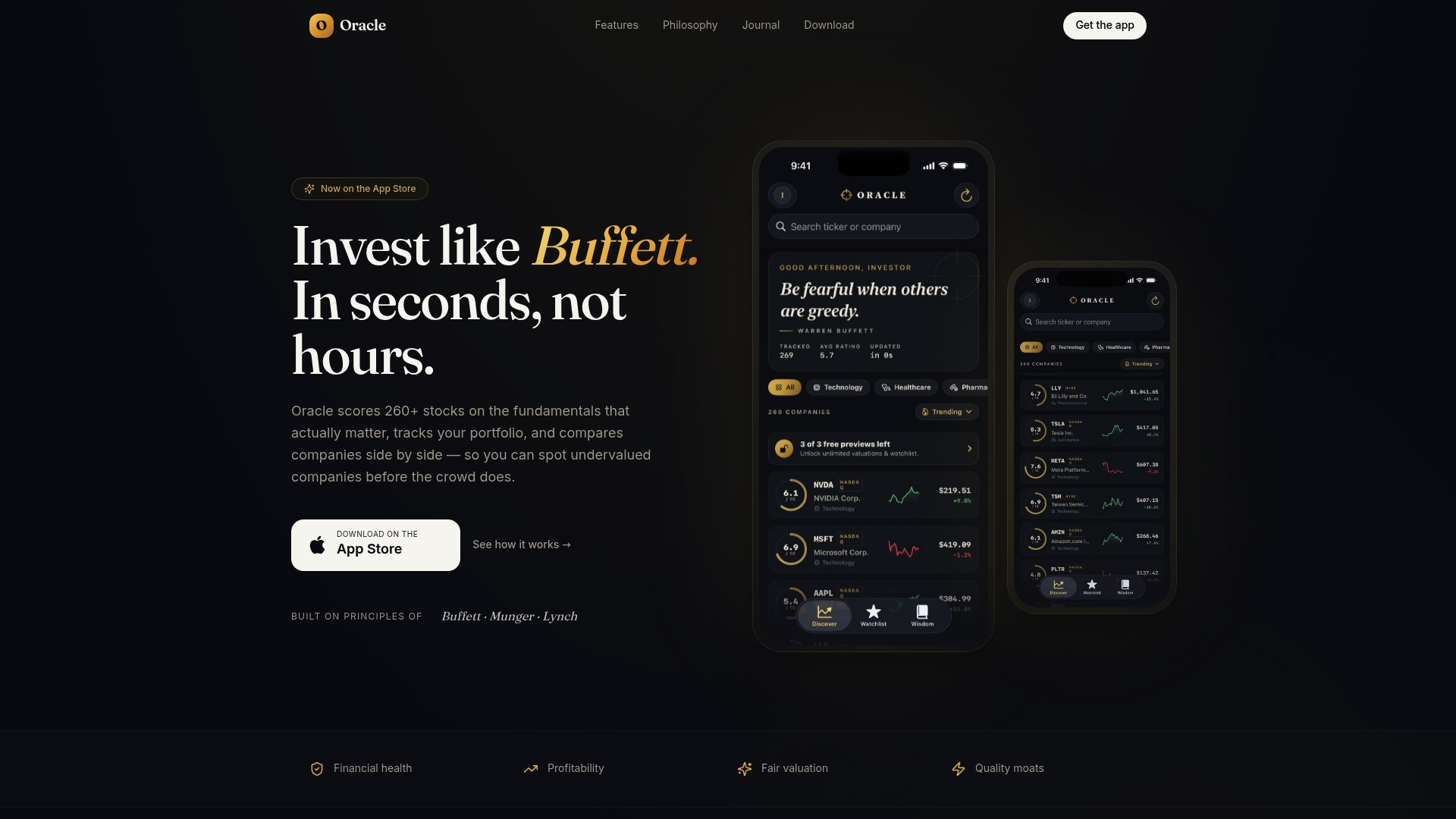
The hardest part of rule 5 is doing it consistently, because spreadsheets get skipped when markets are loud. Oracle Investments scores over 260 stocks on profitability, valuation and financial health, so you can assess and compare companies side by side without building anything yourself. The ratings are rule-based and grounded in reported company fundamentals, and the scoring inputs are shown, so you can see exactly why a stock scores the way it does. The app also includes real-time portfolio tracking and lessons drawn from investors such as Warren Buffett, Charlie Munger and Peter Lynch.
If you want a steady method in your pocket for the next time the market scares you, the Premium Annual plan gives you the portfolio tracking and in-depth stock analysis in one app.
Our perspective
Most advice on emotional investing tells you to stay calm. That is true and useless at the moment you most need it. Calm is a result, not a technique.
What produces calm is having an answer ready. When a stock drops 20%, the useful question is not how worried you are but whether profitability, valuation or financial health has changed. If the answer is no, you have a reason to hold. If the answer is yes, you have a reason to act, and it is a reason you can write down.
That is why we built Oracle around rule-based scores from reported fundamentals and show the inputs behind them. We avoid AI or model-driven guesswork so you can check the logic yourself and learn from it. Value investing is accessible when it takes seconds instead of a weekend with a spreadsheet, and a habit that takes seconds is a habit people keep.
Buffett, Munger and Lynch all said versions of the same thing: temperament matters more than cleverness. A consistent scorecard is a way of borrowing temperament when yours is under pressure.
Matt
FAQ
What is emotional investing?
It is making buy or sell decisions based on feelings such as fear, greed or excitement instead of a plan. The usual result is selling after prices fall and buying after they rise. Research from the SEC describes these as predictable, repeated errors rather than random ones.
How do I stop making emotional investing mistakes?
Decide the rules before the market tests you. Write a plan tied to your goals, invest at regular intervals, diversify across and within asset classes, and review on a calendar. FINRA recommends focusing on what you can control instead of reacting to market swings.
How do I know if I am overconfident?
Warning signs include trading much more after a few wins, being unable to explain a purchase simply, and sizing positions by gut feel. Studies by Barber and Odean link overconfidence with heavier trading. Judging each stock against the same written criteria is a practical way to moderate it.
I lost money in the market. What should I do now?
Start by checking your plan and whether your time horizon still fits your allocation, rather than trying to win it back quickly. Chasing losses is itself an emotional decision. If you are near retirement or need the money soon, speak with a registered financial professional about your specific situation.
How often should I check my portfolio?
Less often than you think. Investor.gov notes that rebalancing works best when done relatively infrequently, with six or twelve months as a common interval. Choose review dates in advance and avoid daily price watching between them.
Sources
- SEC: Behavioral Patterns and Pitfalls of U.S. Investors
- NBER: Lo and Repin, physiology of professional traders
- CFA Institute: Emotions and Decision Making
- SEC Investor Advisory Committee presentation, June 2023
- CFA Institute: The Behavioral Biases of Individuals
- Barber and Odean: The Behavior of Individual Investors
- Graham, Harvey and Huang: Investor competence and trading
- SEC DERA: Financial Illiteracy and Overconfidence of Margin Traders
- FINRA: Investor Tips for Turbulent Markets
- Investor.gov: Beginners' Guide to Asset Allocation, Diversification, and Rebalancing