
Mental accounting in investing means treating identical dollars differently depending on where they came from or what you've labeled them. The result is a fragmented portfolio that carries more risk than you realize and misses optimization opportunities a unified view would catch. The good news: once you see the pattern, you can either correct it or design around it deliberately.
Three immediate steps:
- Audit: Open every account you hold and compute your true total asset allocation across all of them right now.
- Fix: Automate your 401(k) contribution to capture the full employer match before allocating anything elsewhere.
- Stop: Treating a tax refund or investment gain as "free money" that earns a different risk budget than your regular savings.
Key Takeaways
Mental accounting fragments your portfolio's risk profile by treating identical dollars differently based on label or source, and the fix starts with computing your true total asset allocation across every account you hold.
| Point | Details |
|---|---|
| Fungibility is the core principle | Every dollar should be evaluated against your total-portfolio target, regardless of its source or label. |
| The flypaper effect is costly | When the employer match isn't made salient, investors ignore it, producing unintended concentration and drift. |
| Windfalls need rules in advance | Assigning a windfall's destination before it arrives removes the house-money effect from the decision. |
| Goal-based buckets can help | Buckets improve behavioral adherence when each has a written policy covering purpose, target, and withdrawal conditions. |
| Oracleinvestments supports the workflow | The app aggregates holdings, scores stocks on fundamentals, and provides the total-portfolio view the 6-step audit requires. |
Table of Contents
- How does mental accounting in investing actually work?
- The mechanics: how labels become portfolio decisions
- Concrete investing examples you'll recognize
- What does the research actually say?
- How mental accounting should change the way you build a portfolio
- Practical strategies to manage mental accounting in your portfolio
- Common mistakes that reveal harmful mental accounting
- A 6-step audit to find and fix your mental accounts
- Tools and workflows that make this easier
- When should you use mental accounting instead of fighting it?
- Oracleinvestments scores stocks and tracks your full portfolio in one place
- Sources
How does mental accounting in investing actually work?
The concept traces directly to economist Richard Thaler, whose foundational work showed that people assign labels to money and then apply different spending and saving rules to each labeled bucket. This violates a basic economic principle called fungibility: a dollar is a dollar regardless of its source, and rational actors should treat all dollars identically when making decisions.
In practice, nobody does that. You treat a $500 tax refund differently than $500 of your paycheck, even though both spend the same way. Investopedia's explainer on mental accounting calls this out directly: the behavior is irrational by any mathematical standard, yet it is nearly universal.
Three mechanisms drive it:
Framing changes how a transaction feels. A $1,000 bonus feels like a windfall; $1,000 of regular salary feels like income that belongs to fixed expenses. Same amount, completely different psychological treatment.
Earmarking assigns a purpose to money before it is spent or invested. A "vacation fund" and a "retirement fund" both hold cash, but the rules governing each feel completely different, even when the optimal move would be to consolidate them.
The house-money effect is the investing version of the same bias. Once you've made a gain, those profits feel like "the casino's money," and you're willing to take risks with them that you'd never accept with your original capital. The Federal Reserve Bank of St. Louis explains this clearly: windfalls and gains get mentally separated from earned income, which directly shapes how people invest them.
Prelec and Loewenstein's research on the "pain of paying" adds another layer. The emotional friction of spending varies by payment method and framing. Cash feels more painful than a card swipe; a realized investment loss feels more painful than an unrealized one sitting in a separate account. That asymmetry explains why investors hold losing positions far longer than logic would suggest.
The mechanics: how labels become portfolio decisions
Picture the flow. Money arrives, you assign it a label, the label generates rules, and the rules produce behavior. The label is the hinge.
When a paycheck hits your checking account, it flows into predictable buckets: rent, groceries, savings. But when a $3,000 bonus arrives, the label "windfall" activates a different ruleset. Suddenly that money is available for a speculative stock bet or a vacation you'd otherwise budget for carefully. The amount is the same; the label changed everything.

This plays out in three recognizable investor patterns. First, 401(k) enrollment: many participants set their contribution rate once and never revisit it, while the employer match sits in a default fund they never consciously chose. The two accounts feel separate, so the employee optimizes one without accounting for the other. Second, windfalls: a tax refund or inheritance gets treated as discretionary money, often flowing into speculative positions rather than filling gaps in a long-term allocation. Third, the "fun money" brokerage account: investors open a separate account for individual stock picks, mentally ring-fencing it from their "serious" retirement portfolio. The problem is that the total risk across both accounts is what actually matters for their financial future.
The pain-of-paying dynamic reinforces all of this. Realizing a loss in a mental account feels like closing a ledger in the red. Investors avoid it by simply not selling, which means losers accumulate in separate mental buckets while winners get sold to "lock in" a positive bookkeeping entry. That's the disposition effect, and it's mental accounting operating at the transaction level.
Concrete investing examples you'll recognize
The 401(k) flypaper effect
Research by Choi, Laibson, and Madrian documented what they called a flypaper effect in 401(k) portfolio choice: when both employee and employer contribution flows were made salient simultaneously, participants integrated their accounts and made coherent allocation decisions. When only one flow was salient, allocations "stuck" to that account and didn't adjust for the other. The employer match effectively disappeared from the investor's mental model.
The practical consequence is significant. They optimized one mental account and ignored the other entirely.
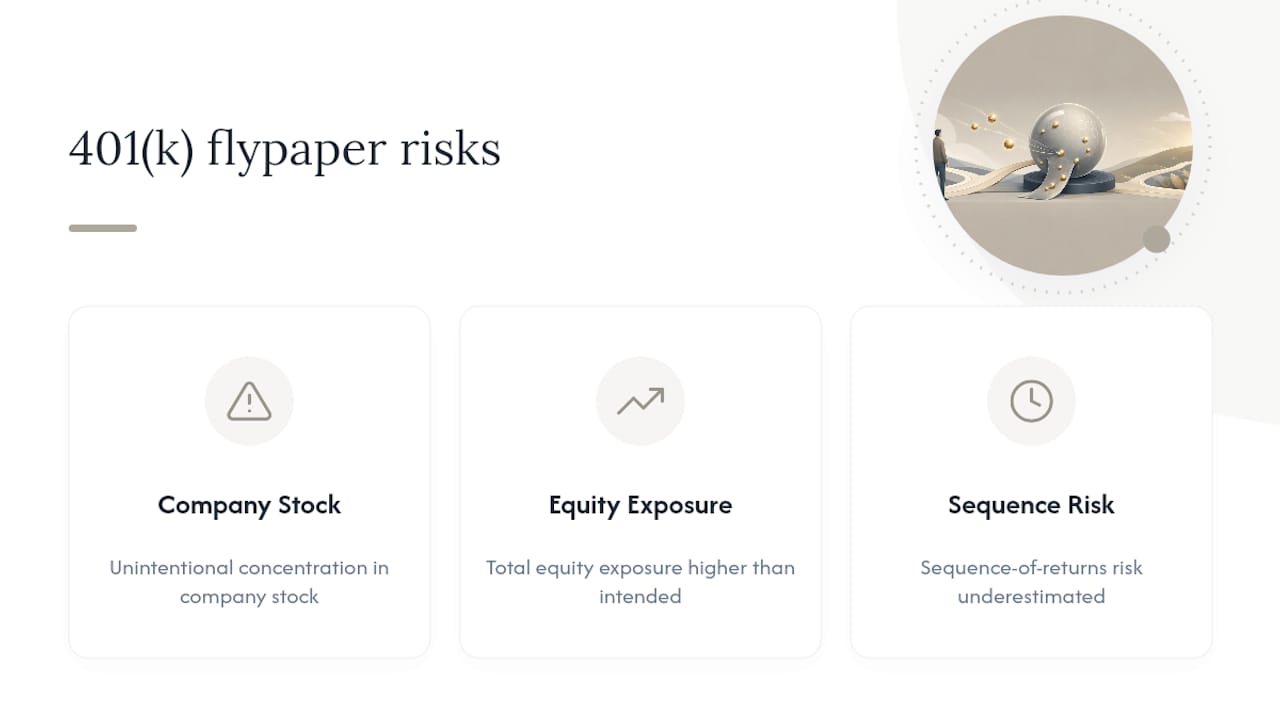
Risk distortion: Unintentional concentration in company stock; total equity exposure higher than intended; sequence-of-returns risk underestimated because the full picture was never computed.
Tax refunds and windfalls as speculative fuel
U.S. tax refunds commonly arrive as lump sums with no pre-assigned purpose, which activates the house-money effect immediately. For most households, this money arrives as a lump sum with no pre-assigned purpose, which activates the house-money effect immediately. CFGI's explainer on mental accounting notes that investors routinely treat gains and windfalls as "play money," taking on risk levels they'd reject if the same amount came from their paycheck.
The result: refund money flows disproportionately into speculative individual stocks, crypto, or options rather than filling the most efficient gap in a long-term allocation.
Risk distortion: Speculative positions sized beyond the investor's actual risk tolerance; portfolio skew toward high-volatility assets that weren't part of the original plan.
The segregated "lottery ticket" brokerage account
Many investors maintain a separate taxable brokerage account for individual stock picks alongside a 401(k) or IRA. The mental separation feels disciplined ("I'm keeping my retirement money safe"), but it creates a blind spot. Each account gets optimized in isolation, and the combined risk profile is never computed.
Behavioral Portfolio Theory, developed by Shefrin and Statman and published in the Journal of Financial and Quantitative Analysis, predicts exactly this pattern: investors build a safety layer (bonds, stable funds) and an aspirational layer (speculative bets), and the two layers don't add up to a mean-variance efficient portfolio. The total risk is higher than intended, and the expected return doesn't compensate for it.
Risk distortion: Total portfolio volatility exceeds the investor's stated tolerance; tax-inefficient asset placement (holding bonds in taxable accounts, growth stocks in tax-advantaged ones); no systematic rebalancing across accounts.
What does the research actually say?
The scholarship on this topic is unusually consistent. Different methodologies, different settings, same core finding: mental categories change financial behavior in ways that cost investors real money.
| Study | Setting | Key finding | Investor takeaway |
|---|---|---|---|
| Thaler (1999) | Theoretical / lab | Money is coded, evaluated, and spent differently by label; fungibility is routinely violated | Treat all dollars identically when setting risk targets |
| Choi, Laibson & Madrian (2009) | 401(k) natural experiment | Flypaper effect: salience of contribution flows determines whether accounts are integrated | Make all account flows visible at enrollment; review match allocation actively |
| Shefrin & Statman (2000) — BPT | Portfolio theory | Behavioral investors build safety + speculative layers; combined portfolio diverges from efficient frontier | Compute total-portfolio risk, not layer-by-layer risk |
| Prelec & Loewenstein (1998) | Lab experiments | Pain of paying varies by payment method and framing; affects willingness to realize losses | Automate rebalancing to remove emotional friction from sell decisions |
| St. Louis Fed (2026) | Consumer finance explainer | Windfalls and gains are treated differently from earned income; house-money effect is pervasive | Assign explicit rules to windfalls before they arrive |
The Choi, Laibson, and Madrian finding is the most directly actionable for 401(k) investors. The flypaper effect isn't a personality flaw; it's a structural response to how information is presented. Make the match visible, and behavior changes.
How mental accounting should change the way you build a portfolio
The core principle is straightforward: set targets at the total-portfolio level, then use individual accounts as tax-efficient containers for specific asset classes. Never optimize an account in isolation.
| Do | Don't |
|---|---|
| Aggregate all accounts before setting an asset allocation | Set a target allocation for each account separately |
| Include the employer match in your total equity exposure calculation | Ignore the match fund when reviewing your "own" contributions |
| Place bonds and fixed income in tax-advantaged accounts | Hold bonds in taxable accounts while growth stocks sit in your IRA |
| Set a single rebalancing trigger (e.g., 5% drift from target) across all accounts | Rebalance each account to its own target independently |
| Assign explicit rules to windfalls before they arrive | Decide what to do with a windfall after it lands in your account |
Your 401(k) holds $80,000, with the employer match defaulted into a stable-value fund ($20,000). Your IRA holds $40,000 in a total-market index fund. Your taxable account holds $10,000 in individual stocks.
Without integration: you see $40,000 in equities (IRA) and $10,000 in stocks (taxable) and think you're roughly 50/50. The match allocation was invisible, and it was pulling your actual allocation away from your target the entire time.
The fix: redirect the match into the same target-date or equity fund as your employee contributions, or manually offset it by holding more bonds in your IRA. Either way, the decision has to happen at the total-portfolio level. For a deeper look at how portfolio drift accumulates across accounts, the mechanics apply directly here.
Practical strategies to manage mental accounting in your portfolio
This is a prioritized playbook, not a checklist of equal-weight items. Steps 1 and 2 matter most; the rest build on them.
-
Aggregate every account. Pull balances and holdings from your 401(k), IRA, taxable brokerage, and any other investment account into a single view. This single step breaks the mental separation that drives fragmented decisions.
-
Set one total-portfolio target. Decide your target asset allocation (e.g., 70/30 equities/bonds) at the aggregate level. Every subsequent decision gets evaluated against that target, not against the individual account's balance.
-
Automate contributions and rebalancing. Automation removes the emotional friction that Prelec and Loewenstein identified. When rebalancing happens automatically at a 5% drift threshold, you never have to make a painful sell decision manually.
-
Create purpose-driven buckets with explicit rules. Goal-based buckets (retirement, down payment, emergency fund) are fine and often improve behavioral adherence. The rule is: each bucket needs a written policy covering contribution rate, target balance, and what triggers a withdrawal. Without rules, buckets drift into mental accounting traps.
-
Use tax-advantaged accounts as containers, not strategies. Max your 401(k) to capture the full match first. Then fund a Roth IRA if eligible. Then use taxable accounts for overflow. The IRS publishes current contribution limits annually; check them each January.
-
Assign windfall rules in advance. Before a tax refund, bonus, or inheritance arrives, write down exactly where it goes: X% to the account with the largest gap from target, Y% to a specific goal bucket, Z% to discretionary spending. Deciding in advance removes the house-money effect from the equation.
Pro Tip: Treat the employer match as the first line of your asset allocation, not as a bonus. If your match defaults into company stock or a stable-value fund, that allocation is already shaping your total risk profile whether you acknowledge it or not. Review it the same day you set your contribution rate.
Implementation cadence: Monthly, check that automated contributions are processing correctly. Quarterly, review total-portfolio allocation against your target and note any drift. Annually, update contribution rates (especially after a raise), review windfall rules, and recheck tax placement across accounts.
Common mistakes that reveal harmful mental accounting
Recognizing the pattern in your own behavior is half the correction. These are the red flags most investors encounter.
Ignoring the employer match. The match is an immediate return on that portion of your contribution, representing valuable free money that should not be left uncaptured. Leaving it uncaptured because you're "focused on paying off debt" or "not ready to invest" is one of the most expensive mental accounting errors in personal finance. Corrective action: contribute at least enough to capture the full match before directing money anywhere else.
Investopedia's mental accounting entry flags this as one of the most common and costly manifestations of the bias. Corrective action: pay down high-rate debt first, then rebuild the emergency fund.
Frequent speculative bets from recent gains. If you find yourself opening positions in meme stocks, options, or crypto specifically after a portfolio gain, the house-money effect is running. The gain didn't change your risk tolerance; it changed your perception of what you're risking. Corrective action: apply the same position-sizing rules to gains as you do to new contributions.
Holding losers indefinitely in a separate account. Sunk-cost behavior in investing ties directly to mental accounting: closing a losing position feels like admitting the account failed. Investors hold losers to avoid that emotional bookkeeping entry, even when the capital would be better deployed elsewhere. For a practical framework on when to sell stocks, the disposition effect is the central behavioral trap to address.

Corrective action: set a pre-defined exit rule (e.g., cut a position if the thesis changes, not based on whether you're up or down) and apply it uniformly.
When to seek a consolidated review. If you hold more than four accounts, haven't computed your total asset allocation in the past 12 months, or can't state your combined equity exposure off the top of your head, a consolidated review with a fee-only financial advisor is worth the cost. The behavioral asset allocation framework recommends diagnosing biases first, then adjusting allocations to balance mathematical optimality with what you'll actually maintain under stress.
A 6-step audit to find and fix your mental accounts
Run this in one session. It takes about 90 minutes the first time.
-
List every account you hold. Include 401(k), IRA, Roth IRA, taxable brokerage, HSA, 529, and any cash savings you consider "investment-adjacent." The goal is a complete inventory with current balances.
-
Compute your true asset allocation. Add up total equities, total fixed income, total cash, and total alternatives across all accounts. Divide each by total portfolio value. This is your actual allocation, not the one you think you have.
-
Tag every windfall and gain in the past 12 months. Note where that money went. If it went into higher-risk positions than your regular contributions, you've found a house-money pattern.
-
Adjust auto-contributions to reflect your total-portfolio target. If your true allocation is 80/20 but your target is 70/30, increase bond contributions in your next available contribution cycle.
-
Set a rebalancing trigger. Write it down: "I will rebalance when any asset class drifts more than 5% from its target weight." Automate it if your platform allows; schedule a calendar reminder if it doesn't.
-
Document your bucket rules. For each goal-based bucket you maintain, write one sentence covering its purpose, target balance, and the condition that triggers a withdrawal. Undocumented buckets drift back into mental accounting traps within a year.
Tools and workflows that make this easier
The workflow above requires one thing above all else: a single view of all your accounts. Without aggregation, steps 2 through 6 are guesswork.
The features worth looking for in any portfolio tool:
- Account aggregation that pulls live balances from 401(k), IRA, and taxable accounts into one dashboard
- Asset allocation visualization at the total-portfolio level, not account-by-account
- Tagging or labeling so you can mark positions by goal, risk tier, or mental account category
- Scenario modeling to simulate what a windfall allocation does to your total risk profile before you commit
- Rebalancing alerts triggered by drift thresholds, not calendar dates
- Tax-aware reporting that shows which accounts hold which asset classes and flags inefficient placement
A practical workflow: start by connecting all accounts to an aggregation tool. Run the total-portfolio allocation calculation. Tag each position with its mental account label (retirement, speculation, emergency). Then simulate: what happens to your total equity exposure if you redirect the next windfall to bonds? What does your allocation look like after capturing the full employer match?
For investors who want to go deeper on tracking total portfolio performance, the same aggregation-first principle applies: you can't measure what you haven't consolidated.
When should you use mental accounting instead of fighting it?
The conventional advice is to eliminate mental accounting entirely. That's wrong, or at least incomplete.
Mental accounts work well when they improve behavioral adherence. A dedicated "down payment" savings account with automatic contributions and a no-touch rule is mental accounting by design, and it works precisely because the label creates friction against raiding the fund for other purposes. Goal-based financial planning, which most fee-only advisors now use as a default framework, is essentially formalized mental accounting with guardrails.
Where the bias causes real damage is in portfolio construction: when accounts are optimized in isolation, when the employer match is invisible, when windfalls bypass the allocation framework entirely, and when the total risk picture is never computed. Those are the cases where the bias costs money in a measurable way.
The practical recommendation: keep goal-based buckets for behavioral adherence, but compute total-portfolio risk across all buckets at least quarterly. The buckets can stay; the blind spot between them has to go. Investors who want to avoid the most common behavioral traps in this space will find the value investing mistakes beginners make worth reading alongside this framework.
The hardest part isn't knowing what to do. It's building a system that makes the right behavior automatic, because under stress, the mental accounts reassert themselves every time.
Oracleinvestments scores stocks and tracks your full portfolio in one place
Knowing your mental accounts exist is step one. Having a tool that makes the total-portfolio view automatic is what actually changes behavior over time.
Oracleinvestments scores over 260 stocks on profitability, valuation, and financial health, so you can see at a glance whether a position you're considering belongs in your allocation or is a house-money bet dressed up as analysis. The portfolio tracking feature pulls your holdings into a single dashboard, giving you the aggregated view that the 6-step audit above requires.

The app integrates the investment frameworks of Warren Buffett, Charlie Munger, and Peter Lynch directly into the scoring model, which means the same discipline that keeps those investors from chasing windfalls is built into how every stock gets evaluated. For investors who want to stop optimizing account-by-account and start thinking at the total-portfolio level, Oracleinvestments is a practical place to start. Download it from the Apple App Store and run your first portfolio score today.
Sources
The papers and explainers below map directly to the claims in this article. Start with Thaler for the theoretical foundation, then Choi, Laibson, and Madrian for the most directly actionable 401(k) finding.
- Mental Accounting in Portfolio Choice: Evidence from a Flypaper Effect - PMC
- Mental accounting - Investopedia
- Behavioral Portfolio Theory | Journal of Financial and Quantitative Analysis | Cambridge Core
- How mental accounting shapes our financial choices - Federal Reserve Bank of St. Louis
- Prelec & Loewenstein (DOI)
This article is general information, not a substitute for advice from a qualified financial advisor. Consult a qualified financial professional about your own circumstances before acting on anything here.