
Sell when your original reason for owning a stock no longer holds, when a position has grown so large it distorts your portfolio, or when you need the cash for a defined financial goal. Those three triggers cover the vast majority of good selling decisions. The rest of the time, the right move is usually to hold. Knowing which situation you are in requires a clear plan set before emotions enter the picture.
The core signals worth watching:
- A stock has gained significantly from your buy point and you have no strong thesis for further upside
- The position has fallen noticeably and the original investment case has weakened
- One holding now represents a disproportionate share of your total portfolio
- A company's fundamentals, earnings trajectory, or competitive position have materially changed
- You need liquidity for a near-term financial obligation
- Your target asset allocation has drifted significantly from its intended mix
Selling should be a deliberate act, not a reaction. Oracleinvestments scores over 260 stocks on profitability, valuation, and financial health, giving you an objective read on whether a company's fundamentals still justify holding before you make that call.
Table of Contents
- When should you sell a stock versus hold it?
- How emotions sabotage your selling decisions
- Tax implications you need to understand before selling
- Practical rules of thumb for when to liquidate investments
- How disciplined analysis tools help you decide when to sell
- Key Takeaways
- Make smarter sell decisions with Oracleinvestments
When should you sell a stock versus hold it?
The decision to sell almost always comes down to one question: has the reason you bought this stock changed? If the answer is yes, selling is usually correct. If the answer is no, patience tends to win.
Reasons to sell:
- Your target allocation has drifted. Rebalancing your portfolio means selling the positions that have grown beyond their intended weight, say from 60% to 70% in equities, to restore your intended risk level.
- Company fundamentals have deteriorated. Falling revenue, shrinking margins, a CEO departure, or a lost competitive moat are all legitimate triggers.
- A single stock has become an outsized concentration risk, putting too much of your net worth at the mercy of one company's fortunes.
- You have a real cash need: a home purchase, tuition payment, or emergency fund gap that cannot be covered another way.
- The macroeconomic environment has shifted in a way that structurally harms the sector, not just creates short-term noise.
Reasons to hold:
- The company's growth trajectory remains intact and the original thesis is still valid.
- Timing market peaks is notoriously difficult. Markets tend to recover before positive economic signals appear, so staying invested through downturns usually produces stronger long-term returns than selling and waiting for clarity.
- Short-term price drops driven by broad market sentiment, not company-specific news, rarely justify an exit.
- Tax consequences of selling would significantly erode your actual gain, and the position still has room to run.
The discipline is in separating those two lists clearly. A stock that has dropped 15% because the whole market sold off is a very different situation from one that dropped 15% because its largest customer walked away.
How emotions sabotage your selling decisions
Fear of missing out and loss aversion are the two forces that wreck most individual investors' selling records. Behavioral finance research shows that investors consistently hold winners too long, hoping for more, and hold losers too long, hoping for a recovery. Both errors stem from the same root: letting feelings drive a decision that should be driven by facts.

FOMO shows up when a stock you own has already gained substantially and you convince yourself it will go much higher. You ignore the valuation stretch, the slowing growth, and the fact that you had no plan for what "enough" looked like. The stock corrects, and you end up with a fraction of the gain you could have locked in.
Loss aversion is the mirror image. Selling a loser feels like admitting a mistake, so investors avoid it. The stock sits in the portfolio, bleeding quietly, while better opportunities go unfunded. Selling is often more difficult than buying precisely because market declines are sharp and recoveries are slow, which makes the pain of holding a loser feel temporary even when it is not.
How to fight back:
- Write down your sell criteria the day you buy, not the day you are deciding whether to sell.
- Use stop-loss orders to automate exits at predetermined levels, removing the in-the-moment emotional calculation entirely.
- Size positions so that no single stock can cause catastrophic damage. When a position is small enough that a typical significant drop does not ruin your year, it is much easier to cut it without anguish.
- Review your thesis quarterly, not your price. Ask whether the business has changed, not whether the chart looks scary.
Pro Tip: Before you sell anything, write a one-paragraph answer to this question: "What would have to be true for me to buy this stock today at its current price?" If you cannot write that paragraph, selling is probably the right call.
Tax implications you need to understand before selling
Taxes do not drive the sell decision, but they absolutely shape how and when you execute it. Selling a stock held for less than one year triggers short-term capital gains, taxed at your ordinary income rate. Hold for more than a year and you qualify for the lower long-term capital gains rate. That difference can be meaningful, so if you are within a few weeks of the one-year mark and the investment thesis has not broken down, waiting often makes financial sense.
Tax-loss harvesting is the practice of selling positions at a loss to offset taxable gains elsewhere in your portfolio. Done well, it reduces your tax bill without changing your overall market exposure, since you can reinvest the proceeds in a similar (though not identical) position. The IRS wash-sale rule prohibits repurchasing the same security within 30 days before or after the sale, so you need to plan the replacement carefully.
Key tax considerations:
- Short-term vs. long-term holding period changes your effective tax rate on gains.
- Tax-loss harvesting offsets gains but should never be the primary reason to exit a quality position.
- Selling in a tax-advantaged account like an IRA or 401(k) eliminates the immediate capital gains question entirely.
- Consult a tax professional before executing large sales, particularly if you are in a high income bracket or have complex holdings.
The trap to avoid: selling a fundamentally sound stock purely to harvest a loss, then missing the recovery because you were sitting in cash or a substitute position. Tax efficiency is a tool, not a strategy.
Practical rules of thumb for when to liquidate investments
The most useful selling rules are simple enough to follow under pressure. Complexity fails when markets move fast and emotions run high.
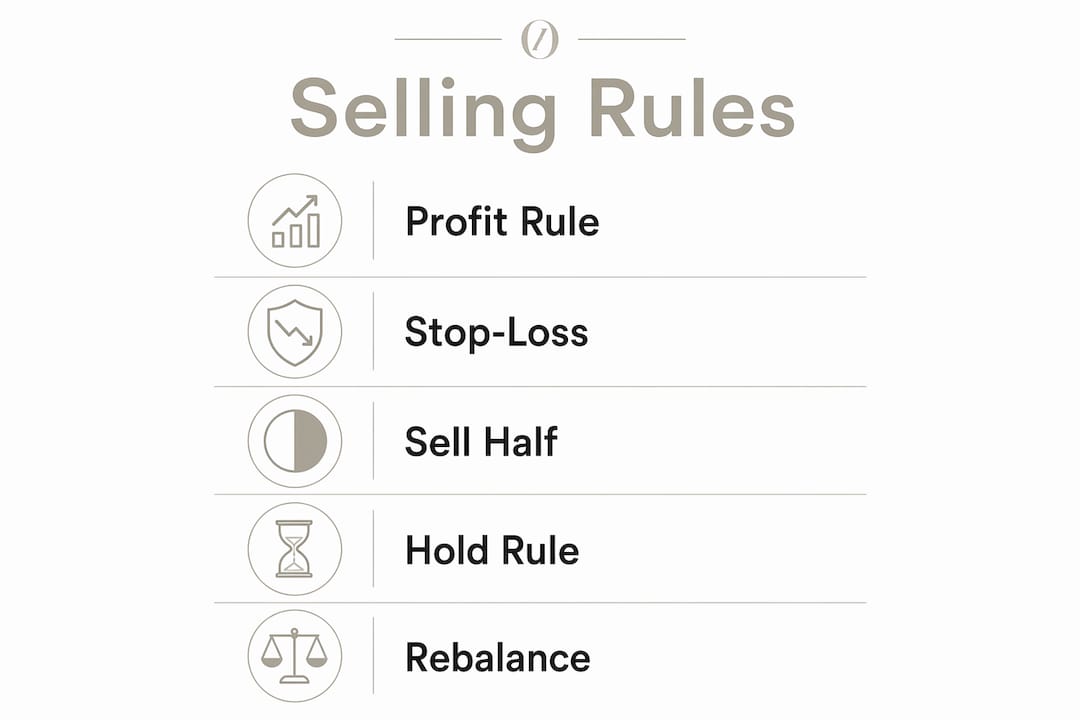
The profit rule. Experienced investors recommend selling into strength, locking in gains when a stock has risen substantially from your buy point rather than waiting for a peak that may never come. This feels counterintuitive because the stock is still going up, but selling while a position is rising protects you from giving back gains in the next correction.

The stop-loss rule. Cutting a loss at a moderate level below your purchase price limits the damage before it compounds. Fidelity's position management guidance suggests limiting any single stock's loss to 2% of your total portfolio value, with stop-losses set up to 20% to allow for normal market fluctuations.
The "sell half after doubling" approach. When a stock doubles, selling half your position returns your original capital and lets the remaining shares ride with house money. You eliminate the risk of a total loss while keeping upside exposure.
The hold rule. For stocks that break out strongly from a sound base and gain significantly within a short period of the breakout, holding for a couple of months before making a sell decision often allows the full move to develop. This rule applies specifically to high-momentum growth stocks.
Rebalancing triggers. Trimming positions that outperform disproportionately keeps concentration risk in check. A stock that grows from 5% to 12% of your portfolio has changed your risk profile whether you intended it to or not.
Pro Tip: Set your sell rules in writing before you buy. A rule you create under pressure is not a rule. It is a rationalization.
How disciplined analysis tools help you decide when to sell
The best sell decisions come from the same place as the best buy decisions: a clear, written investment thesis with specific conditions that would invalidate it. Professional investors write down their thesis and sell triggers upfront to separate genuine fundamental breaks from normal market noise. Without that written record, every dip feels like a crisis and every rally feels like vindication.
A practical framework for evaluating whether to sell a position:
- Review the original thesis. What did you expect the company to do? Has it done it? If earnings growth was the thesis and the company has now missed three consecutive quarters, the thesis has failed.
- Check the fundamentals. Revenue growth, profit margins, return on equity, and debt levels tell you whether the business is getting stronger or weaker. Learning how to read a value rating quickly can make this step take minutes instead of hours.
- Watch volume and moving averages. A stock breaking below its 50-day or 200-day moving average on heavy volume is a technical signal worth taking seriously, especially when it coincides with weakening fundamentals.
- Assess position size. No single stock should exceed about 2% of your portfolio as a general discipline. If a position has grown well beyond that through appreciation, trimming is a risk management decision, not a market call.
- Separate noise from signal. A broad market selloff, a single bad headline, or a short-term earnings miss driven by a one-time item are noise. A structural shift in the company's competitive position, a regulatory threat to its core business, or a pattern of deteriorating margins is signal.
Oracleinvestments scores stocks across profitability, valuation, and financial health, giving you a side-by-side comparison that makes it easier to spot when a holding has slipped relative to alternatives. Real-time portfolio tracking means you can see concentration drift as it happens, not after it has already become a problem. For investors who want to avoid common value investing mistakes, having that objective score as a reference point removes a lot of the guesswork from the sell decision.
Aligning your sell discipline with your broader cash flow management goals also matters, particularly for investors who rely on their portfolio to fund near-term expenses. Knowing what you need and when you need it keeps selling decisions grounded in reality rather than market sentiment.
Key Takeaways
Selling stocks well requires predetermined rules, objective fundamentals analysis, and the discipline to follow both when emotions push the other way.
| Point | Details |
|---|---|
| Sell on substantial gains | Lock in profits while the stock is rising rather than waiting for a peak. |
| Use up to a 20% stop-loss | Limit single-position losses, but avoid triggering exits during normal fluctuations. |
| Rebalance when allocation drifts | Sell positions that have grown disproportionately to restore your intended risk level. |
| Write your thesis before you buy | Predefined sell triggers separate genuine fundamental breaks from market noise. |
| Keep tax strategy in its place | Use tax-loss harvesting to reduce liabilities, but never let taxes override a sound investment decision. |
Make smarter sell decisions with Oracleinvestments

Knowing when to sell is only half the equation. The other half is having the right data in front of you when the moment arrives. Oracleinvestments scores over 260 stocks on the fundamentals that actually drive long-term returns: profitability, valuation, and financial health. You can compare positions side by side, track your portfolio allocation in real time, and apply the same disciplined framework Warren Buffett, Charlie Munger, and Peter Lynch built their records on.
Stop making sell decisions based on headlines or gut feelings. Start investing with clarity and let the fundamentals tell you when it is time to move on.