
Meeting ASC 280 comes down to one discipline: identify your chief operating decision maker (CODM) correctly, apply the ASU 2023-07 expense disclosures at every interim period, and pass the 10% and 75% quantitative tests before you aggregate anything. Get that sequence wrong, and an SEC comment letter is the most likely outcome. Get it right, and your segment reporting analysis becomes a genuine tool for judging where the business actually makes money.
TL;DR:
- Proper identification of the chief operating decision maker is crucial and must be based on actual review reports, not titles or assumptions.
- Companies must now disclose detailed segment expenses and provide interim disclosures in quarterly filings, significantly increasing reporting complexity.
- Segments are reportable if they meet any of the 10% revenue, profit, or asset thresholds, and must collectively account for at least 75% of total revenue.
- Documentation of similar long-term margins, products, and regulatory environments is essential before aggregating segments to avoid SEC pushback.
- Governance processes, including regular management approval and traceability of data flow, are key to maintaining compliance and avoiding comment letters.
Table of Contents
- What Is Segment Reporting Analysis Under ASC 280?
- How Do You Identify the CODM and Map Segments?
- What Are the 10% Thresholds and the 75% Test?
- What Disclosures and Reconciliations Does ASC 280 Require?
- What Do SEC Comment Letters Focus On?
- Which KPIs and Techniques Reveal True Segment Performance?
- Using a Scoring Tool to Cross-Check Segment Trends
- Governance Is the Real Fix, Not Better Footnote Language
- Where Oracle Investments Fits Into Segment-Level Analysis
- Where to Verify These Requirements Yourself
- Sources
- FAQ
What Is Segment Reporting Analysis Under ASC 280?
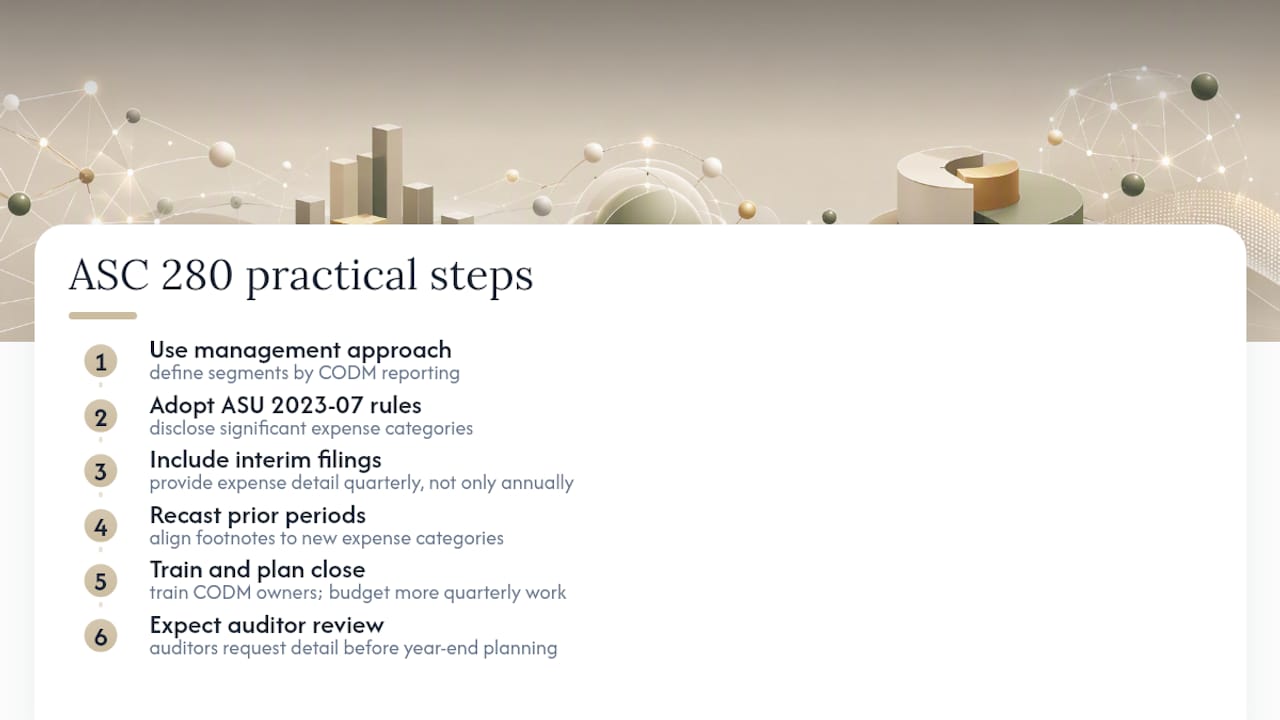
ASC 280 requires public companies to report financial results the way their own management looks at the business, not the way a textbook org chart suggests. That's the "management approach": segments are defined by whatever internal reporting the CODM actually uses to allocate resources and judge performance, not by product lines or geography chosen for optics.
The FASB's ASU 2023-07 changed the mechanics substantially. Companies must now disclose significant segment expense categories, not just a single profit or loss figure, and they must provide this detail in interim filings, not only annual ones. The update responds directly to investor pressure for more visibility into what drives segment costs, and it raises the disclosure bar even for entities with a single reportable segment.
Practically, this means recasting prior-period segment footnotes to match the new expense categories, updating interim disclosure templates, and training whoever owns the CODM report package on what "significant" expense means for your business. Most preparers underestimate how much this touches quarterly close. If your segment note used to be two paragraphs and a table, budget for it becoming twice that, because the standard now expects expense-level granularity that used to live only in internal management decks. Auditors are already asking for this detail before year-end planning even starts.
How Do You Identify the CODM and Map Segments?
The CODM is not necessarily the CEO. It can be an individual, a committee, or even a management group, and the test is functional: whoever regularly reviews operating results to allocate resources and assess performance holds that role, regardless of title, according to KPMG's segment reporting handbook. Document the evidence carefully, because auditors and the SEC will ask for it.
- Pull the actual reports the CODM reviews. Board decks, monthly operating reviews, budget variance packages, whatever gets used to make real resource decisions.
- Identify the measure of profitability the CODM relies on. This might not be GAAP net income. It could be adjusted EBITDA or a contribution margin figure specific to your industry.
- Map each internally-tracked unit to a potential operating segment, then test which of those qualify as reportable under the thresholds below.
- Reconcile inconsistencies between business units that report on different calendars, currencies, or chart-of-accounts structures before you aggregate anything.
Fragmented internal reporting is the most common practical hurdle here. When acquired subsidiaries still run on legacy systems, or regional units track cost centers differently, reconciliation becomes manual and error-prone, which is exactly what draws SEC scrutiny later. Fix the data lineage before you fix the footnote language.
What Are the 10% Thresholds and the 75% Test?
An operating segment becomes reportable when it crosses any one of three quantitative thresholds under ASC 280: its revenue (combined internal and external) represents a significant portion of total combined revenue, the absolute value of its reported profit or loss is materially large compared to aggregate profits or losses of segments, or its assets represent a notable share of combined total assets. Hit any single test and the segment stands alone in your disclosures.
Once you know which segments pass, run the 75% test: reportable segments must together account for at least 75% of consolidated external revenue, a threshold EY's segment reporting guidance walks through with worked examples.
Aggregation of similar segments is where preparers get into trouble. ASC 280 allows combining operating segments only when they share similar economic characteristics, and the SEC staff tends to presume investors want more disaggregation, not less, according to CFGI's analysis of comment letter trends. Before aggregating, document:
- Similar long-term gross margins across the combined segments
- Comparable products, services, and production processes
- Similar customer classes and distribution methods
- A comparable regulatory environment, where relevant
Weak aggregation memos are a recurring theme in SEC pushback, so treat this documentation as seriously as the numbers themselves.
What Disclosures and Reconciliations Does ASC 280 Require?
Every reportable segment footnote needs a specific set of line items, and ASU 2023-07 added more granularity to nearly all of them. The core disclosure package includes:
- Segment revenues, broken out by major product or service category where material
- Significant segment expense categories that the CODM regularly reviews, a new requirement under ASU 2023-07
- A measure of segment profit or loss, using whatever metric the CODM actually relies on
- Segment assets, when that figure is regularly provided to the CODM
- A full reconciliation of total segment revenues, profit or loss, and assets to the corresponding consolidated statement totals
Interim filings now carry nearly the same expense-level detail as annual filings, which is the single biggest operational shift ASU 2023-07 introduced.
Reconciling items deserve their own line of scrutiny. Corporate overhead, intersegment eliminations, and one-time items that don't belong to any single segment all need to appear in the reconciliation, clearly labeled rather than buried in a plug figure. If a prior comparative period doesn't match the new segment structure or expense categories, recast it. Restating comparatives is standard practice under the update, and skipping it is one of the faster ways to draw a follow-up letter from the SEC.
What Do SEC Comment Letters Focus On?
The SEC staff has issued comment letters on segment reporting for years, and the themes barely change: insufficient breakdown of segment expenses, thin justification for aggregating operating segments, and non-GAAP measures appearing in segment footnotes without proper reconciliation to GAAP figures, per SEC guidance on non-GAAP disclosures. A representative EDGAR filing shows how granular the follow-up requests can get, often asking for the underlying schedules behind a single footnote sentence.
When the SEC does push back, it typically requests historical management reports, forecast data used in impairment testing, and reconciliations tying segment figures back to the CODM's actual internal reports. Run this checklist before you file:
- Confirm the CODM identification memo is current and signed off by the right person.
- Re-test aggregation criteria against this period's actual results, not last year's assumptions.
- Verify every non-GAAP measure in the segment note reconciles cleanly to its GAAP counterpart.
- Cross-check interim segment expense detail against the annual disclosure format.
- Assemble supporting schedules and internal reports as exhibits before the comment letter arrives, not after.
Pro Tip: Keep a standing folder of the exact CODM reports used each quarter, timestamped. When the SEC asks "what did management actually review," you want the answer to be a document, not a reconstruction.
Which KPIs and Techniques Reveal True Segment Performance?
Compliance tells you what to disclose. Analysis tells you what it means. Once the footnote is built, the real work is turning segment revenue, expense, and profit figures into a performance narrative that investors and internal stakeholders can act on.
Start with the metrics that separate a healthy segment from one quietly dragging on consolidated results:
- Revenue mix and its trend over the last four to eight quarters
- Segment margin (segment profit divided by segment revenue), tracked against peer segments
- Contribution margin after allocating only direct, controllable costs
- Year-over-year growth rate, isolated from currency or acquisition effects
- Return on segment assets, where asset disclosures are available
A segment performance tree takes this further by decomposing contribution into its component drivers: account counts, average revenue per account (ARPU), retention, and churn. This kind of decomposition, described in KPI tree frameworks, assigns ownership of each driver to a specific team, which turns a static disclosure into an operating feedback loop. If segment revenue slipped, the tree tells you whether it was fewer accounts, lower ARPU, or worse retention, rather than leaving you guessing from a single top-line number.
Trend and variance analysis across several periods is also your best defense for aggregation decisions. If two segments' margins have been diverging for three straight quarters, that is direct evidence against continued aggregation, and documenting it protects you the next time a reviewer asks why they're still combined.

Using a Scoring Tool to Cross-Check Segment Trends
A workable practitioner routine looks like this: extract the CODM's reviewed metrics, map each line to its reportable segment, compute the core KPIs (margin, growth, contribution), and then compare those results against how similar public companies report their own segments.
That last step is where a scoring tool can save real time. A scoring tool can analyze stocks on profitability, valuation, and financial health, and an instant comparison feature lets an analyst pull up two or three peer companies side by side without rebuilding spreadsheets from scratch.
- Extract CODM-reviewed segment metrics from internal management reports
- Compute segment KPIs (margin, growth, contribution) consistently across periods
- Cross-reference peer companies' overall financial health scores in Oracle Investments to sanity-check whether your segment margins look reasonable against the broader market
- Use portfolio tracking to monitor how peer companies' consolidated metrics move quarter over quarter
None of this substitutes for the reconciliations, audit evidence, or professional judgment that ASC 280 compliance demands. A scoring app can flag that something looks off. Only the preparer's own workpapers can prove why.
Governance Is the Real Fix, Not Better Footnote Language
Most segment reporting problems trace back to governance gaps, not drafting mistakes. If the CODM identification memo hasn't been refreshed since a reorganization, or if forecast data used for impairment testing doesn't tie to the numbers in the segment note, no amount of polished disclosure language will save you from a comment letter.
Push for board-level sign-off on CODM identification annually, not just at IPO. Tighten data lineage so segment figures trace cleanly back to source systems, and reconcile management reporting to budgeting and forecasting on a regular cadence rather than only at year-end. That alignment is what actually prevents recurring SEC questions, more than any change to the words in the footnote itself.
— Matt
Where Oracle Investments Fits Into Segment-Level Analysis
Building segment disclosures is one job. Judging whether your segment margins and growth actually stack up against comparable companies is a different one, and it's where a lot of internal teams run out of time. A scoring tool scores stocks on profitability, valuation, and financial health, using transparent, rule-based scoring grounded in reported fundamentals rather than opaque AI guesses, so you can see exactly what drove a company's score.

For an analyst who just finished mapping segment KPIs internally, the app's instant side-by-side comparisons make it fast to check whether a peer's consolidated margins support or contradict your own segment-level conclusions. It also folds in investing frameworks from Warren Buffett, Charlie Munger, and Peter Lynch, so the numbers come with some context rather than sitting in a vacuum. It won't replace your reconciliations or your audit evidence. But as a quick cross-check on how your segment story compares to the broader market, it's worth having open in a second tab. Try the Premium Annual plan and see how the scoring holds up against companies you already know well.
Where to Verify These Requirements Yourself
- FASB's ASU 2023-07 for the full text of the segment expense and interim reporting changes
- KPMG's segment reporting handbook for CODM identification examples and interpretive guidance
- RSM's practitioner notes on expanded disclosures for common implementation pitfalls
- SEC guidance on non-GAAP and disclosure practices for comment-letter themes
For further reading on applying these outputs to investment decisions, see how financial health analysis and income statement analysis connect to segment-level figures.
Sources
- FASB: ASU 2023-07 (Segment Reporting)
- EY: Financial reporting developments—Segment reporting
- SEC: Staff views on non-GAAP and disclosure (representative SEC guidance and filings)
FAQ
What Is a Segment Reporting Example?
A retailer with distinct store-brand and e-commerce operating segments would disclose separate revenue, significant expenses, and profit figures for each, reconciled to consolidated totals. Under ASU 2023-07, that same retailer would also break out significant expense categories like fulfillment or marketing within each segment, not just a single profit line.
What Is the 75% Test in Segment Reporting?
If the segments that pass the individual 10% thresholds fall short of that mark, additional segments must be added as reportable until the combined total clears 75%.
What Are the Rules for Segment Reporting in Accounting?
ASC 280 requires public companies to define segments using the management approach, meaning segments mirror how the CODM actually reviews the business internally.
Is Segment Reporting Mandatory?
Segment reporting under ASC 280 is mandatory for public entities whose securities trade on a stock exchange or that file with the SEC. Private companies generally aren't required to comply, though many voluntarily adopt similar disclosures for lender or investor reporting purposes.
Does Oracle Investments Help With Segment-Level Analysis?
Oracle Investments isn't an accounting compliance tool, but its side-by-side comparison and scoring features can help analysts sanity-check how a company's overall financial health stacks up against peers after segment figures are finalized. Current plan details, including the Premium Annual subscription, are available directly on Oracle Investments' site.