
Tilt part of your equity allocation toward healthcare, consumer staples, utilities, and select REITs. These sectors have historically fallen less than the broader market during downturns because their revenue depends on things people buy no matter what the economy is doing. No stock is truly immune to a recession, but pairing dividend history with balance-sheet discipline, the kind of screen Oracle Investments applies across its stock database, gives you a repeatable way to separate durable names from merely popular ones.
TL;DR:
- Defensive sectors like healthcare, consumer staples, utilities, and select REITs tend to have lower downturn declines due to inelastic demand for essential goods and services.
- Evaluating stock resilience requires checking debt levels, consistent free cash flow, payout ratios, pricing power, demand essentiality, and revenue diversification.
- Companies such as Johnson & Johnson, Procter & Gamble, Walmart, NextEra Energy, and Realty Income exemplify stocks with traits suited for recession resistance.
- Interest-rate sensitivity and balance-sheet strength are critical in assessing utilities and REITs, especially as market conditions shift.
- Diversifying with bonds and gold alongside defensive stocks offers a balanced hedge, as each asset class reacts differently during downturns.
Table of Contents
- Which Sectors Actually Resist Recessions, and Why
- How Do You Judge a Stock's Recession Resilience?
- Real Examples: Stocks That Fit the Recession-Resistant Profile
- Building Defensive Stocks Into a Diversified Portfolio
- How Oracle Investments Scores Recession Resilience
- What Taxes and Dividend Cuts Mean for Your Returns
- Recession-Resistant Stocks vs. Bonds and Gold
- Spotting the Next Wave of Recession-Resistant Names
- Lessons From Past Downturns
- Author's Take: Defense Without Abandoning Growth
- Sources
Which Sectors Actually Resist Recessions, and Why
Demand for prescription drugs, toilet paper, and electricity doesn't disappear when unemployment rises. Economists call this inelastic demand, and it's the mechanical reason certain defensive sectors hold up better than the broader market during recessions. Consumer staples, healthcare, and regulated utilities dominate this category because their revenue streams are tied to necessity rather than sentiment.
Within those broad categories, some subgroups deserve special attention:
- Pharmaceuticals and medical services — people keep filling prescriptions and seeing doctors regardless of GDP growth.
- Grocery chains and packaged foods — households cut vacations before they cut groceries.
- Regulated utilities — rate structures are set by state commissions, not by consumer mood.
- Grocery-anchored and data-center REITs — tenants sign long leases tied to businesses that don't pause during a downturn.
Johnson & Johnson illustrates the healthcare case: a diversified pharmaceutical and medical-device business with decades of steady demand. Procter & Gamble and PepsiCo represent consumer staples, selling household basics and snacks that people keep buying even on tighter budgets. Walmart fits both staples and discount retail, often gaining market share when shoppers trade down. NextEra Energy shows the utility logic, regulated electricity rates that don't swing with the stock market. Realty Income, a net-lease REIT, collects rent from tenants like pharmacies and dollar stores under long-term contracts, giving it more predictable cash flow than a typical landlord during stress periods.
How Do You Judge a Stock's Recession Resilience?
A ticker's sector alone doesn't tell you enough. Two grocery chains can carry wildly different debt loads, and one bad balance sheet can turn a "defensive" stock into a liability. Run every candidate through a short process before you buy.
- Check the debt ratios. Companies with low debt relative to earnings have more room to keep paying dividends and reinvesting when revenue softens.
- Look at free cash flow, not just net income. Stable free cash flow over multiple years, not one good quarter, signals a business that generates real cash under pressure.
- Review the payout ratio. A company paying out 40% to 60% of earnings as dividends has cushion; one paying out 95% does not.
- Calculate or look up beta. A beta under 1.0 suggests the stock has historically moved less than the market, though it's a backward-looking signal, not a guarantee.
- Assess pricing power. Can the company raise prices without losing customers? Brand loyalty and switching costs matter here.
- Confirm demand is essential, not discretionary. Ask whether people would still buy this in a serious downturn.
- Check revenue diversification. A single-customer or single-region business carries hidden concentration risk.
Pro Tip: Before you buy anything on a "recession-resistant" list, pull up the last five years of dividend history and free cash flow side by side. A rising dividend paid from shrinking cash flow is a red flag, not reassurance.
Real Examples: Stocks That Fit the Recession-Resistant Profile
These names show how the checklist plays out in practice. None of them are guaranteed to avoid losses in the next downturn, they're illustrations of the traits worth hunting for, not a buy list.
- Johnson & Johnson has raised its dividend for over six decades, backed by a diversified pharmaceutical and medical-device portfolio that spreads risk across dozens of product lines.
- Procter & Gamble owns household staples like Tide and Bounty. Brand loyalty gives it pricing power even when shoppers are trading down elsewhere.
- PepsiCo sells snacks and beverages people rarely cut from their budgets, and its global distribution network smooths out regional weakness.
- Walmart tends to gain foot traffic during downturns as budget-conscious shoppers consolidate spending, a countercyclical quirk that sets it apart from most retailers.
- NextEra Energy runs regulated utility operations alongside a renewables business, giving it a cash-flow base that state regulators effectively guarantee.
- Realty Income structures long-term net leases with essential-retail and healthcare tenants, producing monthly dividend payments that have grown for decades.
- Kroger operates thousands of grocery stores, a business built entirely on demand that doesn't pause in a slowdown.
- Pfizer anchors part of its revenue in vaccines and established drug franchises, though patent cliffs and pipeline risk mean its resilience is less uniform than a grocery chain's.
- UnitedHealth Group benefits from steady demand for insurance and medical services, plus scale advantages that smaller insurers can't match.
- CVS Health blends pharmacy, insurance, and health services, giving it multiple essential-demand revenue streams under one roof.
Each of these carries its own risks, regulatory scrutiny for healthcare and insurance names, interest-rate sensitivity for the utility and REIT, and none of them is a substitute for checking current financials before you buy.
Building Defensive Stocks Into a Diversified Portfolio
A defensive tilt should be sized to your goals, not treated as a wholesale portfolio switch.
A few rules keep this from becoming guesswork:
- Tilt gradually rather than timing a single move. Nobody rings a bell when a recession starts, and waiting for a perfect signal usually costs more than a modest early tilt.
- Rebalance on a schedule, quarterly or semiannually, rather than reacting to headlines. Check our guide on spotting portfolio drift if your defensive sleeve has quietly grown past its target.
- Watch for dividend cuts as an early warning sign, not just a lagging indicator.
- Remember utilities and REITs carry interest-rate exposure; rising rates can pressure their share prices even when their underlying business is fine.
- Factor in taxes and trading costs before rotating a large position all at once.
How Oracle Investments Scores Recession Resilience
Oracle Investments scores more than 260 stocks across profitability, valuation, and financial health, the same three pillars the checklist above breaks into debt ratios, cash flow, payout ratios, and pricing power. Instead of reading ten filings by hand, you can pull up two candidates side by side and compare their cash-flow coverage and payout ratios in one screen.
A stock that looks cheap on price alone can still fail every financial-health test that matters in a downturn. Score-based comparison exists to catch that gap before your money does.
Try it as a quick exercise: pick two companies in the same defensive sector and compare their financial-health scores. The one with steadier free cash flow and a more conservative payout ratio is usually the one built to survive a longer downturn, not just the current earnings cycle. Our guide to reading a value rating walks through how to interpret those scores in under a minute.
What Taxes and Dividend Cuts Mean for Your Returns
Dividends from most defensive stocks are taxed as qualified dividends in the United States, generally at lower long-term capital gains rates rather than ordinary income rates, provided you've held the shares long enough to meet the IRS holding-period rule. REIT dividends work differently: they're often treated as ordinary income because REITs avoid corporate tax by passing income through to shareholders, so a REIT-heavy defensive sleeve can create a bigger tax bill than a stock-heavy one, especially in a taxable brokerage account rather than an IRA.
Dividend sustainability matters more than dividend size. A 6% yield sounds better than a 3% yield until you check whether the cash flow actually covers the payout. Companies that stretch to maintain a dividend during a downturn sometimes cut capital spending or take on debt to keep the payment flowing, which weakens the business long after the recession ends. That's why payout ratio and free cash flow coverage belong in your screen alongside the yield itself, not as an afterthought.
Recession-Resistant Stocks vs. Bonds and Gold
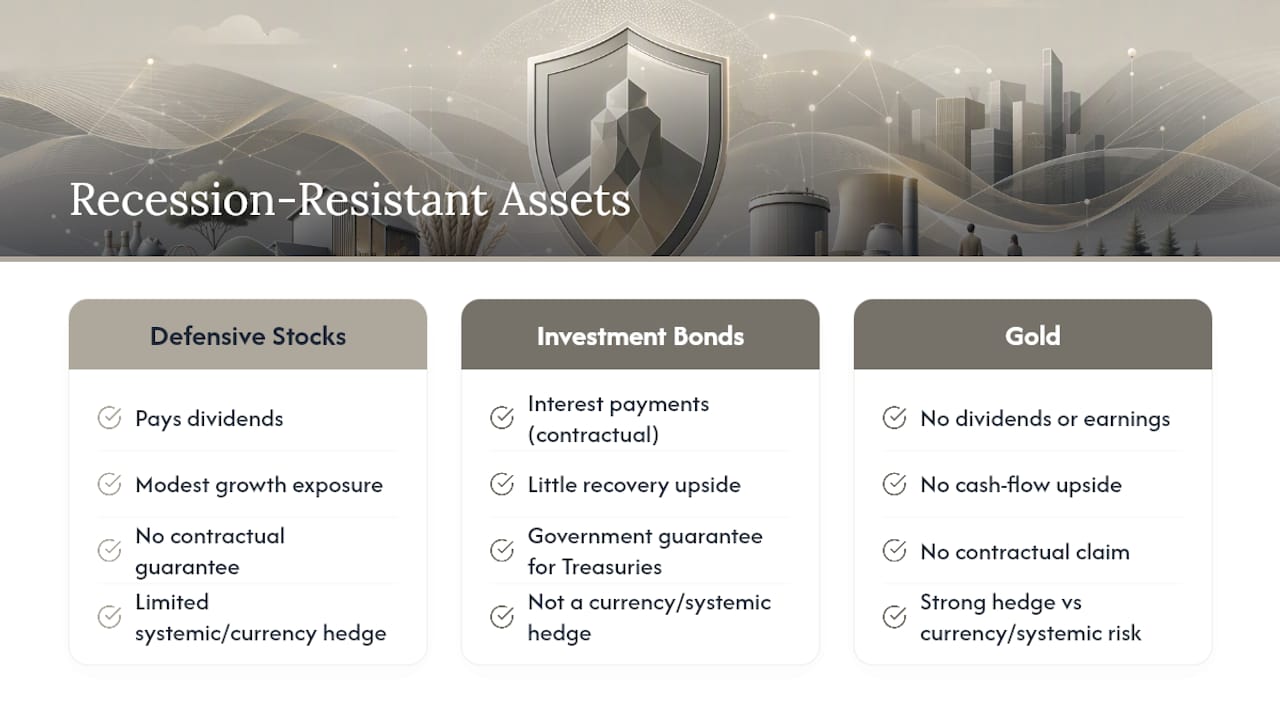
Defensive stocks aren't the only tool for cushioning a downturn, and they're not interchangeable with bonds or gold. Investment-grade bonds offer contractual interest payments and, in the case of Treasuries, a government guarantee that no stock can match. That safety comes at the cost of upside: bonds don't participate when the eventual recovery rally hits, while defensive stocks at least keep some exposure to that rebound.
Gold behaves differently again. It has no earnings, no dividend, and no cash flow to analyze, its value depends almost entirely on investor sentiment and currency dynamics rather than business fundamentals. That makes it a hedge against systemic fear rather than a substitute for the checklist-driven approach that works for individual stocks.
A blended approach tends to serve most portfolios better than picking one lane. Defensive stocks give you dividend income and modest growth potential; bonds give you contractual stability and ballast; gold gives you a hedge against scenarios where currencies and financial systems come under real stress. Treating any single asset class as the whole solution ignores how differently each one behaves once a recession actually arrives, since some recessions hit financial and credit markets harder than consumer demand, while others do the opposite.
Spotting the Next Wave of Recession-Resistant Names
The sectors that protected portfolios in past downturns won't automatically be the ones that protect the next one. Healthcare and staples earned their reputation over decades, but new categories are quietly building the same defensive traits. Data-center REITs are a good example: demand for cloud infrastructure has proven remarkably steady across economic cycles, and long-term leases with major tech tenants create the same contractually secured cash flow that traditional utilities offer.

Look for businesses solving problems that don't go away in a downturn, cybersecurity, essential software subscriptions, water utilities, and specialty pharmacy distribution all share the inelastic-demand trait even though none of them show up on a traditional "defensive stocks" list from a decade ago. The screening process doesn't change: check debt levels, free cash flow trends, and payout sustainability regardless of how new or unfamiliar the sector feels. A stock's age or industry label matters less than whether its revenue actually holds up when consumers and businesses cut spending elsewhere.
Rate-sensitive sectors deserve extra scrutiny right now. Utilities and REITs that looked rock-solid in a low-rate environment carry more interest-rate risk than their historical reputation suggests, so re-check their debt maturity schedules rather than assuming yesterday's defensive label still applies today.
Lessons From Past Downturns
During the 2008 to 2009 financial crisis, consumer staples and healthcare stocks declined less than the S&P 500 overall, though they still lost value, underscoring that "resistant" never meant "unaffected." Utilities held up reasonably well too, until credit markets froze and some highly leveraged utility operators found refinancing difficult, a reminder that even regulated cash flow doesn't erase balance-sheet risk.

The 2020 pandemic recession told a different story. It was short and demand-shock driven rather than credit-driven, and staples, healthcare, and grocery-anchored retail barely stumbled while travel, energy, and discretionary retail cratered. That divergence is exactly why sector-level resilience depends on what's actually causing the recession, a financial-crisis recession stresses different companies than a demand-shock recession does. The NBER, which officially dates U.S. recessions, doesn't classify recessions by cause, so investors have to make that judgment themselves when deciding which defensive names actually fit the moment.
The consistent thread across both episodes: companies with low debt and steady free cash flow going into the downturn came out the other side in better shape than highly leveraged peers in the same sector, regardless of how "defensive" the sector label sounded on paper.
Author's Take: Defense Without Abandoning Growth
A permanent defensive allocation makes sense for a lot of investors, but the size of that allocation should match your timeline, not your anxiety about the next headline. If you're decades from retirement, oversizing your defensive sleeve mostly just caps your long-term returns.
What deserves more attention is sequence-of-returns risk: a downturn hitting right before you need to draw on your portfolio does far more damage than the same downturn hitting ten years earlier. That's the real argument for defensive positioning near retirement, and for calm, scheduled rebalancing over reactive trading. For decisions that touch your entire allocation, it's worth reviewing your plan with a long-term investing framework or a qualified advisor rather than deciding it all in one anxious afternoon.
— Matt
Ready to put the checklist to work instead of just reading about it? Oracle Investments scores more than 260 stocks on profitability, valuation, and financial health, so you can compare candidates like Johnson & Johnson or Realty Income side by side and see exactly where each one's cash flow, debt, and payout ratios stand before you commit real money.
This article is general information, not a substitute for advice from a qualified financial advisor. Consult a qualified financial professional about your own circumstances before acting on anything here.
Sources
- Recession-Proof Investments: How They Work and Examples
- Defensive Stocks: Benefits, Risks, and Top Examples Explained
- Recession-Proof Stocks: Industries That Thrive During Recessions
- US Defensive Stocks: Complete Guide to 3 Recession-Resistant Sectors | Longbridge