
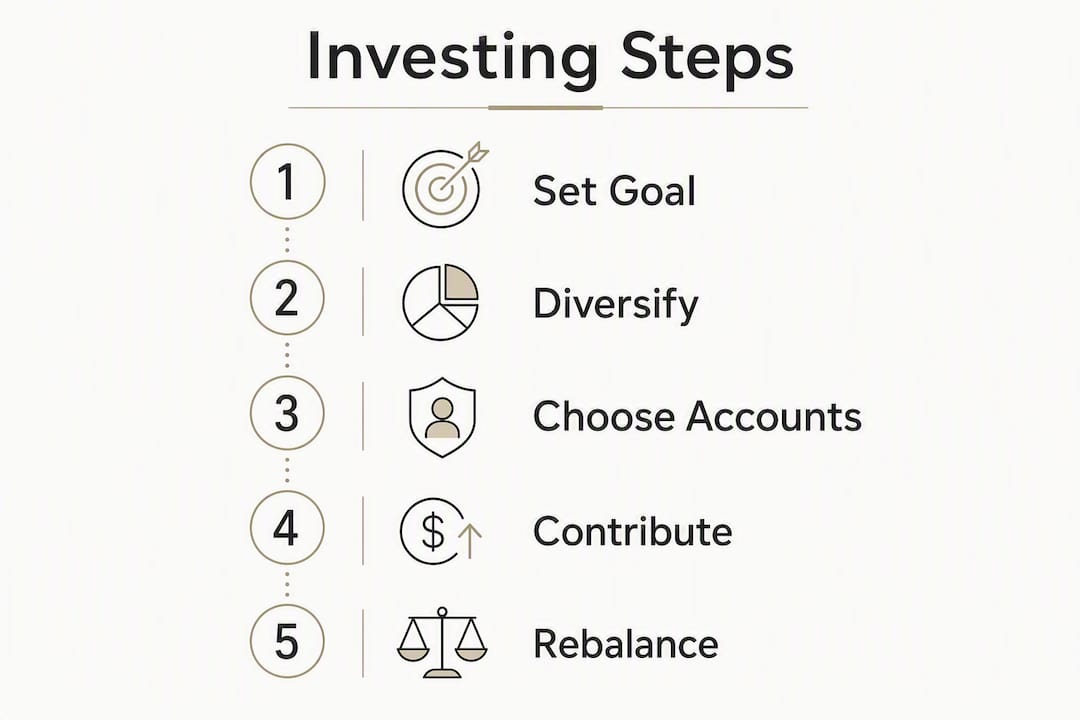
A solid long-term investing strategy comes down to five moves: set a specific goal, build a diversified low-cost core using index funds or ETFs, automate contributions so you never skip a month, rebalance once a year, and hold through the noise. That's it. Everything else is refinement.
A workable starter allocation for most beginners is: 60% total stock market ETF, 30% total bond ETF, 10% international ETF. If your horizon is 20-plus years and you can stomach a rough quarter without selling, tilt equity heavier. If retirement is within a decade, add bonds.
Two contribution approaches:
- Dollar-cost averaging (DCA): invest a fixed amount on a set schedule regardless of price. Psychologically easier and reduces regret when markets dip.
- Lump-sum: if you have a windfall and a long horizon, research from U.S. Bank shows lump-sum investing often outperforms DCA mathematically, though DCA wins on peace of mind.
Start here this week:
- Open a tax-advantaged account first: 401(k) up to the employer match, then a Roth IRA or traditional IRA.
- Pick one broad index ETF or a target-date fund as your core holding.
- Set up an automatic monthly transfer so contributions happen without a decision.
- The one metric to watch: asset allocation drift (how far your actual split has moved from your target).
Table of Contents
- What "long-term investing" actually means, and how it differs from trading
- The core principles that make long-term investing work
- How to build your long-term investing strategy step by step
- Sample portfolio allocations by risk profile
- Where to hold each goal: tax-advantaged accounts and asset location
- Costs, fees, and taxes that quietly erode long-term returns
- How to monitor performance, when to rebalance, and the tools that help
- Common investor mistakes and how to avoid emotional reactions
- How to start when you only have small amounts to invest
- Estate planning considerations for long-term investments
- Key Takeaways
- Why the conventional wisdom on long-term investing undersells the behavioral challenge
- Oracleinvestments makes the monitoring step concrete
- Useful sources and further reading
What "long-term investing" actually means, and how it differs from trading
Long-term investing means holding assets for years or decades to capture compounding and the underlying growth of businesses. Trading, by contrast, is frequent buying and selling to profit from short-term price moves, often over days or months.
The practical difference matters more than the definition. A trader needs to be right about price direction and timing, repeatedly. A long-term investor needs to be right about one thing: that the economy and the companies in it will be worth more in 20 years than they are today. History has consistently supported that second bet.
Typical time horizons map to goals this way:
- Retirement (20-40 years out): maximum compounding runway; can tolerate higher equity exposure.
- College funding (10-18 years): moderate horizon; shift toward bonds as the date approaches.
- Wealth transfer / estate (30+ years): longest horizon; growth-oriented with estate-planning overlay.
- Major purchase (3-7 years): borderline long-term; use a conservative allocation and avoid heavy equity exposure.
Finder's comparison of long-term vs. short-term investing notes that assets held longer than one year qualify for long-term capital gains tax treatment, a concrete financial advantage over short-term trading income taxed at ordinary rates.
This article covers portfolio design, account selection, rebalancing, and fees. It does not cover day-trading techniques, options strategies, or speculative positions.
The core principles that make long-term investing work
Six principles separate investors who build wealth from those who spin their wheels.
1. Time in the market beats timing the market. Compounding rewards patience in a way that's easy to underestimate. Put $10,000 in an account earning 8% annually and leave it alone: after 10 years you have roughly $21,589; after 30 years, roughly $100,627. The last decade does more work than the first two combined. Missing even a handful of the market's best days, which tend to cluster around its worst days, can cut that final number dramatically. Staying invested through downturns is how you capture those recoveries.
2. Diversification is the only free lunch. Spreading holdings across asset classes, geographies, and sectors reduces single-stock risk without necessarily reducing expected return. Fidelity describes diversification as the foundation of a sound allocation. A practical rule: keep any single stock below 5–10% of your total portfolio unless you have a specific, well-researched reason to concentrate.

3. Risk tolerance is personal and time-dependent. A 25-year-old with a 40-year horizon can ride out a 40% drawdown. A 58-year-old with $800,000 saved cannot afford to watch it drop to $480,000 and wait a decade for recovery. Match your allocation to your actual emotional and financial capacity to absorb losses, not to what you think you should tolerate.
4. Costs compound against you. Every dollar paid in fees is a dollar that stops compounding. A higher annual expense ratio on a portfolio can significantly reduce long-term growth compared to a lower expense ratio, assuming identical gross returns. Low-cost index funds and ETFs are the default choice for most long-term investors for exactly this reason.
5. Tax-aware account selection multiplies returns. Holding the right assets in the right accounts, a concept called asset location, can add meaningful return without changing your underlying investments. More on this in the accounts section below.
6. Periodic rebalancing controls drift. A portfolio that starts at 70/30 equity/bond can drift to 85/15 after a strong equity run, exposing you to more risk than you intended. Annual rebalancing keeps you honest. For a deeper look at how sequence-of-returns risk interacts with allocation, that's worth reading before you set your target split.
How to build your long-term investing strategy step by step
Fidelity's framework for building an investment strategy runs: goals → allocation → accounts → assets → rebalancing → professional help when needed. Here's that sequence made concrete.
The seven-step checklist
- Estimate required savings and returns — Use a compound interest calculator (Investor.gov has a free one). Assume a conservative long-term equity return of 6–7% real (after inflation) for planning purposes.
Timeline for new investors
| Timeframe | Action |
|---|---|
| This week | Open a 401(k) or IRA; pick one core ETF or target-date fund |
| First month | Enable automatic contributions; turn on dividend reinvestment (DRIP) |
| First year | Review allocation drift; confirm you're on track with your savings target |
Lump-sum vs. DCA: If you have a large amount to invest and a horizon of 10-plus years, lump-sum investing tends to outperform DCA because more money compounds for longer. If the thought of investing everything at once and watching it drop 20% in month one would cause you to sell, DCA is the better behavioral choice. U.S. Bank's analysis puts it plainly: both approaches are valid, and the right one is the one you'll actually stick with.
On expense ratios: when comparing funds, look at the total expense ratio (TER), not just the management fee. A fund charging 0.03% (like many Vanguard or iShares total-market ETFs) vs. one charging 1.0% is not a minor difference over 30 years.
Sample portfolio allocations by risk profile
These are illustrative starting points, not personalized recommendations. Adjust based on your actual timeline, income stability, and comfort with volatility.
| Risk Profile | Equities | Bonds | International / Alternatives | Example ETFs (illustrative only) |
|---|---|---|---|---|
| Conservative | 30% | 60% | 10% cash/short-term | BND, VGSH, VTI |
| Moderate | 60% | 30% | 10% international | VTI, VXUS, BND |
| Growth | 80% | 15% | 5% small-cap | VTI, VXUS, VBR, BND |
| Aggressive | — | 0% | 5% emerging markets | VTI, VXUS, VWO |
Asset allocation drives the majority of a portfolio's long-term return variability, more so than individual security selection in most cases. Getting this right matters more than picking the "best" individual stocks.
When to tilt:
- Dividend-focused: — useful for income-oriented investors or those approaching retirement who want cash flow without selling shares.
Target-date funds (e.g., Vanguard Target Retirement 2055) handle the allocation shift automatically as you approach your goal year. They're a legitimate "set it and forget it" option for investors who don't want to manage rebalancing themselves. The trade-off is a slightly higher expense ratio than building the same allocation from individual ETFs.
A core-and-satellite approach keeps 80–90% in low-cost index funds (the core) and allocates 10–20% to higher-conviction individual stocks or sector ETFs (the satellite). This lets you express views without betting the whole portfolio on them.
Where to hold each goal: tax-advantaged accounts and asset location
Choosing the right account type is one of the highest-leverage decisions in a long-term plan. The same investment held in a Roth IRA vs. a taxable brokerage account can produce meaningfully different after-tax outcomes over decades.
Account types and their primary uses:
- Roth IRA: — contributions are after-tax, but qualified withdrawals in retirement are completely tax-free. Best for investors who expect to be in a higher tax bracket later, or who want tax-free income in retirement.
Asset location in practice: place tax-inefficient assets (high-yield bonds, REITs, actively managed funds with high turnover) inside tax-advantaged accounts. Hold tax-efficient assets (broad index ETFs, municipal bonds) in taxable accounts where possible.
Holding assets for more than one year qualifies them for long-term capital gains rates, which are 0%, 15%, or 20% depending on income, compared to ordinary income rates that can reach 37%. That gap is a strong argument for the buy-and-hold approach on its own.
For authoritative guidance on contribution limits and eligibility rules, Investor.gov and the IRS website are the primary sources. Rules change annually, so confirm current limits before filing.
Costs, fees, and taxes that quietly erode long-term returns
The math here is unforgiving. A $100,000 portfolio growing at 8% gross annually:
- At 0.05% expense ratio: grows to approximately $957,000 over 30 years.
- At 1.0% expense ratio: grows to approximately $761,000 over 30 years.
That's roughly $196,000 lost to fees alone, on the same underlying market return. The compounding effect of costs works exactly like the compounding effect of returns, just in reverse.
The main cost categories to watch:
- Expense ratios: the annual percentage a fund charges to manage assets. Target below 0.20% for index funds; below 0.50% for actively managed funds if you use them.
- Transaction costs: most major brokerages now offer commission-free ETF trades, but bid-ask spreads still apply. Wide spreads on thinly traded ETFs add up.
- Advisory and management fees: a 1% AUM fee from a financial advisor is significant over decades. Fee-only advisors who charge flat or hourly rates are often more cost-effective for straightforward portfolios.
- Tax drag from fund turnover: actively managed mutual funds that trade frequently trigger capital gains distributions, which are taxable to shareholders even if they didn't sell. Tax drag from fund turnover can shave 1–2 percentage points off long-run returns; placing high-turnover funds inside tax-advantaged accounts and using tax-managed wrappers in taxable accounts materially improves net performance.
Practical steps to minimize costs:
- Use broad index ETFs with expense ratios under 0.10% for your core holdings.
- Choose a commission-free brokerage (Fidelity, Schwab, and Vanguard all offer this for their own ETFs).
- Avoid frequent rebalancing in taxable accounts; use new contributions to rebalance instead of selling.
- In taxable accounts, prefer ETFs over mutual funds because ETFs are generally more tax-efficient due to the in-kind creation/redemption mechanism.
Pro Tip: Watch for mutual fund capital gains distributions in November and December. Buying into a fund just before it distributes a large gain means you owe taxes on appreciation you didn't benefit from. Check the fund's estimated distribution before buying in taxable accounts late in the year.
How to monitor performance, when to rebalance, and the tools that help
Monitoring a long-term portfolio doesn't mean watching it daily. It means checking the right metrics at the right intervals and acting only when something meaningful has changed.

Metrics that matter for long-term investors:
Two rebalancing approaches:
- Calendar rebalancing: — review and rebalance once a year, on a fixed date. Simple, predictable, and sufficient for most investors.
Example: You target 70% equities, 30% bonds. After a strong equity year, your portfolio sits at 78% equities, 22% bonds. That 8-point drift exceeds the 5% threshold. You sell enough equities and buy bonds to restore the 70/30 split.
For tracking and stock scoring, Oracleinvestments offers a practical workflow: import your holdings, view each position's fundamental score (covering profitability, valuation, and financial health), and set alerts for allocation drift. For individual stock positions in a core-and-satellite portfolio, the scoring system surfaces whether a holding still meets the quality bar you set when you bought it. Portfolio analysis tools that combine tracking with fundamental scoring reduce the time between "something changed" and "I know what to do about it."
Wellington Management's framework argues that a 10-year holding ambition forces higher-quality selection: investors who commit to long horizons naturally focus on stewardship and durable competitive advantage rather than short-term sentiment. Scoring systems that surface profitability and financial health metrics help apply that discipline at the individual investor level.
When to consult a financial professional: when your situation involves significant complexity (estate planning, tax optimization across multiple accounts, business ownership, or an inheritance), a fee-only fiduciary advisor adds more value than their cost.
Common investor mistakes and how to avoid emotional reactions
Most long-term investing failures aren't analytical. They're behavioral. Financial planners consistently identify removing emotional noise as the primary long-term advantage of a disciplined, rules-based approach.
The predictable traps:
- Market timing: selling after a drop and waiting for a "better entry point." The problem is that the best days in the market tend to follow the worst days. Missing a handful of the top-performing days in a decade can cut long-run returns by more than half.
- Abandoning your allocation after a drawdown: the urge to "go to cash" during a crash feels rational in the moment. It locks in losses and leaves you on the sideline when the recovery happens.
- Chasing recent performance: buying whatever went up the most last year is a reliable way to buy high and sell low.
- Concentration risk: holding too much in a single stock or sector, often because it's a familiar company or an employer's stock. A single-stock blow-up can set a portfolio back years.
- Ignoring fees and taxes: the silent compounders working against you.
- Overconfidence after a winning streak: a few good picks in a bull market don't validate a stock-picking system. The market has a way of correcting that assumption.
For a detailed breakdown of the selection and behavioral errors new investors make most often, this guide to value investing mistakes is worth reading before you make your first individual stock purchase.
Practical safeguards:
- Automate contributions so investing happens regardless of how you feel about the market that week.
- Write down your investment policy statement: your target allocation, rebalancing rules, and the conditions under which you would sell a position. Refer to it before making any change.
- Before selling, run through this checklist: Has my goal or timeline changed? Has the fundamental thesis for this holding changed? Or am I reacting to a price move? If the answer to the first two is no, don't sell.
How to start when you only have small amounts to invest
Small balances are not a barrier. Fractional shares and zero-minimum index funds have made it possible to build a diversified portfolio with $50 a month. The habit of investing consistently matters far more than the starting amount.
A 90-day plan for small balances:
- Week 1: Open a Roth IRA or taxable brokerage account at a low-cost brokerage (Fidelity and Schwab both have no account minimums). If your employer offers a 401(k) with a match, enroll first and contribute enough to capture the full match.
- Week 2: Pick one fund as your core holding. A target-date fund (e.g., a 2055 fund if you're in your 20s) or a total stock market ETF like VTI are both solid starting points. Don't overthink it.
- Week 3: Set up an automatic monthly contribution, even if it's $25 or $50. The amount matters less than the habit.
- Month 2: Enable dividend reinvestment (DRIP) so any dividends automatically buy more shares.
- Month 3: Review your account once. Check that contributions are landing correctly. Don't check your balance every day.
- Day 90: Increase your automatic contribution by $10–$25 if your budget allows. Small increases compound significantly over years.
Fractional shares, available at most major brokerages, let you buy a slice of a high-priced ETF or stock without needing the full share price. This makes diversification accessible at any balance level.
The behavioral point here is simple: focus on contribution consistency, not on timing. An investor who puts in $200 a month for 30 years, rain or shine, will almost always outperform one who invests larger amounts sporadically while waiting for the "right moment."
Estate planning considerations for long-term investments
Long-term investing and estate planning intersect in ways that catch many investors off guard, often at the worst possible time.
Beneficiary designations override your will. The beneficiary named on your IRA, 401(k), and life insurance policy receives those assets directly, regardless of what your will says. Review and update these designations after major life events: marriage, divorce, the birth of a child, or the death of a named beneficiary.
The step-up in cost basis is one of the most valuable estate planning tools available. When appreciated assets in a taxable brokerage account are inherited, the cost basis resets to the market value at the date of death. Heirs who sell immediately owe no capital gains tax on the appreciation that occurred during the original owner's lifetime. Assets held in IRAs and 401(k)s do not receive this treatment; withdrawals are taxed as ordinary income.
Roth IRAs and estate planning: a Roth IRA passes to heirs income-tax-free, making it one of the most efficient assets to leave to the next generation. Under current rules, non-spouse beneficiaries must withdraw the full balance within 10 years, but those withdrawals remain tax-free.
Trusts and long-term portfolios: a revocable living trust can hold investment accounts and allows assets to pass to heirs without going through probate, which is public, slow, and costly. For larger portfolios or blended families, a trust structure often makes sense.
Annual gifting: the annual gift tax exclusion allows you to give a set amount per recipient per year without triggering gift tax. Gifting appreciated securities directly (rather than cash) to heirs in lower tax brackets can be a tax-efficient way to transfer wealth while you're alive.
Estate planning rules are complex and change with legislation. Consult a qualified estate attorney or financial planner to structure your specific situation correctly.
Key Takeaways
A consistent long-term investing strategy built on low-cost index funds, tax-advantaged accounts, automated contributions, and annual rebalancing is the most reliable path to building wealth steadily over decades.
| Point | Details |
|---|---|
| Start with tax-advantaged accounts | Fund your 401(k) to the employer match first, then a Roth or traditional IRA before using taxable accounts. |
| Allocation drives outcomes | Asset allocation explains most of a portfolio's long-run variability; set it deliberately and rebalance when drift exceeds 5%. |
| Costs compound against you | A 1% vs. 0.05% expense ratio gap on $100,000 can cost roughly $196,000 over 30 years at the same gross return. |
| Automate to override emotion | Automatic contributions remove the decision of whether to invest during downturns, which is when most investors make costly mistakes. |
| Oracleinvestments for tracking and scoring | Use Oracleinvestments to score holdings on profitability, valuation, and financial health, and to monitor allocation drift in real time. |
Why the conventional wisdom on long-term investing undersells the behavioral challenge
Most long-term investing guides make the strategy sound easy: buy index funds, hold them, rebalance once a year. And mechanically, it is easy. The hard part is the 20-year stretch in the middle where you watch your portfolio drop 35% in a bear market, read headlines about why "this time is different," and still do nothing.
What the standard advice underweights is that the strategy only works if you actually execute it during the moments when every instinct tells you to stop. The 2008–2009 financial crisis, the March 2020 COVID crash, the 2022 rate-driven selloff: each of those was a test of whether investors would stay the course. The ones who did recovered and then some. The ones who sold locked in losses and often missed the recovery entirely.
There's a second thing most guides miss: the quality of what you hold matters more as your balance grows. A $5,000 portfolio in a total-market ETF is fine. A $500,000 portfolio with 15% in a single speculative position is a different risk profile entirely. Wellington's institutional framework makes this point well: a genuine long-term holding ambition forces you to ask harder questions about stewardship and durable competitive advantage, not just whether a stock is cheap today. Tools that score companies on fundamental health, the way Oracleinvestments does, help individual investors apply that same discipline without needing a research team.
The simplest version of the advice still holds: automate, diversify, minimize costs, and don't touch it. But understanding why that's hard, and building systems to protect yourself from your own reactions, is what separates investors who actually get there from those who perpetually restart.
Oracleinvestments makes the monitoring step concrete
Knowing what to monitor is one thing. Having a tool that surfaces the right signals without drowning you in data is another. Oracleinvestments scores over 260 stocks across profitability, valuation, and financial health, the same fundamentals institutional investors use, and presents them in a format you can act on in seconds.
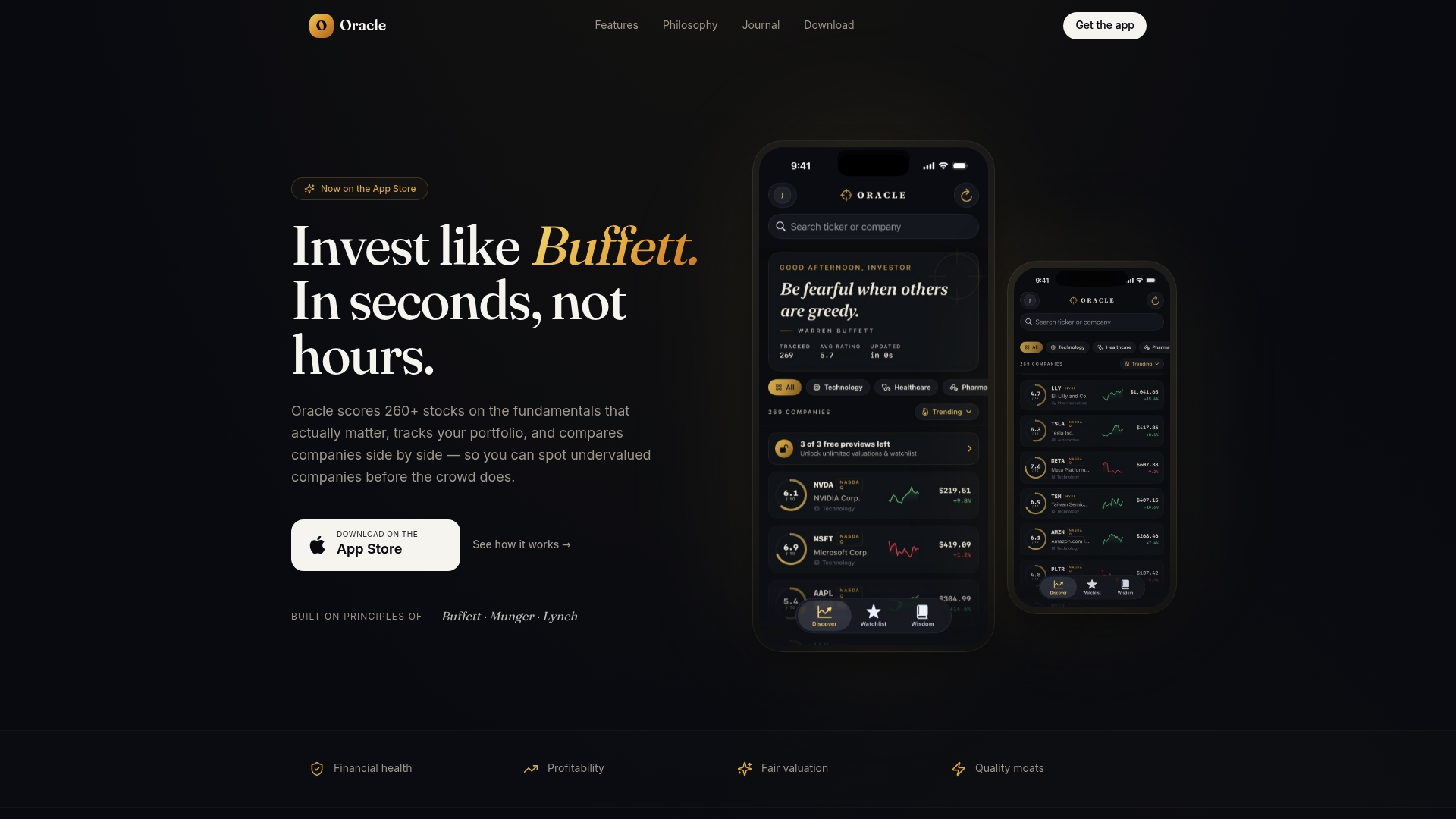
For investors running a core-and-satellite portfolio, the workflow looks like this: in week one, import your individual stock holdings and review each position's score. Any holding that scores poorly on financial health or valuation relative to peers is a candidate for review, not necessarily a sell, but a flag worth investigating. Set an alert for allocation drift so you're notified when your equity/bond split moves beyond your threshold. Use the side-by-side comparison feature to evaluate whether a new position improves or dilutes your portfolio's overall quality score.
The app integrates investment principles from Warren Buffett, Charlie Munger, and Peter Lynch, so the scoring methodology isn't arbitrary. It reflects the same criteria these investors have used to identify durable businesses over decades.
Real-time portfolio tracking means you're not waiting for a quarterly statement to notice that one position has grown to 18% of your portfolio. You see it when it happens and can decide whether to act.
Start using Oracleinvestments to score your current holdings and set up your monitoring workflow today.
Useful sources and further reading
The sources below back the claims in this article and are worth bookmarking for ongoing reference.
For tax and account rules (IRS/SEC):
- Build Wealth Over Time Through Saving and Investing | Investor.gov: the SEC's investor education hub; covers contribution limits, account types, and foundational investing principles. Start here for anything related to account rules.
For portfolio construction and strategy:
- 6 Steps to Building an Investment Strategy | Fidelity: covers goal-setting, allocation, accounts, and rebalancing in a practical sequence.
- Buy-and-Hold Investing: A Long-Term Strategy Guide | U.S. Bank: explains the buy-and-hold approach, DCA vs. lump-sum, and staying invested through volatility.
- Buy and Hold Investing | Fidelity: covers tax efficiency of long holding periods and dividend reinvestment implications.
- Difference Between Investing and Trading | Fidelity: clear explanation of the time-horizon distinction and what each approach requires.
- Long-Term vs. Short-Term Investment | Finder: useful comparison of tax treatment, time commitment, and strategy differences.
- Putting Long-Term Investing Into Context | Wellington Management: institutional perspective on why a 10-year holding ambition changes how you evaluate companies.
- Difference Between Investing and Trading | Investopedia: explains why removing emotional noise is the primary long-term advantage of a disciplined approach.
From the Oracle Journal (deeper dives on specific topics):
- Sequence of Returns Risk: What Stock Investors Must Know: critical reading before you set your allocation near retirement.
- How to Track Portfolio Performance Like a Pro: step-by-step guide to setting up performance dashboards and tracking the metrics that matter.
- 5 Value Investing Mistakes Beginners Make: covers the behavioral and selection errors that derail new investors most often.
This article is general educational information, not personalized financial or tax advice. Confirm current account limits, tax rules, and eligibility requirements with the IRS, SEC, or a qualified financial professional before making decisions.