
The single most important move you can make right now is to lock your essential expenses behind guaranteed income, park 1–3 years of spending in cash or short-term Treasuries, and keep a meaningful equity sleeve to fight inflation and longevity. Everything else in retirement portfolio management flows from those three decisions.
Your immediate action checklist:
- Step 1: Add up your monthly essential spending (housing, food, healthcare, utilities) and compare it to your guaranteed income (Social Security, pension). The gap is what your portfolio must cover.
- Step 2: Confirm you have at least 12 months of total expenses sitting in liquid cash or a money-market fund. Twelve months is the floor; 24–36 months is safer in the first five years of retirement.
- Step 3: Set a target equity allocation and write it down. If you have not done this, the sections below give you specific ranges by retirement stage.
Quick self-check before you read further:
- Do you have at least one year of expenses in liquid cash or an FDIC-insured account?
- Do your guaranteed income sources (Social Security, pension) cover your essential monthly bills?
- Do you have a written target allocation you review at least once a year?
If you answered "no" to any of these, the sections below are where to start.
Key Takeaways
A sound retiree investing strategy pairs a guaranteed income floor for essential expenses with a liquidity buffer of 1–3 years and a growth-oriented equity sleeve sized to your horizon and inflation needs.
| Point | Details |
|---|---|
| Income floor first | Cover essential expenses with Social Security, pensions, or annuities before asking the portfolio to do that job. |
| Cash buffer is non-optional | Hold 1–3 years of total expenses in liquid cash or short-term Treasuries to avoid forced selling during downturns. |
| Keep equities in the mix | Advisors recommend 40%–70% equities in early retirement to address longevity and inflation over a 30-year horizon. |
| Tax diversification saves money | Sequence withdrawals across traditional, Roth, and taxable accounts; model Roth conversions during low-income years before RMDs begin. |
| Review annually, rebalance on drift | Check allocation drift every year and rebalance inside tax-advantaged accounts when any asset class moves more than 5 points off target. |
The income-first case is stronger than most retirees realize
Most retirement articles spend the bulk of their space on accumulation: save more, invest early, maximize your 401(k). The distribution phase gets a fraction of that attention, even though the decisions made in the first five years of retirement have more impact on long-term outcomes than almost anything that happened in the 30 years before.
The income-floor approach is not conservative in the pejorative sense. Locking essential expenses behind guaranteed income and keeping a liquidity buffer is what allows you to hold a meaningful equity allocation without panic-selling during a crash. The retirees who abandon stocks at the worst moment are almost always the ones who did not have a cash buffer and had no guaranteed income covering their bills. The structure removes the pressure; the structure is what makes the growth sleeve sustainable.
What I find underappreciated in most retirement planning conversations is the interaction between tax sequencing and withdrawal strategy. Getting the allocation right matters. Getting the tax order wrong can cost as much as a bad investment decision, sometimes more, especially once RMDs and IRMAA surcharges enter the picture. Model the conversions before you need them, not after.
If the complexity of coordinating Social Security timing, Roth conversions, asset location, and rebalancing feels like too many moving parts to manage alone, that is a reasonable signal to bring in a CFP who operates as a fiduciary. Use the question checklist above to screen them. For tracking your allocation and monitoring portfolio drift between advisor meetings, Oracleinvestments at Oracleinvestments offers stock scoring, real-time portfolio tracking, and educational resources built around the kind of fundamental, evidence-based investing that holds up across market cycles.
The checklists in this article are designed to be used, not just read. Print the one that applies to where you are right now and work through it before your next plan review.
This article is general information, not a substitute for advice from a qualified financial advisor. Consult a qualified financial professional about your own circumstances before acting on anything here.
Table of Contents
- What does a solid retiree investing strategy actually look like?
- How should you allocate assets to balance income, growth, and inflation?
- How to build a cash reserve and short-term bond ladder
- What withdrawal rate is actually safe, and how do you sequence withdrawals?
- How does tax diversification work in retirement?
- How often should you rebalance and monitor your portfolio?
- Which investment vehicles work best for retirees?
- When should you hire a financial advisor, and what should you ask?
- Common retirement investing mistakes and how to avoid them
- Practical tools to stress-test your retirement plan
- Sources
What does a solid retiree investing strategy actually look like?
Vanguard's research frames it plainly: retirement security depends more on income predictability than on a single final account balance. That reframes the whole game. You are no longer trying to maximize a number. You are trying to build a machine that pays you reliably for 30 or more years without running dry.
The first step in any investment strategy for retirees is separating what you must spend from what you want to spend.
Essential spending covers housing (mortgage or rent, property taxes, insurance), food, healthcare premiums and out-of-pocket costs, utilities, and transportation. These bills arrive every month whether markets are up or down.
Discretionary spending covers travel, dining, hobbies, gifts, and home improvements. These are real and worth planning for, but they can flex when a market drops 30%.
How to calculate your income gap
Here is a simple framework:
- Total monthly essential spending: $X
- Total monthly guaranteed income (Social Security + pension): $Y
- Portfolio gap = X minus Y
If your essential spending is $5,000 a month and Social Security plus a small pension covers $3,200, your portfolio needs to generate $1,800 a month in reliable income. That number drives every allocation decision you make.
Checklist for estimating your needs:
- List every fixed monthly expense and categorize it as essential or discretionary
- Pull your Social Security statement from SSA.gov and confirm your benefit at your planned claiming age
- Add any pension or annuity income
- Subtract guaranteed income from essential spending to find the gap
- Multiply the monthly gap by 12 to get your annual portfolio income requirement
Timeline matters enormously. A 62-year-old retiring today should plan for a 30-year horizon as a baseline. The Social Security Administration's actuarial tables show that a 65-year-old woman has roughly a 50% chance of living past 85. Plan for the longer scenario, not the average. A shorter horizon (say, a 75-year-old in good health) still warrants a 15–20 year plan.
Pro Tip: *Before you finalize your spending targets, run a 3-month real-life trial. Track every dollar you actually spend, not what you think you spend.
When does buying an annuity make sense?
The decision checklist:
- Your guaranteed income (Social Security + pension) covers less than 80% of essential spending
- You are in good health and your family history suggests longevity past 85
- You have enough liquid assets that annuitizing a portion does not leave you cash-poor
- You are willing to accept reduced liquidity in exchange for lifetime income certainty
| Income source | Lifetime guarantee | Inflation protection | Liquidity | Flexibility |
|---|---|---|---|---|
| Guaranteed government benefits | Yes | Partial (COLA) | None | None |
| Employer pension | Yes | Varies by plan | None | Limited |
| Purchased income products (SPIA) | Yes | Optional rider | None | Very low |
| Portfolio withdrawals | No | Depends on allocation | High | High |
The trade-off is real. Annuities give you certainty but lock up capital. Portfolio withdrawals give you flexibility but expose you to sequence-of-returns risk. Most retirees benefit from a blend rather than an all-or-nothing choice.

The guaranteed floor removes the pressure to sell equities during a downturn, which is exactly when selling does the most damage to a long-term plan.*
How should you allocate assets to balance income, growth, and inflation?
The old rule of "100 minus your age in stocks" produces allocations that are far too conservative for a 30-year retirement. Modern advisor consensus now recommends maintaining equity exposure of roughly 40%–80% in early retirement to address longevity risk and inflation. Being too conservative raises the probability of running out of money, not lowering it.
Here is how allocation ranges typically shift across retirement stages:
Vanguard's retirement guidance recommends matching your asset mix to your timeline and risk tolerance, with stocks, bonds, and cash all playing a role across a multi-decade horizon.
Three model portfolio profiles
This profile accepts lower long-term returns in exchange for stability.
This is the most common profile for a healthy 65-year-old.
The guaranteed income floor is what makes this allocation sustainable, because essential bills are covered regardless of what markets do.
TIPS (Treasury Inflation-Protected Securities) help, but they do not replace the long-term growth that equities provide.
Pro Tip: Size your equity sleeve by working backward from your withdrawal rate. The more your income floor covers, the more risk your growth sleeve can take.
How to build a cash reserve and short-term bond ladder
The bucket strategy keeps 1–3 years of living expenses in immediate liquidity so you never have to sell equities at a loss to pay next month's grocery bill. It is one of the most psychologically powerful structures in retirement portfolio management.
How many years of cash to hold:
- If guaranteed income covers 90%+ of essential spending, 12 months of total expenses in cash is sufficient.
- If guaranteed income covers 60%–80% of essential spending, hold 18–24 months.
- If guaranteed income covers less than 60%, hold 24–36 months, especially in the first five years of retirement when sequence-of-returns risk is highest.
Building the ladder, step by step:
- Immediate bucket (0–12 months): Hold in a high-yield savings account or money-market fund at an FDIC-insured bank. This covers day-to-day spending without any market exposure.
- Near-term bucket (12–36 months): Build a ladder of 3-month, 6-month, 12-month, and 24-month Treasury bills or CDs. As each rung matures, roll it forward or spend it, depending on what the market has done.
- Growth bucket (36+ months): Invested in your target equity and bond allocation. This is the sleeve that fights inflation and longevity over the long run.
Illustrative ladder example:
- Month 1–12: $60,000 in a high-yield savings account (assuming $5,000/month spending)
- Month 13–24: $30,000 in 12-month T-bills purchased today
- Month 25–36: $30,000 in 24-month T-bills purchased today
- Month 37+: Growth portfolio (equities, intermediate bonds, TIPS)
Practical placement tips:
- Hold the immediate cash bucket in a taxable account for easy access; interest is taxable, but liquidity matters more here.
- Hold the T-bill or CD ladder in a taxable account or a Roth IRA, depending on your tax situation. Roth is ideal if you expect to be in a higher bracket later.
- Replenish the ladder annually, ideally by trimming the growth bucket after a strong market year, never after a down year.
What withdrawal rate is actually safe, and how do you sequence withdrawals?
It is a useful starting benchmark, not a guarantee.
- High equity valuations at the start of retirement reduce expected future returns, which lowers the sustainable withdrawal rate.
- Horizons longer than 30 years (a 60-year-old couple, for example) push the failure probability higher.
- Inflexible spending during a market downturn accelerates portfolio depletion.
Dynamic alternatives that work better in practice:
- Guardrails approach: Set an upper spending limit (say, 5% of portfolio) and a lower floor (3%). If the portfolio grows, you can spend more. If it drops, you cut discretionary spending temporarily.
- Spending bands: Define a "normal" spending level and a "reduced" level. When the portfolio drops more than 15% from its peak, shift to the reduced level until it recovers.
- Proportional withdrawal: Withdraw a fixed percentage of the current portfolio value each year rather than a fixed dollar amount. Spending fluctuates, but the portfolio never gets depleted by a fixed draw during a crash.
Early losses shrink the base from which the portfolio recovers, and withdrawals during the drop lock in those losses permanently. This is why the liquidity ladder matters most in the first 5–10 years. For a deeper look at how this plays out mathematically, the sequence-of-returns risk explainer on the Oracleinvestments blog walks through the mechanics with concrete scenarios.
Pro Tip: For the first 5–10 years of retirement, use this sequencing rule: spend from cash first, replenish cash from bonds when markets are flat or down, and replenish from equities only after a recovery year. This simple rhythm keeps you from selling stocks at the worst possible time.
How does tax diversification work in retirement?
Most retirees hold money in three types of accounts, and the order you draw from them determines how much of your own money you actually keep.
The three tax buckets:
- Traditional (pre-tax): 401(k), traditional IRA. Withdrawals are taxed as ordinary income. Required Minimum Distributions (RMDs) begin at age 73 under current law.
- Roth (after-tax): Roth IRA, Roth 401(k). Qualified withdrawals are tax-free. No RMDs during the owner's lifetime.
- Taxable brokerage: Interest and dividends taxed annually; long-term capital gains taxed at 0%, 15%, or 20% depending on income.
The standard withdrawal sequence (taxable first, then traditional, then Roth) works in many cases, but it is not always optimal. Spending down traditional accounts too slowly leads to large RMDs later that push you into higher brackets and trigger Medicare IRMAA surcharges.
When Roth conversions make sense:
- The years between retirement and age 73 (when RMDs begin) are often the lowest-income years of a retiree's life. That window is the prime conversion opportunity.
- Convert enough each year to fill your current tax bracket without crossing into the next one.
- Watch the Medicare IRMAA thresholds. A conversion that pushes your modified adjusted gross income above the threshold can add hundreds of dollars per month to your Part B and Part D premiums, with a two-year lookback.
Roth conversion decision checklist:
- What is your current marginal tax rate?
- What will your RMDs be at 73, and what bracket will they push you into?
- Will a conversion trigger IRMAA this year or in two years?
- Do you have cash outside the IRA to pay the conversion tax (paying from the IRA itself reduces the benefit)?
- Is your estate large enough that heirs would benefit from inheriting a Roth rather than a traditional IRA?
Pro Tip: Model your conversions with a spreadsheet or a tool like the one at Oracleinvestments before committing. The goal is to fill your current bracket to its ceiling, not cross it. Even a $5,000 overshoot can cost more in IRMAA than the conversion saves in future taxes.
How often should you rebalance and monitor your portfolio?
Rebalancing inside tax-advantaged accounts avoids triggering capital gains, making your 401(k) or IRA the most efficient place to restore target allocations. In taxable accounts, rebalancing requires attention to long-term versus short-term gains.
A practical monitoring cadence for most retirees:
- Annual review (every January or on your retirement anniversary): Check actual allocation against targets, review spending versus plan, confirm the liquidity buffer is fully funded, and update assumptions for any major life changes (health, family, tax law).
- Threshold-based rebalancing: Rebalance whenever any asset class drifts more than 5 percentage points from its target. This prevents the portfolio from becoming unintentionally aggressive after a strong equity run or unintentionally conservative after a crash. The portfolio drift guide at Oracleinvestments covers how to spot and fix drift efficiently.
- Event-triggered reviews: A major health change, the death of a spouse, a large inheritance, or a significant tax-law change each warrants an immediate plan review, not a wait until January.
Monitoring checklist:
- Actual spending vs. planned spending (flag if over by more than 10%)
- Current allocation vs. target allocation (flag if any class is off by more than 5 points)
- Liquidity buffer: is it still 12–36 months of expenses?
- RMD status: have you taken the required amount for the year?
- Beneficiary designations: are they current?
- Insurance coverage: are healthcare and long-term care policies still adequate?
Behavioral safeguards: The most expensive retirement mistake is usually not a bad investment. A written investment policy statement (IPS), a one-page document that states your target allocation, your rebalancing rules, and your withdrawal plan, gives you something to read before you call your broker in a panic. Commit to a 48-hour waiting period before making any allocation change during a market drop.
Which investment vehicles work best for retirees?
The right vehicle depends on what you need it to do: generate income, protect against inflation, minimize taxes, or preserve liquidity.
Broad categories and their roles:
- Broad-market equity funds and ETFs: Low-cost, diversified exposure to U.S. and international stocks. The core of the growth sleeve. Total-market index funds with expense ratios below 0.10% are the standard benchmark.
- Dividend-focused ETFs: Provide income alongside growth. Useful for retirees who prefer cash flow over total-return withdrawals, though dividend income is not free of tax.
- Short- and intermediate-term bond funds: Reduce volatility and provide income. Intermediate-term (5–7 year duration) bonds balance yield and interest-rate sensitivity.
- TIPS (Treasury Inflation-Protected Securities): Principal adjusts with CPI. Ideal for the portion of the portfolio dedicated to inflation protection. Best held in tax-advantaged accounts because the inflation adjustment is taxable annually even if not paid out.
- Municipal bonds: Interest is generally exempt from federal income tax and often state tax for in-state residents. Most useful for retirees in the 22% bracket or higher with significant taxable account assets.
- Income annuities (SPIAs, DIA): Not an investment vehicle in the traditional sense, but a risk-transfer tool. Converts capital into guaranteed lifetime income. Appropriate for covering the essential-spending gap that Social Security and pensions do not fill.
Account placement rules:
- Hold TIPS and bond funds in tax-advantaged accounts (traditional IRA, 401(k)) to defer or avoid tax on interest and inflation adjustments.
- Hold broad-market equity index funds in taxable accounts where qualified dividends and long-term gains receive preferential rates.
- Hold municipal bonds in taxable accounts where their tax exemption has the most value.
- Hold Roth accounts for your highest-growth assets, since those gains are never taxed.
A dividend-based three-bucket plan, as illustrated in income-focused portfolio designs, can generate steady monthly cash flow when sized to your actual spending needs, though the required capital varies significantly with current yields and your withdrawal rate.
When should you hire a financial advisor, and what should you ask?
Not every retiree needs a full-service financial advisor, but certain situations make professional help worth the cost.
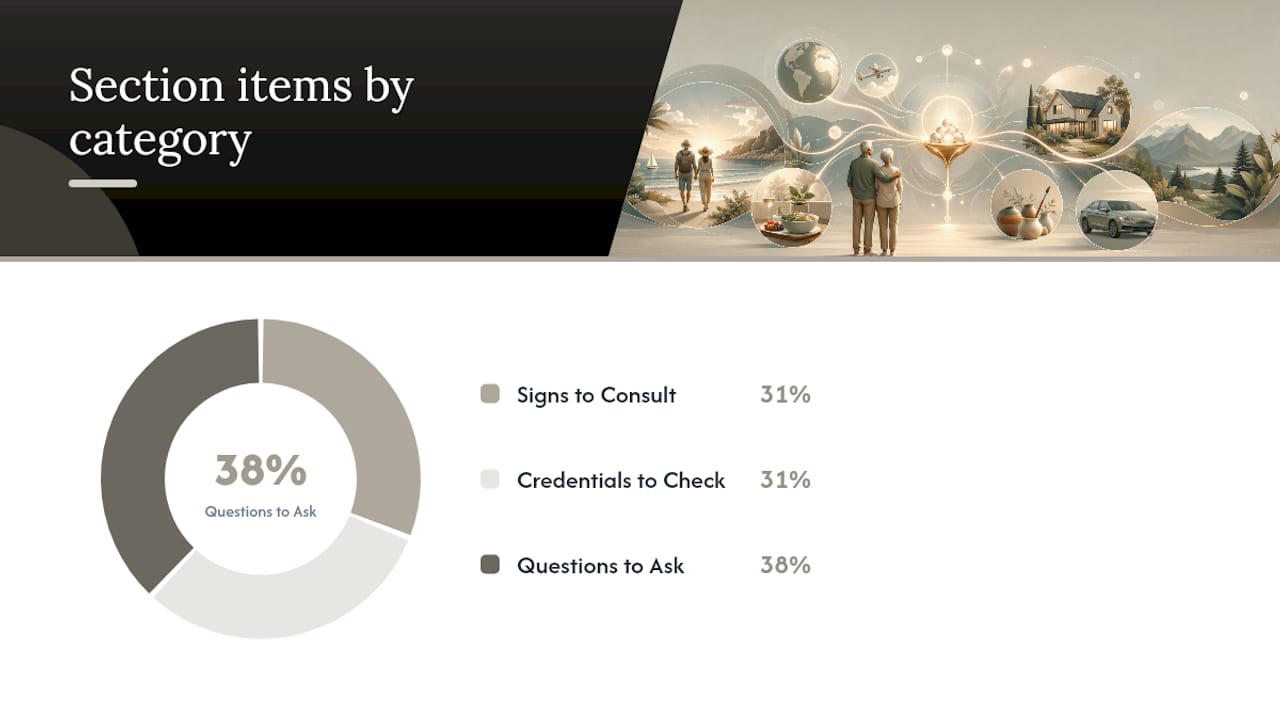
Signs you should consult a CFP or fiduciary advisor:
- Your tax situation involves multiple income sources, large traditional IRA balances, and Roth conversion decisions that interact with Medicare IRMAA
- You are making a large annuity or pension lump-sum decision (these are often irreversible)
- Your estate includes a business, real property, or complex beneficiary structures
- You find yourself making emotional allocation changes during market downturns
- You have never built a written withdrawal plan and are within five years of retirement
Credentials and protections to verify:
- CFP (Certified Financial Planner): Requires education, examination, experience, and an ethics commitment. The CFP Board's website lets you verify any CFP's status and disciplinary history.
- Fiduciary duty: A fiduciary is legally required to act in your interest, not their firm's. Ask directly: "Are you a fiduciary 100% of the time for all advice you give me?" Some advisors are fiduciaries only for certain account types.
- FINRA BrokerCheck: Search any broker or advisor at FINRA BrokerCheck to see their registration history, complaints, and disciplinary actions.
- SIPC coverage: Protects brokerage accounts against broker-dealer failure (not market losses) up to specified limits. Verify that your custodian is a SIPC member before transferring assets.
- FDIC insurance: Confirm that cash held in bank accounts (savings, CDs, money-market deposit accounts) is at an FDIC-insured institution and within coverage limits.
Questions to ask any advisor before hiring:
- Are you a fiduciary for all advice, all the time?
- How are you compensated? (Fee-only, fee-based, or commission?)
- What conflicts of interest do you have, and how do you manage them?
- Can you show me a sample retirement income plan you have built for a client in a similar situation?
- What credentials do you hold, and where can I verify them?
- How often will we meet, and what triggers an unscheduled review?
Common retirement investing mistakes and how to avoid them
FINRA warns that the move from accumulation to distribution requires a different discipline, and that overspending early in retirement is one of the most common and costly errors retirees make. It compounds with sequence-of-returns risk in the worst possible way: you spend more right when markets may be down, locking in losses and shrinking the base permanently.
The most expensive mistakes, and how to avoid each:
- Overspending in early retirement: The first five years set the trajectory. Stick to your planned withdrawal rate even when markets are strong and you feel flush. Use guardrails, not feelings.
- Going all-cash or all-bonds: This feels safe but destroys purchasing power over 20–30 years. Maintain a meaningful equity allocation sized to your income floor and horizon.
- Ignoring sequence-of-returns risk: A 25% drop in year two is not the same as a 25% drop in year 15. The liquidity ladder and the guardrails approach exist specifically to absorb early-retirement downturns.
- Failing to diversify tax buckets: Holding everything in a traditional IRA means every dollar you spend is taxed as ordinary income. Build or maintain Roth and taxable accounts alongside pre-tax assets.
- Neglecting healthcare and long-term care costs: The average couple retiring at 65 can expect to spend over $300,000 on healthcare in retirement, according to Fidelity's annual estimate. Long-term care costs are on top of that. Budget for both, and consider long-term care insurance or a hybrid life/LTC policy before health changes make coverage unavailable.
- Skipping annual plan reviews: A plan built at 65 needs updating at 70, 75, and after every major life event. Markets change, tax laws change, and your spending changes.
Do-not-do checklist for emotional market events:
- Do not sell equities during a correction without checking whether your liquidity buffer is still intact
- Do not change your target allocation based on news headlines
- Do not skip your annual review because "everything seems fine"
- Do not ignore RMDs; the penalty for missing one is 25% of the amount not withdrawn
- Do not assume your spending will decrease in later retirement; healthcare costs typically rise
Practical tools to stress-test your retirement plan
SmartAsset's retirement planning framework recommends reviewing and stress-testing your plan regularly, not just at inception.
Tool types and what to test with each:
- Retirement income calculators: Input your current savings, expected Social Security, planned withdrawal rate, and expected return. Test what happens if returns are 2% lower than expected or if you live 10 years longer than planned. The Social Security Administration's online estimator is a free starting point.
- Monte Carlo simulators: Run thousands of market scenarios to estimate the probability that your portfolio lasts 30 years. A result above 85%–90% success rate is generally considered acceptable; below 75% warrants a plan adjustment. Many brokerage platforms include these tools at no cost.
- Sequence-of-returns simulators: Test what happens if a major market drop occurs in year one versus year ten of retirement. This is the most important stress test for early retirees.
- Roth conversion modeling tools: Model the tax impact of converting $10,000, $20,000, or $50,000 per year from a traditional IRA to a Roth. Compare the tax cost today against the projected RMD tax burden at 73.
- Portfolio tracking dashboards: Monitor allocation drift, income generated, and spending versus plan in real time. Oracleinvestments offers portfolio analysis tools that score stocks on fundamentals and track allocation, which is useful for retirees who hold individual equities alongside funds.
How to use tools to set your annual review agenda:
- Run a Monte Carlo simulation each January and note whether your success rate has moved more than 5 points in either direction.
- Check your actual withdrawal rate against your planned rate. If you are withdrawing more than planned, identify whether it is a one-time event or a structural overspend.
- Update your longevity assumption if your health has changed significantly.
- Keep a simple spreadsheet or document that records your target allocation, your actual allocation, your withdrawal rate, and your liquidity buffer balance. Review it at every annual meeting, whether with an advisor or on your own.
Sources
These are the primary sources behind this article's guidance. Each one is worth bookmarking for ongoing reference.
- Vanguard principles retirement income (PDF)
- In retirement, your equities exposure is the make-or-break factor
- SIPC