
A net net stock trades below its net current asset value (NCAV), meaning the market prices the company for less than what would remain if it liquidated its current assets and paid off all its liabilities. That gap is your margin of safety, not a guarantee. The strategy has produced strong historical returns, but only when investors underwrite asset quality and spread bets across enough names to survive the losers.
TL;DR:
- Many net-net stocks trade below two-thirds of their NCAVPS, but strict discipline and diversification are essential to avoid the high risk of business deterioration.
- Investors must verify all balance sheet figures against primary filings and consider factors like receivables quality and inventory obsolescence to prevent value traps.
- A broad basket of 20 to 30 small, thinly traded stocks is recommended, with initial positions around 2% to 4% of the portfolio and rebalancing after earnings updates.
- Automated screening tools can speed identification but do not replace thorough analysis of footnotes, cash flow trends, and management changes.
- Net-net investing favors disciplined, rule-based execution and is unsuitable for those needing quick liquidity or unwilling to study detailed financial statements.
Table of Contents
- What Is Net Current Asset Value (NCAV)?
- Why Have Net-Net Stocks Historically Outperformed?
- How Do You Screen for Net-Net Stocks Today?
- What Underwriting Checks Matter Beyond the Screen?
- How Many Net-Net Stocks Should You Hold?
- Where Can You Find Current Net-Net Candidates?
- Who Should Actually Run a Net-Net Strategy?
- Automate the Screening, Not the Judgment
- Sources
- FAQ
What Is Net Current Asset Value (NCAV)?
Net current asset value strips a company down to its most liquid, verifiable resources and compares them against everything it owes. Benjamin Graham built his entire net-net framework around this number because current assets, cash, receivables, inventory, are far harder to fake or overstate than goodwill or intangible assets sitting on the balance sheet.
The core formulas:
- NCAV = Current Assets − Total Liabilities (including preferred stock)
- NCAVPS (per share) = NCAV / Shares Outstanding
- NNWC (Net Net Working Capital, the conservative version) applies haircuts: count 75% of accounts receivable and 50% of inventory, per Investopedia's net-net framework, to avoid overstating what a fire sale would actually recover.
Here's a quick example. Say a company has $50 million in current assets, $8 million in total liabilities, and 10 million shares outstanding. NCAV comes to $42 million, and NCAVPS is $4.20. Graham's rule says you want to pay about two-thirds of that figure or less, so you'd be hunting for shares trading around $2.77 or below.
Why Have Net-Net Stocks Historically Outperformed?
Graham's logic was simple: a company priced below its liquidation value is either mispriced or genuinely dying, and statistically, more of them turn out mispriced than dying. A State University of New York study tracking the 1970 to 1983 period found that a portfolio built on Graham's NCAV rule returned roughly 29.4% annually on a one-year holding basis. That's a striking number, but it comes from an era before algorithmic screening, when inefficiencies in small, ignored stocks lasted longer.
Institutional voices add necessary friction to that enthusiasm. Brown Advisory's research argues that a low price alone never justifies a purchase. The distinction that matters: is the market's pessimism temporary or structural?
- Screens surface candidates, they don't confirm quality.
- Graham's era had less data transparency, meaning more stocks got mispriced and stayed that way longer.
- GMO's deep value research stresses that portfolio construction and risk sizing determine whether a screen's edge survives contact with real markets, which is the focus of detailed analysis on the StockPilot Investor Insights Blog.
How Do You Screen for Net-Net Stocks Today?
Building your own screen isn't complicated, but it does require pulling real numbers rather than trusting a summary site blindly. Start with the balance sheet from the company's most recent 10-Q or 10-K, filed with the SEC, and cross-reference against a quote service for share count and price.
- Pull the raw figures: total current assets, total liabilities, preferred stock (if any), and diluted shares outstanding.
- Calculate NCAV: current assets minus total liabilities.
- Apply conservative haircuts if you want the NNWC version: multiply receivables by 0.75 and inventory by 0.50 before summing.
- Divide by shares outstanding to get NCAVPS.
- Compare to the current share price. Graham's threshold was 66% to 67% of NCAVPS; a stricter version targets 50% for extra cushion.
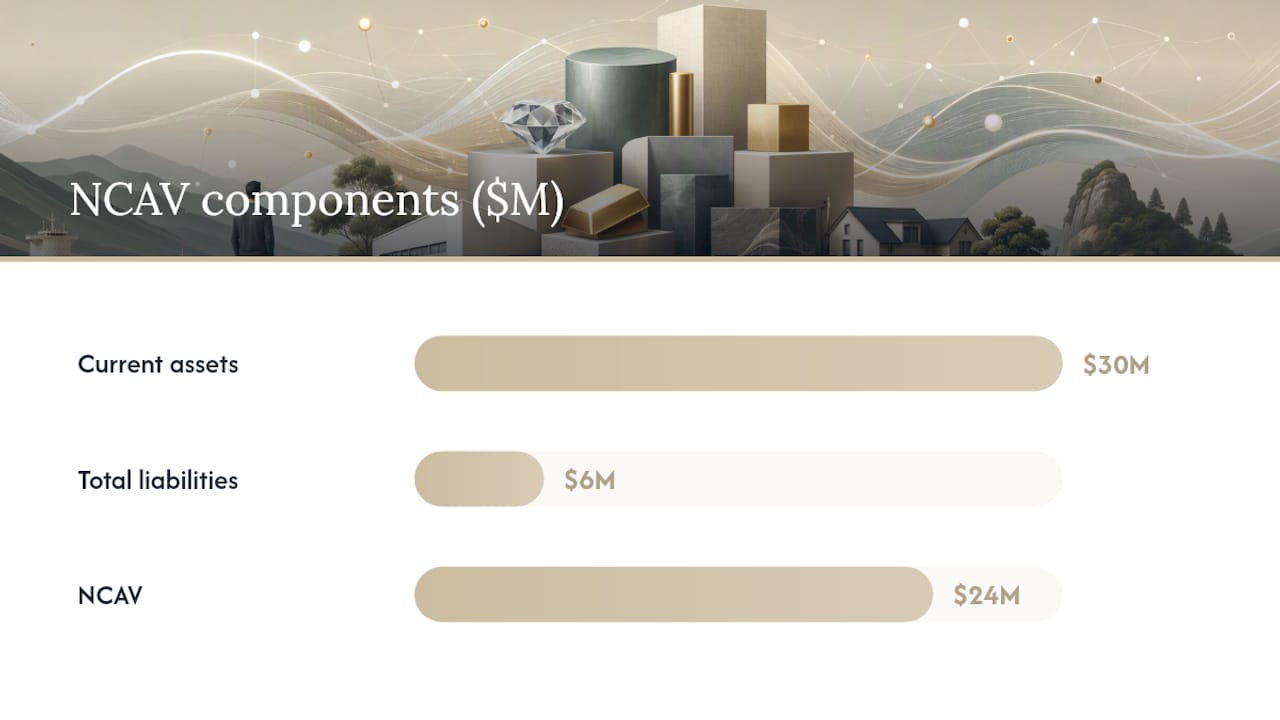
Worked example: a small industrial company shows $30 million in current assets, $6 million in liabilities, and 6 million shares. NCAV is $24 million, NCAVPS is $4.00.
Pro Tip: Rebuild your screen quarterly, right after earnings season, since NCAV shifts every time a company reports new receivables, inventory, or debt levels.
What Underwriting Checks Matter Beyond the Screen?
A stock passing the NCAV test is a candidate, not a conclusion. The balance sheet numbers that make a company look cheap can also be the numbers hiding the reason it's cheap.
- Check receivables aging and customer concentration. A single client responsible for 40% of receivables is a collectibility risk the screen can't see.
- Review inventory turnover. Slow-moving or obsolete inventory (think outdated electronics or seasonal goods) rarely liquidates near book value.
- Read the footnotes for contingent liabilities, pending litigation, and related-party transactions that don't show up in the summary balance sheet.
- Track cash flow trends over three to five years. Repeated write-downs or shrinking operating cash flow often precede a value trap, even when NCAV looks stable.
- Run a basic DuPont analysis to see whether declining returns stem from margin pressure, leverage, or asset turnover, each tells a different story about whether the business is stabilizing or bleeding out.
Pro Tip: If a company has changed auditors twice in three years or restated earnings, treat that as a hard stop regardless of how attractive the NCAV discount looks.
How Many Net-Net Stocks Should You Hold?
Graham's own answer was blunt: diversify broadly, often citing baskets of 20 to 30 names or more, because individual net-nets fail often enough that concentration turns a sound strategy into a gamble. Small-cap, thinly traded stocks carry idiosyncratic risk that no amount of research fully eliminates.
- Start with small initial positions, often 2% to 4% of the portfolio per name, and add only if the thesis strengthens.
- Cap total net-net exposure at a level you can stomach seeing drop 30% in a bad quarter, since illiquidity means you can't always exit cleanly.
- Hold periods commonly run one to three years; frequent trading eats returns through transaction costs and, in taxable accounts, short-term capital gains rates.
- For a smaller account, five to ten positions may be the realistic ceiling given commission and bid-ask spread drag, but that concentration raises single-name risk meaningfully compared to Graham's broader basket.
Rebalancing matters too. When a position approaches full NCAV or your price target, trim it and recycle capital into fresh candidates rather than letting winners drift into oversized portfolio weights.
Where Can You Find Current Net-Net Candidates?
Public screener lists and value-investing blogs publish net-net rosters, but freshness is a real problem. A list compiled last quarter may include companies that have since burned through cash or issued new shares, distorting the NCAVPS calculation entirely.
- Cross-check any public list against the company's latest 10-K or 10-Q filing before trusting the numbers.
- Set up a watchlist and review it monthly, since NCAV changes with every earnings report.
- Reconcile screener figures against the actual balance sheet line items. Automated tools sometimes miscategorize items like restricted cash or deferred tax assets.
- Read commentary from sources like The Long Run Plan's net-net list as a starting point, not a final answer, and always verify against primary filings.
Tools that automate scoring and tracking can speed up the mechanical parts of this process considerably. What they can't do is replace actually reading the filing before you commit capital.
Who Should Actually Run a Net-Net Strategy?
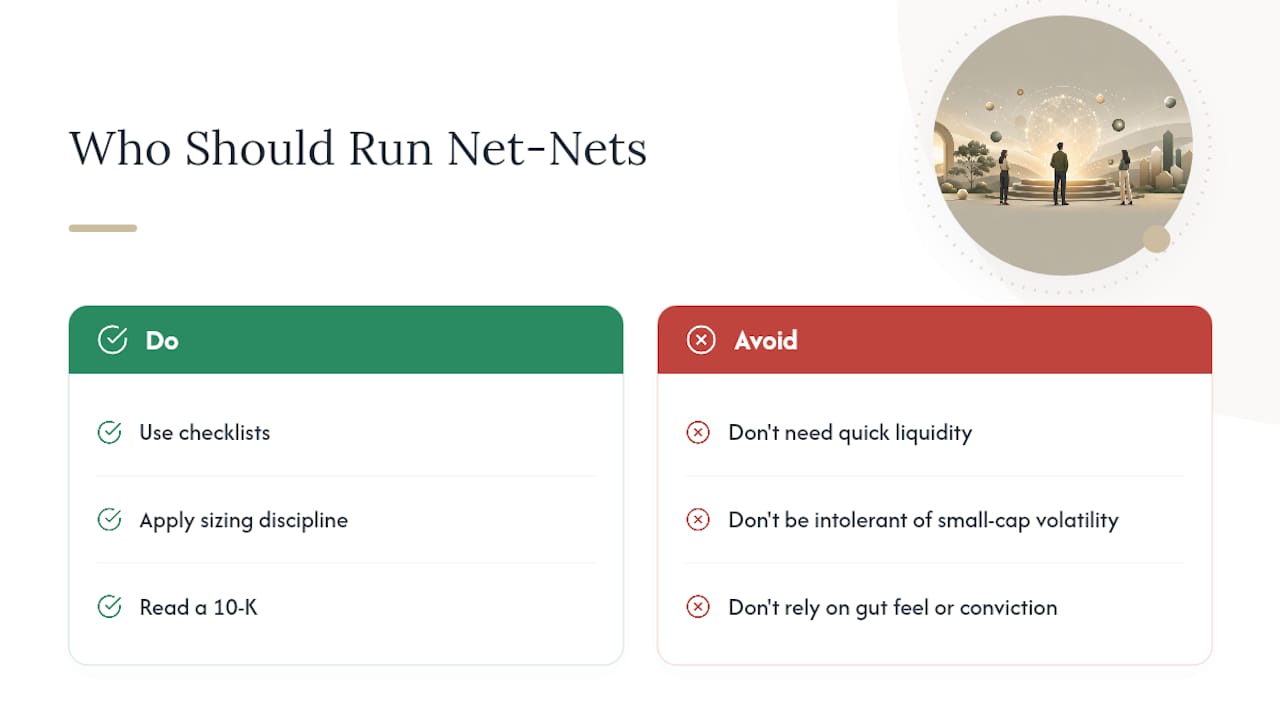
It rewards checklists and sizing discipline over conviction and gut feel.
It's the wrong tool if you need quick liquidity, can't stomach small-cap volatility, or lack the time to actually read a 10-K. Net-nets punish shortcuts.
— Matt
Automate the Screening, Not the Judgment
Oracle Investments is built for exactly the mechanical grind this strategy demands, scoring over 260 stocks on profitability, valuation, and financial health so you spot undervalued candidates without building spreadsheets from scratch.

The app's real-time tracking and instant side-by-side comparisons help you monitor a watchlist of net-net candidates the way this guide recommends: refreshed regularly, checked against fundamentals, and never taken at face value. Oracle Investments layers in investing principles drawn from Warren Buffett, Charlie Munger, and Peter Lynch, so the screening groundwork connects to a broader framework rather than a single formula in isolation. It's rule-based scoring grounded in reported fundamentals, not AI guesswork, with every input shown transparently. If you want to spend less time rebuilding NCAV calculations by hand and more time reading footnotes on the candidates that matter, check out Oracle Investments' Premium Annual plan and see how it fits into your screening routine.
Sources
For more grounding, review Benjamin Graham's original NCAV framework, Brown Advisory's take on underwriting deep value, and practical case studies in Oracle Investments' undervalued stocks strategy guide.
This article is general information, not a substitute for advice from a qualified financial advisor. Consult a qualified financial professional about your own circumstances before acting on anything here.
- Net current asset value
- Net-Net Investing: Definition, Strategy, and NCAVPS ...
- Deep Value Beyond the Screen: Where Price, Risk and Behaviour Meet | Brown Advisory
- DEEP VALUE (GMO)
FAQ
What Is a Net Net Stock?
A net net stock trades below its net current asset value, meaning current assets minus total liabilities exceed the company's market capitalization. Investors use this as a rough proxy for liquidation value, buying the business for less than its most liquid assets alone would theoretically fetch.
How Does Net-Net Investing Work?
You calculate NCAVPS for a company, then compare it to the current share price, targeting stocks priced at 66% to 67% of that figure or lower, following Graham's original threshold. The strategy relies on buying a diversified basket of these candidates since individual names often carry real business risk despite the statistical cheapness.
What Are the Risks of Net-Net Investing?
The biggest risk is mistaking a dying business for a mispriced one, since declining receivables quality, obsolete inventory, and hidden liabilities can erase the apparent discount. Institutional research from Brown Advisory stresses that a cheap price alone doesn't distinguish temporary distress from permanent impairment, which is why underwriting beyond the screen matters as much as the initial number.
What Is the Smartest Thing to Invest in Right Now?
There's no single "smartest" investment since it depends on your time horizon, risk tolerance, and how much research you're willing to do. Net-net stocks can offer a disciplined, evidence-based approach to undervalued small caps for investors willing to diversify broadly and verify each candidate against its actual filings rather than a screener's summary.
How Much Does Oracle Investments Cost?
Current pricing for the Premium Annual plan is listed directly on the Oracle Investments site, since pricing details aren't published elsewhere. The plan is built to automate stock scoring and real-time portfolio tracking for investors running strategies like this one.