
The circle of competence is the specific area of business or knowledge where your judgment is reliably good enough to act on, a term Warren Buffett and Charlie Munger built into a working discipline for investing. Knowing where that circle ends matters more than how big it is. A tight, well-mapped circle beats a wide, fuzzy one every time you have real money on the line.
Start applying it today with three moves:
- Stop before your next purchase or investment and ask if you actually understand how the thing makes money.
- Inventory the two or three areas where your judgment has actually been tested and proven right.
- Build a "too hard" pile for everything else, and leave it there without guilt.
Key Takeaways
Staying inside your circle of competence protects capital by preserving an information edge, while stepping past its boundary quietly transfers that edge to someone else.
| Point | Details |
|---|---|
| Definition matters | Your circle of competence is where your judgment is tested and reliable, not just familiar. |
| Boundary beats size | Knowing where your understanding ends protects you more than expanding how much you know. |
| Screen before buying | Check if you understand how a business makes money, its edge, and its earnings visibility. |
| Grow it deliberately | Use small bets, written post-mortems, and cross-disciplinary models to expand safely. |
| Use Oracle Investments | Its stock scoring and comparisons help test whether your read on a company matches its fundamentals. |
Table of Contents
- What Is a Circle of Competence, Really?
- Where the Circle of Competence Idea Came From
- Why the Boundary Matters More Than the Size
- How to Map Your Own Circle of Competence
- Applying the Circle of Competence to Investing Decisions
- Expanding Your Circle of Competence Without Blowing It Up
- Common Mistakes That Blur the Boundary
- How Oracle Investments Helps You Apply the Model
- A Quick Word on Humility
- Put Your Circle of Competence to Work
- Frequently Asked Questions
- Sources
What Is a Circle of Competence, Really?
Your circle of competence is the set of subjects where your understanding is deep enough to judge quality, price, and risk without relying on someone else's opinion. Buffett's own definition: he doesn't need to be an expert on every business, just honest about which ones he actually understands.
That honesty is the hard part. A useful mental check comes from psychology: people's perceived competence and their actual competence often diverge most right at the edges of what they know, not in the areas they've clearly mastered or clearly never touched.
A few examples make the boundary concrete:
- A mechanic understands engines but may have no edge picking auto parts stocks.
- A software engineer might correctly judge a cloud company's product but completely misjudge its accounting.
- An investor who has run a small retail business for a decade probably reads a retailer's earnings report better than a hedge fund analyst who has never touched a cash register.
Pro Tip: If you can't explain how a company makes money to a smart twelve-year-old in two minutes, it's outside your circle, no matter how many articles you've read about it.
Where the Circle of Competence Idea Came From
Buffett laid out the idea plainly in a 1996 Berkshire Hathaway shareholder letter, arguing that investors don't need broad expertise, just a clear sense of which businesses they can actually evaluate. Munger extended the thinking with what he called a "latticework of mental models," pulling frameworks from psychology, biology, and economics to sharpen judgment inside and around that circle.
Experienced investors keep citing this decades later because it's one of the few investing rules that costs nothing to apply and works regardless of market conditions. If you want primary material rather than secondhand summaries, three sources are worth reading directly:
- Buffett's own shareholder letters, especially the 1996 edition
- Munger's speeches and interviews on multidisciplinary thinking
- The Wikipedia entry on circle of competence, which tracks the concept's development
Why the Boundary Matters More Than the Size
A larger circle sounds better, but it isn't the variable that protects your money. What protects you is knowing exactly where your circle stops, because inside it you hold a genuine information advantage over other market participants. Step past that edge, and the advantage flips to whoever actually understands the business better than you do.
The psychological trap is that confidence rarely retreats at the same pace as competence. You can feel just as sure about a biotech stock as you do about a business you've studied for years, right up until the moment the science proves you wrong.
"Know your circle of competence, and stick within it. The size of that circle is not very important; knowing its boundaries, however, is vital." That framing, echoed by analysts at Farnam Street, is why the edge deserves more attention than the interior.
Real portfolios show the damage: investors who bought into complex financial instruments they didn't understand before 2008, or who chased unprofitable tech names during the dot-com run, weren't unintelligent. They were simply operating past their own perimeter without realizing it.
How to Map Your Own Circle of Competence
Mapping your circle isn't a one-time exercise. It's a habit you build with a short, repeatable process.
- Inventory your real experience. List industries, jobs, hobbies, or purchases where you've made decisions with consequences and been right more often than wrong.
- Interrogate that knowledge with specific questions. Could you explain the business's unit economics, its main competitor, and its biggest risk without notes?
- Run small experiments. Make a tiny bet, track it, and see if your reasoning held up.
- Build your "too hard" pile. Write down every idea you passed on because you didn't understand it well enough, and don't revisit it out of boredom or FOMO.
A short pre-decision checklist keeps this honest:
- Can I explain how this business or decision actually generates value?
- Have I been right about similar situations before, or is this my first attempt?
- What would have to be true for me to be wrong, and would I know if it happened?
Applying the Circle of Competence to Investing Decisions
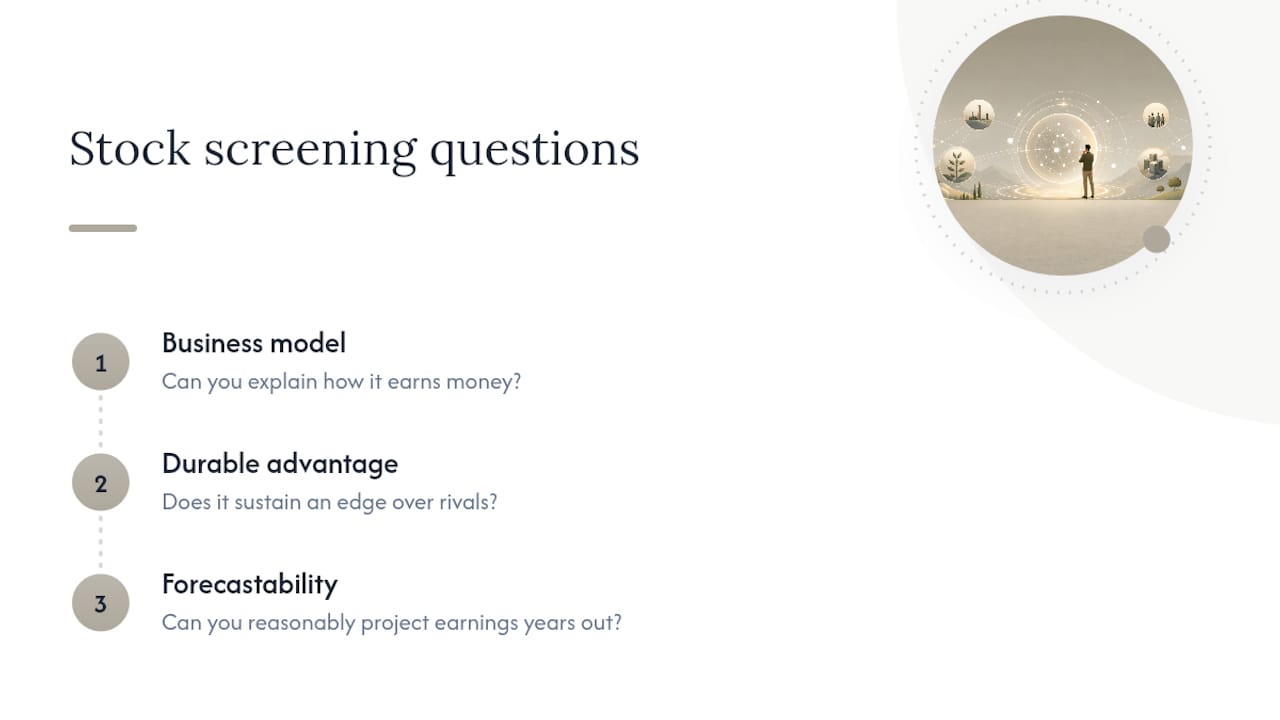
Screening a stock against your circle of competence starts with three questions: do you understand how the company makes money, does it have a durable competitive advantage, and can you reasonably forecast its earnings a few years out? Investopedia's breakdown of Buffett's rule treats these three filters as the backbone of practical stock selection, and they hold up whether you're buying your first share or your five-hundredth.
Position sizing should track your depth of knowledge, not your excitement level. A company you've followed for years, in an industry you've worked in, earns a bigger allocation than a name you read about last week. Tools that measure return on invested capital help quantify whether a business you think you understand is actually converting capital into profit efficiently, turning a gut feeling into a testable claim.

The "too hard" pile isn't permanent exile. Revisit it when a real trigger appears: you take a job in the industry, a company you follow publishes a plain-English breakdown of its model, or a metric you now understand well starts explaining the stock's price action. Practitioner guidance on selecting "fat pitches," compiled by investor Jim Bouman, frames this as waiting for a clear edge rather than forcing one.
Expanding Your Circle of Competence Without Blowing It Up
Growing your circle safely means learning first, betting small second, and writing down what happened third. Munger's latticework approach, built from roughly 80 to 90 mental models borrowed across disciplines, gives you a faster route into a new field because you're not starting from zero. A few big ideas from economics, psychology, and biology transfer surprisingly well into evaluating businesses.
- Study one adjacent industry deliberately, not by accident.
- Make a real but small position once you have a testable thesis.
- Write a post-mortem after 6 to 12 months, regardless of the outcome.
- Only increase your bet size after the post-mortem confirms your reasoning held.
Pro Tip: Track your small experiments the same way you'd track a full position. A portfolio tracking habit turns "I think I was right" into "here's the data showing I was right."
Common Mistakes That Blur the Boundary
Overconfidence is the most expensive habit near the edge of your circle, and it rarely announces itself. Watch for these warning signs:
- Single-tool bias, where you judge every company using the one metric you happen to know well.
- Confirmation bias, where you only seek information that supports a decision you've already made.
- Ignoring the "too hard" pile because a stock is popular or a friend made money on it.
Corrective habits are simple: keep a written checklist, ask someone outside your usual circle to poke holes in your thesis, and treat "I don't know enough yet" as a complete answer, not a failure.
How Oracle Investments Helps You Apply the Model
Testing your circle of competence works best when you can compare your judgment against real numbers quickly. Oracle Investments scores more than 260 stocks on profitability, valuation, and financial health, so you can check whether your read on a company actually matches its fundamentals before you commit capital.
- Instant side-by-side comparisons help you see if your "edge" holds up against similar companies you understand less well.
- Real-time portfolio tracking documents the small experiments that grow your circle safely.
- The Oracle Journal blog covers mistakes beginners make and other practical lessons drawn from value investing.
Matt, who covers value investing for Oracle Investments, brings that lens to the analysis above.
A Quick Word on Humility
I've watched smart people lose money not from bad luck but from confusing familiarity with understanding. The fix isn't more research. It's a written "too hard" pile you actually respect. Start yours today, even with one name on it.
Put Your Circle of Competence to Work
Reading about the circle of competence is one thing. Testing it against real numbers before you commit money is another, and that's the gap Oracle Investments was built to close.

Oracle Investments turns the define, test, apply workflow into something you can actually do in minutes instead of hours. You define what you think you understand about a company, the app scores it across profitability, valuation, and financial health, and you compare it against similar names to see if your judgment holds up. That loop, repeated a few times a month, is how a small circle of competence turns into a reliable one. Check out Oracle Investments and run your next stock idea through it before you decide it belongs inside your circle.
Frequently Asked Questions
What is a simple way to explain the circle of competence? It's the specific set of businesses or subjects you understand well enough to judge confidently, without leaning on someone else's opinion.
Did Warren Buffett invent the circle of competence? Buffett popularized the term, notably in his 1996 shareholder letter, while Munger's latticework of mental models expanded on how to build and use it.
How do I know if a stock is inside my circle of competence? If you can explain how the business makes money, its main competitive advantage, and a reasonable earnings forecast without notes, it likely qualifies.
Can I expand my circle of competence over time? Yes. Focused study, small real bets, and written post-mortems after 6 to 12 months are the safest way to grow it without taking on outsized risk.
What's the biggest mistake investors make with this concept? Confusing familiarity with understanding. Knowing a company's name or its product isn't the same as understanding how it earns a profit.
This article is general information, not a substitute for advice from a qualified financial advisor. Consult a qualified financial professional about your own circumstances before acting on anything here.
Sources
- Circle of competence — Wikipedia
- Mastering Success: Navigating Within Your Circle of Competence — Farnam Street
- Warren Buffett's circle of competence investing rule explained — Investopedia