
For beginners who want more than a place to park money, Oracleinvestments is the top pick among investing apps for new investors. It scores over 260 stocks on profitability, valuation, and financial health, pairs that with real-time portfolio tracking, and gets you from download to first trade without a finance degree.
- Easy onboarding, low friction: No steep minimums, fractional share support, and a clean interface built for people who are just starting out.
- Transparent stock scoring: Every score breaks down into readable components, so you know why a stock ranks where it does, not just that it does.
- Real-time portfolio tracking: Your holdings refresh live, and you can compare companies side by side in seconds.
Pro Tip: Set up a recurring weekly or monthly deposit the day you open your account. Automating contributions removes the temptation to time the market and builds the habit that actually compounds over years.
Table of Contents
- Why Oracleinvestments fits beginners who want analysis and tracking
- What should you look for in a beginner investing app?
- How to get started with Oracleinvestments
- Common beginner mistakes and how Oracleinvestments helps you avoid them
- Key Takeaways
- Why a fundamentals-led app builds better investors
- Oracleinvestments: what the app includes and how to get started
- Authoritative sources and further reading
Why Oracleinvestments fits beginners who want analysis and tracking
Most beginner apps give you a brokerage account and a chart. Oracleinvestments gives you a research framework built around fundamentals similar to those used by renowned investors like Warren Buffett, Charlie Munger, and Peter Lynch, translated into scores a new investor can actually read.
How the stock-scoring methodology works
Each stock gets evaluated across three pillars: profitability (is the business actually making money?), valuation (are you paying a fair price?), and financial health (how much debt, how much cushion?). The score aggregates those signals into a single rating, but you can drill into each component. That transparency matters for beginners because it teaches you what to look for, not just what to buy. Reading a value rating takes under a minute once you know the structure, and Oracleinvestments's guide to reading value ratings walks you through it step by step.

Portfolio tracking and company comparisons
Real-time portfolio tracking and instant side-by-side comparisons let you see how your holdings stack up against alternatives without switching between tabs or spreadsheets. That kind of consolidated view, refreshing live, is something most legacy research tools reserve for paid professional tiers.
"The stock market is a device for transferring money from the impatient to the patient." Patience is easier to maintain when you can see, at a glance, that your fundamentals-scored holdings are holding their ground.
On the trust side: Oracleinvestments operates through regulated brokerage partnerships that carry SIPC coverage, protecting the custody of your assets (though not against market losses, a distinction the SEC makes clearly). Pricing is listed transparently, and onboarding typically takes under 15 minutes for identity verification and bank linking.
Investor.gov's student wealth roadmap makes the case plainly: time in the market and consistent contributions are the two biggest drivers of long-term wealth accumulation. Starting with an app that scores stocks and tracks your portfolio means you build both the habit and the analytical skill simultaneously.
Pro Tip: Use the side-by-side comparison tool before your first purchase. Comparing two stocks on the same three-pillar framework takes about two minutes and immediately shows you which one scores better on valuation, which is the mistake most beginners skip.
What should you look for in a beginner investing app?
Use this checklist before committing to any platform.
- Goal alignment. Are you saving for retirement (Roth IRA or Traditional IRA), building a taxable brokerage account for flexibility, or both? Match the account type to the goal before you fund anything.
- Pricing transparency. Look for zero-commission trades and a clear subscription or fee schedule. Hidden fees in expense ratios and account maintenance charges erode returns faster than most beginners realize.
- Account types supported. A good app supports taxable accounts and tax-advantaged accounts (Roth IRA, Traditional IRA). Skipping an IRA when you qualify is one of the most expensive beginner mistakes.
- Minimums and fractional shares. No minimums and fractional share support are the standard recommendation for new investors, because they let you start with whatever you have and diversify across more positions.
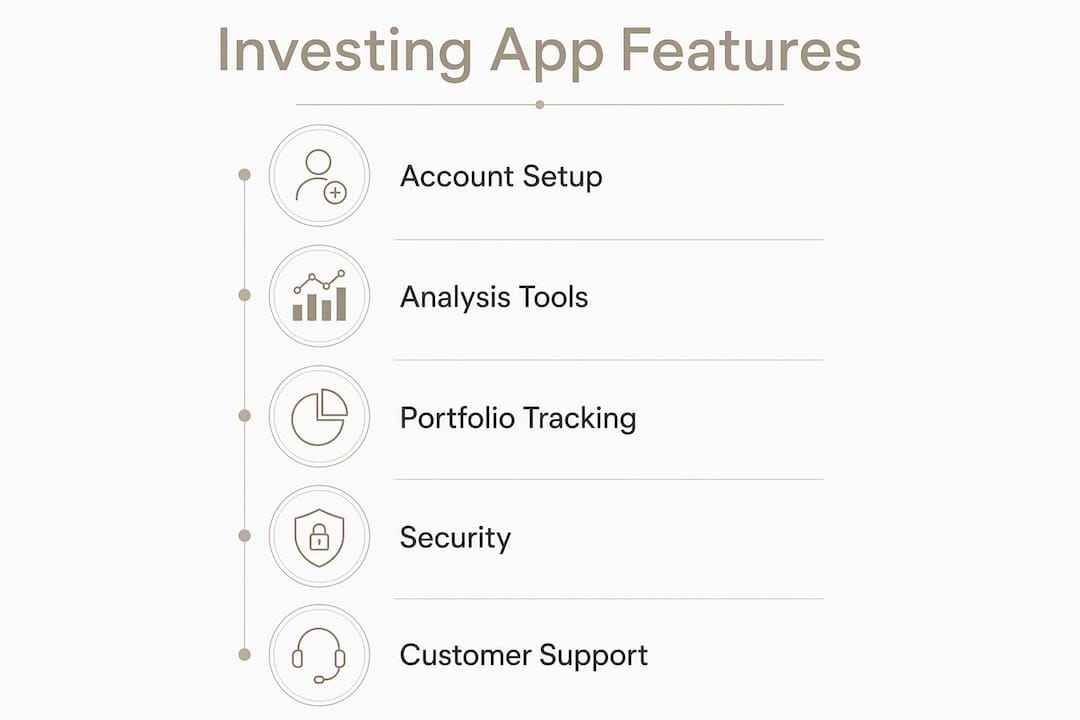
- Research and analysis tools. Look for fundamental metrics (earnings, debt ratios, valuation multiples), not just price charts. A scorecard or rating system that explains its methodology is a significant advantage. See what portfolio analysis tools should include for a detailed breakdown.
- Portfolio reporting and data export. Can you see your total return, cost basis, and allocation breakdown? Can you export for tax software?
- Customer support. Live chat or phone support matters most during onboarding and at tax time.
Security and compliance basics
- SIPC coverage protects up to $500,000 in securities and $250,000 in cash per account if a brokerage fails. It does not protect against investment losses.
- Enable multi-factor authentication (MFA) on day one. Every major platform supports it; most beginners skip it.
- Confirm the app's brokerage partner is FINRA-registered before depositing.
Typical steps and potential delays to make your first trade
| Step | Typical time |
|---|---|
| Download and create account | 5 minutes |
| Identity verification | Instant to a few hours |
| Bank account linking | Instant (micro-deposit: 1–3 days) |
| Initial funding to clear | 1–5 business days |
| First trade available | Same day (with instant deposit options) |
Delays almost always come from manual identity review or micro-deposit verification. Using a debit card or instant bank link speeds this up considerably.
How to get started with Oracleinvestments
What to prepare before you open the account
Have your Social Security number, a government-issued ID, and your bank account routing and account numbers ready. The whole process runs faster when you are not hunting for those mid-session.
- Download the app from the Apple App Store and create your account.
- Choose your account type. If you have earned income and a long time horizon, open a Roth IRA first. If you want flexibility or are investing beyond IRA contribution limits, add a taxable brokerage account.
- Link your bank and set a recurring contribution. Even $25 a week compounds meaningfully over time, per Investor.gov's compounding guidance.
- Run your first stock comparison. Pick two companies in a sector you know, pull up their scores, and compare profitability and valuation side by side. This is the fastest way to learn how the scoring system works.
- Set your initial allocation. A diversified ETF as your core position, plus two or three high-scoring individual stocks, is a reasonable starting point for most beginners.
- Read your first value rating. The Oracle Journal has short tutorials that walk through score interpretation in under five minutes.
For a deeper look at tracking your holdings once you are funded, this performance-tracking guide covers what to measure and how often.
Pro Tip: Keep your first portfolio to five positions or fewer. Spreading $500 across 20 stocks sounds like diversification but makes it nearly impossible to understand why your portfolio moves the way it does.
Pro Tip: Enable two-factor authentication before you deposit a single dollar. It takes 90 seconds and closes the most common account-compromise vector.
Common beginner mistakes and how Oracleinvestments helps you avoid them
- Chasing hot stocks. A stock that tripled last quarter is usually already priced for perfection. Oracleinvestments's valuation score flags when a stock is trading well above its fundamental value, which is the exact signal most beginners ignore when excitement is high.
- Skipping diversification. Concentrating in one sector or one stock amplifies both gains and losses. The side-by-side comparison tool makes it easy to see when two holdings are essentially the same bet.
- Ignoring fees and expense ratios. A 1% annual expense ratio on an ETF costs you roughly 20% of your total return over 30 years due to compounding drag. Check the expense ratio before you buy any fund.
- Skipping tax-advantaged accounts. Investing in a taxable account when you qualify for a Roth IRA means paying taxes on gains you could shelter entirely. Oracleinvestments supports both account types so you can prioritize correctly.
- Misunderstanding SIPC protection. Securities are not federally insured the way bank deposits are. SIPC covers custody, not market losses. Knowing this distinction prevents the dangerous assumption that your portfolio is "safe" the way a savings account is.
"The individual investor should act consistently as an investor and not as a speculator." The scoring methodology in Oracleinvestments is built around exactly this discipline: buy businesses with strong fundamentals at reasonable prices, then hold.
A common early pattern: a new investor buys a stock because it appeared in a news headline, watches it drop 15%, and sells in a panic. The Oracleinvestments profitability and financial-health scores would have shown, before the purchase, whether that company had the earnings and balance-sheet strength to recover from a short-term dip. That context changes the decision entirely.
Pro Tip: Before selling any position at a loss, run it through the scoring tool again. If the fundamentals are still strong and only the price has dropped, that is often a buying opportunity, not an exit signal.
Key Takeaways
Oracleinvestments is the strongest choice among beginner investing apps for anyone who wants fundamentals-led stock analysis and real-time portfolio tracking in a single, low-friction platform.
| Point | Details |
|---|---|
| Start with a recurring contribution | Automating deposits builds the compounding habit that drives long-term wealth accumulation. |
| Match account type to goal | Use a Roth IRA for long-term growth; a taxable account for flexibility and shorter horizons. |
| Prioritize transparent scoring | Apps that explain why a stock scores well teach you to invest, not just to buy. |
| Understand SIPC vs. FDIC | SIPC protects custody up to $500,000; it does not protect against market losses. |
| Oracleinvestments as your starting point | Scores 260+ stocks on fundamentals and tracks your portfolio in real time, built for beginners. |
Pro Tip: Spend your first week reading, not trading. Use the Oracle Journal to understand how value ratings work before you commit capital.
Why a fundamentals-led app builds better investors
The conventional wisdom says beginners should start simple: index funds, no analysis, set it and forget it. There is nothing wrong with that advice, but it leaves a gap. Investors who never learn to read a balance sheet or evaluate a valuation multiple stay dependent on passive strategies forever. They cannot tell a genuinely cheap stock from a cheap-looking one, and they have no framework for the moments when passive strategies underperform.
A fundamentals-led app like Oracleinvestments closes that gap without requiring you to become a CFA. The scoring system does the heavy lifting while teaching you the underlying logic. After 90 days of using it, most beginners understand profitability metrics, valuation ratios, and financial health signals well enough to form their own opinions.
What the first 90 days should look like:
- Week 1–2: Open your account, set your recurring contribution, and read five value ratings without buying anything.
- Week 3–4: Run your first side-by-side comparison and make one small, high-scoring stock purchase alongside a core ETF position.
- Month 2–3: Track your portfolio weekly, revisit your initial picks using the scoring tool, and read one educational post from the Oracle Journal each week.
Oracleinvestments: what the app includes and how to get started
Stock analysis at the level Oracleinvestments offers typically costs hundreds of dollars a month on legacy research platforms. The free tier gives you access to basic stock scores and educational content, enough to evaluate the methodology before committing. The paid subscription, available through the Apple App Store, unlocks real-time portfolio tracking, full score breakdowns across all 260+ stocks, instant side-by-side comparisons, and multi-account consolidation.
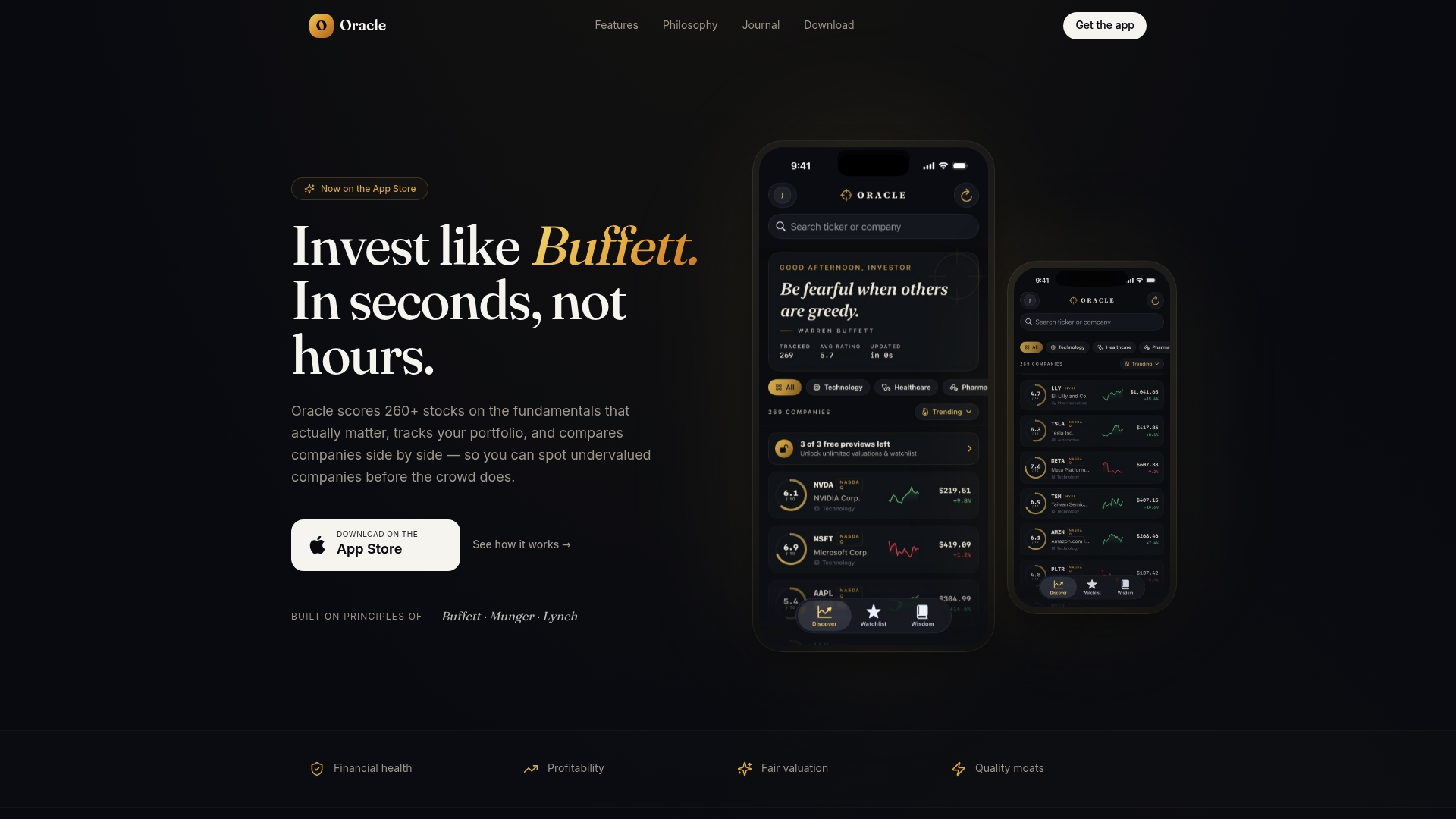
Pricing details and a full feature comparison are listed on the Oracleinvestments landing page. If you are ready to run your first stock comparison or set up portfolio tracking, that is the place to start. Support documentation and educational guides live at the Oracle Journal, accessible directly from within the app.
Authoritative sources and further reading
| Source | What it covers | Why it matters |
|---|---|---|
| Investor.gov — Building Wealth: A Roadmap for Students | Compounding, consistent contributions, and time-in-market principles | Foundational investor education from a U.S. regulator |
| SEC — Savings vs. Investing for Students | Risk profile of securities vs. insured bank accounts; SIPC vs. FDIC | Critical for understanding what protection you actually have |
| Phroogal — How to Start Investing as a College Student | Account-type selection and goal alignment for new investors | Practical guidance on IRA vs. brokerage account decisions |
| U.S. News — Investment Apps for Beginners | Platform selection criteria including minimums and fractional shares | Industry-standard checklist for evaluating beginner platforms |
| Oracle blog — Best Portfolio Analysis Tools | What portfolio analysis tools should include for new investors | Criteria-based guide to evaluating tracking and analysis features |
| Oracle blog — How to Track Portfolio Performance Like a Pro | Step-by-step performance tracking methodology | Practical next step after funding your first account |
| Oracle blog — Motley Fool Alternatives for Fundamental Analysis | Score-driven analysis vs. traditional research tools | Context for why fundamentals-led apps shorten research time |
Further reading from the Oracle Journal:
- How to read a value rating in under a minute
- 5 value investing mistakes beginners make
- PEG ratio explained: a guide for investors
This article is general information, not personalized financial advice. Confirm current rules, contribution limits, and account eligibility with a qualified financial professional or the relevant regulatory body before making investment decisions.