
What are the best Motley Fool alternatives for stock evaluation?
The strongest Motley Fool alternatives for fundamental stock evaluation are Oracleinvestments, Seeking Alpha Premium, Morningstar Investor, and Zacks Investment Research. Each takes a meaningfully different approach from Motley Fool's analyst-led, twice-monthly pick model, and each suits a different kind of investor.
Motley Fool Stock Advisor delivers curated growth-stock picks on a fixed schedule, two per month, with detailed narrative theses. That works well for patient buy-and-hold investors. But if you want quantitative scoring, real-time alerts, or the ability to evaluate stocks yourself against financial fundamentals, you need something built differently.

| Platform | Best For | Methodology | Pricing | Portfolio Tracking | Alert Features | Ease of Use |
|---|---|---|---|---|---|---|
| Oracleinvestments | Fundamental scoring, value investors | Profitability, valuation, financial health scoring | App-based | Real-time | Instant comparisons | Very high |
| Seeking Alpha Premium | Self-directed researchers | Crowdsourced + Quant Ratings | ~$239/yr | Yes | Quant Rating changes | Moderate |
| Morningstar Investor | DIY analysts, conservative investors | Fair Value + economic moat | — | Yes | Fair Value alerts | High |
| Zacks Investment Research | Earnings-focused, active traders | Earnings estimate revisions | — | Yes | Earnings alerts | Moderate |
| Motley Fool Stock Advisor | Long-term buy-and-hold | Analyst-led narrative picks | — | Limited | Monthly picks | High |
Table of Contents
- How do Motley Fool and its top alternatives actually compare?
- How do you choose the right stock evaluation app for your style?
- What makes Oracleinvestments stand out as a Motley Fool alternative?
- What customer support and educational resources do these platforms offer?
- How well do these platforms integrate with other financial tools?
- How reliable are stock recommendations from these alternatives historically?
- Key Takeaways
- Oracleinvestments scores stocks the way legendary investors think
How do Motley Fool and its top alternatives actually compare?
The core divide is qualitative versus quantitative. Motley Fool's analysts write conviction-driven theses on individual stocks. That narrative approach builds confidence but limits frequency and objectivity. The best investment newsletters and platforms built around quantitative models flip that equation.
Methodology differences at a glance:
- Motley Fool: Analyst-led, narrative picks, 2 per month, long-term growth focus
- Seeking Alpha Premium: 18,000+ contributors providing crowdsourced analysis plus algorithmic Quant Ratings
- Morningstar Investor: Institutional-grade fair value estimates, economic moat assessments, 40+ years of recession-tested methodology
- Zacks: Proprietary Rank system (1–5) driven by earnings estimate revisions, built for short-to-mid-term momentum
- Oracleinvestments: Scores 260+ stocks on profitability, valuation, and financial health for side-by-side comparison
On pricing, Morningstar is a subscription-based service and Motley Fool Stock Advisor is a subscription service with a published annual price sit at opposite ends of the value spectrum. Zacks Premium is a subscription service available for an annual fee. Seeking Alpha Premium is approximately $239/year for new subscribers. Oracleinvestments operates as an app with its own pricing structure.
Real-time data is where the Motley Fool falls short most visibly. Stock picks arrive on a fixed schedule, with no alerts for earnings surprises, insider trades, or breaking news. Seeking Alpha sends alerts when a stock's Quant Rating changes. Morningstar flags when a stock crosses its fair value threshold. Zacks is built around earnings release timing. For active investors who need to act on data as it moves, the fixed-schedule model is a genuine constraint.
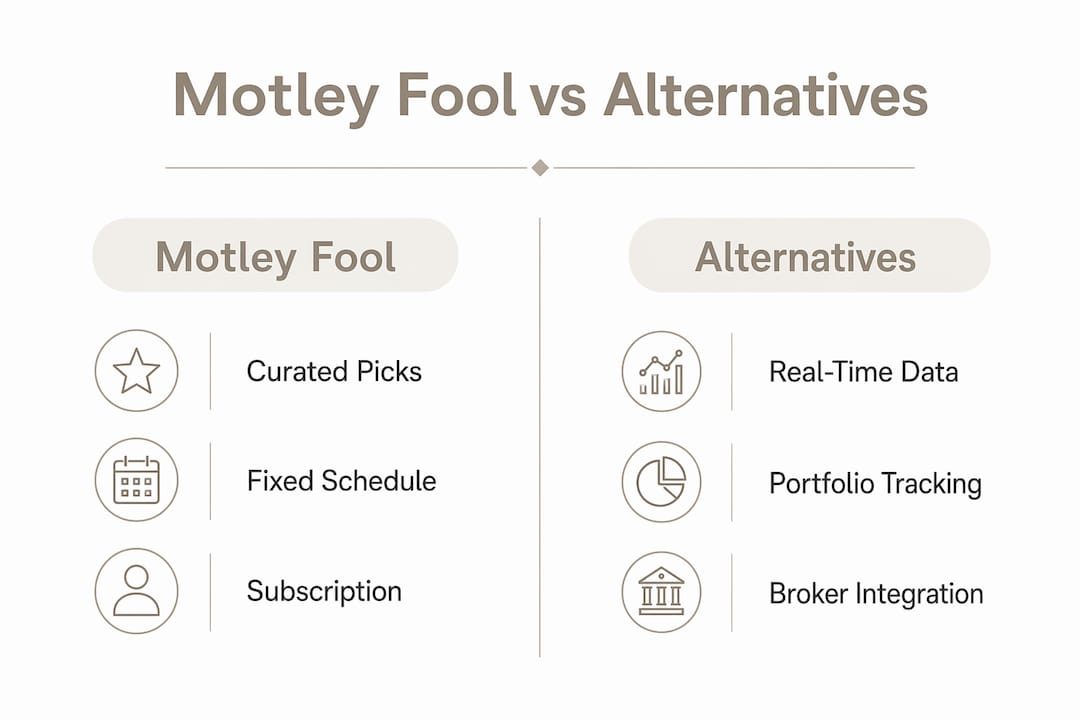
Portfolio tracking is available across all four alternatives, though depth varies. Seeking Alpha Premium allows brokerage account syncing, so your holdings are rated in real time. Morningstar's portfolio tools are thorough but skew toward long-term monitoring rather than day-to-day signals.
How do you choose the right stock evaluation app for your style?
Start with your investment horizon. If you hold for five or more years and want someone to do the research for you, Motley Fool's model still holds up. If you're evaluating stocks yourself, comparing companies on fundamentals, or making decisions on a shorter timeline, you need a platform built around data tools rather than curated picks.
A few practical factors to weigh:
- Active vs. passive: Active investors benefit from real-time alerts and screeners. Passive investors can work with monthly or weekly research digests.
- Data depth vs. simplicity: Platforms like Morningstar and Zacks offer deep data, but that depth can produce analysis paralysis. Tools that distill financials into clear scores, rather than dumping raw data, help investors act with more consistency.
- Educational resources: If you're building investing knowledge alongside building a portfolio, look for platforms with structured learning content, not just data feeds.
Combining tools is common among serious retail investors. A free screener for initial filtering paired with a paid platform for deeper fundamental analysis is a practical approach that optimizes both breadth and depth without overpaying for features you won't use.
Pro Tip: Before committing to any paid subscription, list the three features you actually used in the past 30 days on your current platform. If a new tool doesn't improve on all three, the switch is probably not worth it.
For options-focused investors who want pre-market trade ideas alongside their fundamental research, AI-driven options scanners can complement a fundamental stock evaluation workflow without replacing it.
What makes Oracleinvestments stand out as a Motley Fool alternative?
Oracleinvestments takes a different approach from every platform in this comparison. Rather than delivering picks or raw data, it scores over 260 stocks on three core dimensions: profitability, valuation, and financial health. The result is a structured ranking that lets you compare companies side by side in seconds, without building your own spreadsheet or decoding a 40-page analyst report.
Standout features:
- Fundamental scoring matrix: Every stock gets a score across profitability, valuation, and financial health, making it straightforward to spot undervalued companies with strong balance sheets
- Legendary investor principles: The app integrates investment frameworks from Warren Buffett, Charlie Munger, and Peter Lynch, grounding quantitative scores in time-tested value investing logic
- Real-time portfolio tracking: Holdings update in real time, so you see how your positions score against the full universe of covered stocks at any moment
- Instant side-by-side comparison: Compare any two companies across all fundamental dimensions without switching tabs or building custom views
| Feature | Oracleinvestments | Typical Newsletter Service |
|---|---|---|
| Scoring methodology | Profitability, valuation, financial health | Analyst narrative |
| Stocks covered | 260+ | 20 active picks |
| Data update frequency | Real-time | Monthly |
| Comparison tool | Instant side-by-side | Not available |
| Investor wisdom integration | Buffett, Munger, Lynch principles | Varies |
| Ease of use | Designed for all experience levels | Moderate |
The platform is built for investors who want to read a value rating quickly and act with confidence, not spend an evening parsing footnotes. That's the gap it fills relative to both traditional newsletters and data-heavy research platforms.
What customer support and educational resources do these platforms offer?
Morningstar Investor has the deepest educational infrastructure of any platform in this group. Its analyst reports include methodology explanations, and its website carries decades of published research. Support is available via email and phone for paid subscribers.
Seeking Alpha's community model means educational content is abundant but inconsistent in quality. With 18,000+ contributors, you get range, but not always rigor. Premium subscribers get priority support.
Zacks offers strategy-specific newsletters and premium research reports as part of its paid tiers, which function as both research tools and educational content for earnings-focused investors. Support is standard email-based for most tiers.
Motley Fool has invested heavily in educational content over its 20+ years, including articles, podcasts, and video content accessible to free users. Its Stock Advisor subscription includes detailed stock theses that double as learning material.
Oracleinvestments publishes focused educational content through The Oracle Journal, covering value investing fundamentals in plain language. The app's design itself functions as a teaching tool, showing not just scores but the reasoning behind them, which helps newer investors build intuition alongside their portfolios.
How well do these platforms integrate with other financial tools?
Seeking Alpha Premium offers direct brokerage account syncing, which is genuinely useful. You see your actual holdings rated in real time rather than evaluating hypothetical positions. That integration alone separates it from most newsletter-style services.
Morningstar's portfolio tools connect with major brokerages and allow manual import of holdings. Its data is also licensed by many third-party financial platforms, so Morningstar ratings often appear inside tools you're already using.
Zacks provides screener data and research that can be exported, though deep API or brokerage integrations are limited to higher-tier subscriptions. For active traders evaluating options alongside equities, pairing Zacks' earnings data with a dedicated options trade evaluation tool covers both sides of the analysis.
Motley Fool operates largely as a standalone newsletter. There's no brokerage sync, no API, and no screener to export. You get the picks and the theses, and you execute elsewhere.
Oracleinvestments is built as a self-contained evaluation app. Its real-time portfolio tracking and instant comparison features are designed to work within the app rather than as a hub connecting external accounts.
How reliable are stock recommendations from these alternatives historically?
Motley Fool Stock Advisor has a documented long-term track record. Morningstar's fair value methodology has been tested across multiple market cycles, including 2008 and 2020, and its moat ratings have proven durable as a quality screen.
Zacks' earnings-revision model has a 37-year methodology behind it. The Zacks Rank system is built on the premise that earnings estimate revisions predict near-term price movement, and the historical data supporting that relationship is substantial, particularly for short-to-mid-term horizons.
Seeking Alpha's Quant Ratings have been validated by independent academic research, and Alpha Picks, launched in July 2022, has generated strong early returns, though its track record is shorter than Motley Fool's.
For fundamental scoring tools like Oracleinvestments, reliability comes from the quality of the underlying metrics rather than a pick-by-pick win rate. Scoring on profitability, valuation, and financial health using principles drawn from Buffett and Lynch reflects a methodology with a multi-decade track record in value investing, even if the app itself is newer.
Key Takeaways
The right stock evaluation platform depends on whether you want curated picks, research infrastructure, or a fundamental scoring tool that lets you compare companies directly.
| Point | Details |
|---|---|
| Methodology shapes everything | Quantitative scoring and earnings-revision models serve active investors better than fixed-schedule analyst picks. |
| Pricing varies widely | Platforms have different pricing and features, with Motley Fool Stock Advisor and Zacks Premium at opposite ends of the spectrum. |
| Real-time alerts matter | Motley Fool's fixed schedule leaves active investors without timely signals; Seeking Alpha, Zacks, and Morningstar all offer event-driven alerts. |
| Combine tools strategically | Pairing a free screener with a paid fundamental research platform covers both breadth and depth without overspending. |
| Oracleinvestments for fundamental scoring | Oracleinvestments scores a broad universe of stocks on profitability, valuation, and financial health with real-time tracking and instant side-by-side comparisons. |
Oracleinvestments scores stocks the way legendary investors think
Most platforms give you data or picks. Oracleinvestments gives you a verdict grounded in the same financial fundamentals that Buffett, Munger, and Lynch built their track records on. Every stock in its universe gets scored on profitability, valuation, and financial health, so you can spot genuinely undervalued companies without building a model from scratch.
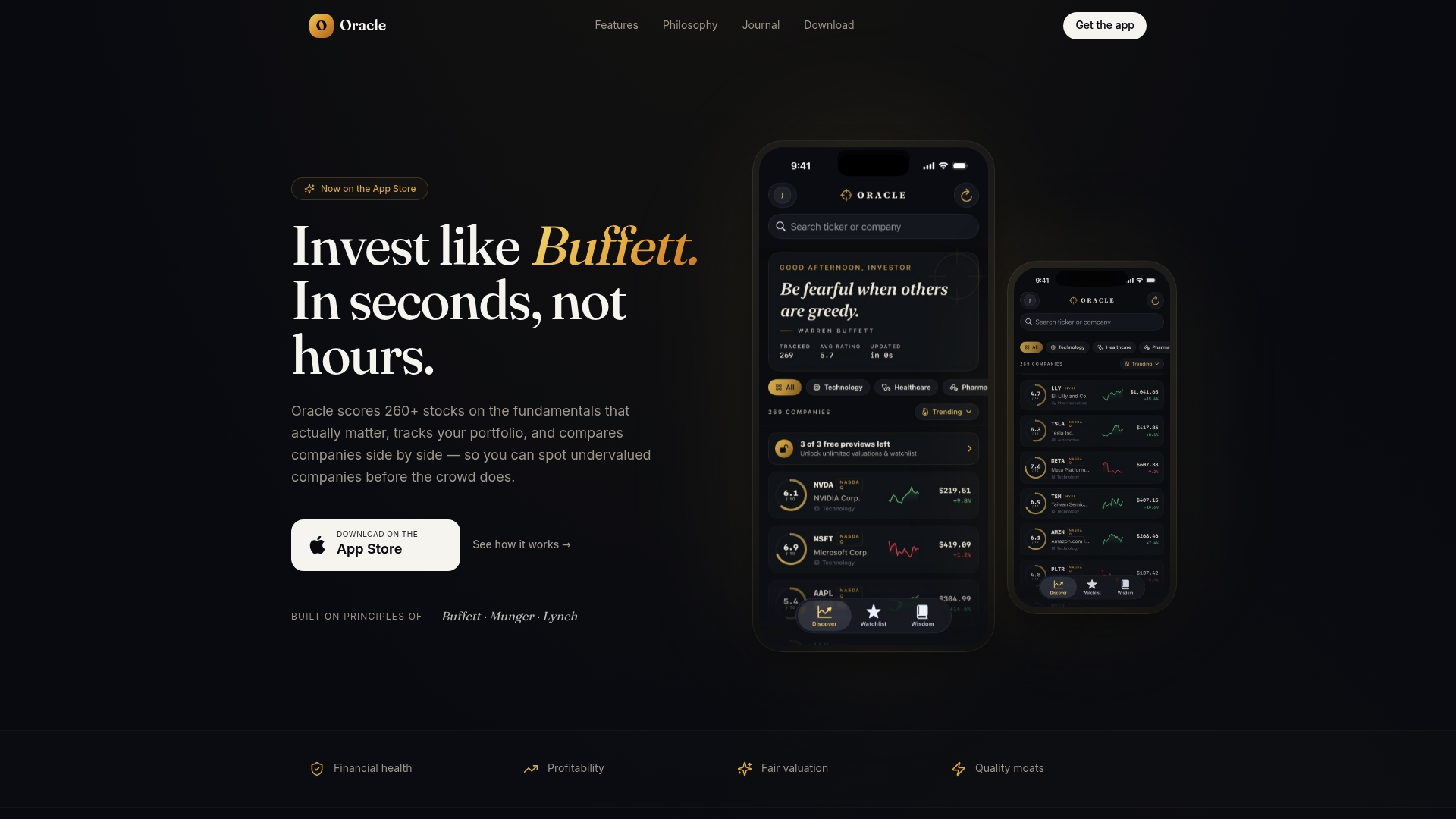
If you've been relying on a newsletter to tell you what to buy, Oracleinvestments puts that analytical power directly in your hands. Real-time portfolio tracking, instant company comparisons, and scores across 260+ stocks mean you're never waiting for the next pick to arrive in your inbox. It's built for investors who want to think for themselves, backed by a framework that has worked for decades. Start evaluating stocks the way the best investors always have.