
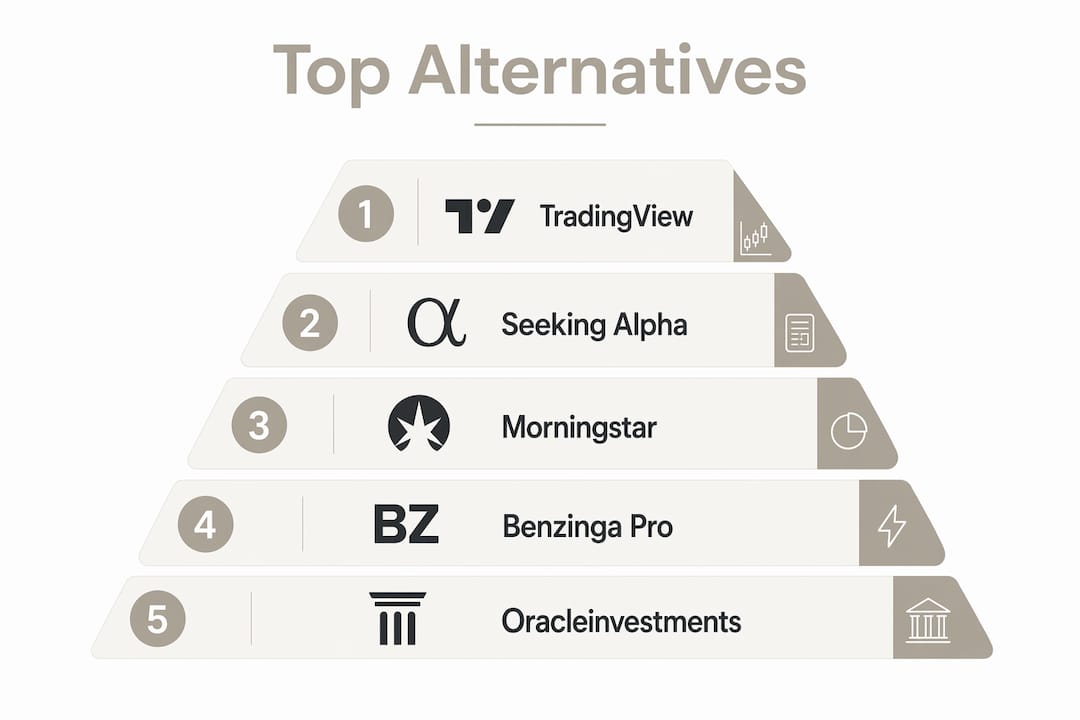
If you want a straight answer: TradingView leads for charts and technical analysis, Seeking Alpha for editorial depth and earnings transcripts, Morningstar for long-term fundamental research, FINVIZ for fast stock screening, and Oracleinvestments for fundamentals scoring and instant side-by-side comparisons. Developers needing raw data feeds should look at Alpha Vantage, IEX Cloud, EOD Historical Data, or FinancialModelingPrep.
Yahoo Finance remains a solid starting point for free quotes and basic watchlists. Where it falls short is synthesis. It hands you raw data and leaves the analysis to you. The platforms below each solve a specific part of that problem better.
TL;DR picks by job-to-be-done:
- Quick news + watchlists: Benzinga or MarketWatch
- Deep fundamental research: Morningstar or Seeking Alpha
- Advanced charting and technicals: TradingView
- Fast screening: FINVIZ
- Fundamentals scoring and portfolio comparison: Oracleinvestments
- Developer data feeds: Alpha Vantage, IEX Cloud, EOD Historical Data, FinancialModelingPrep
See the comparison table below for a side-by-side view, or jump to the API section if you're building a data pipeline.
Table of Contents
- Which Yahoo Finance alternatives win on features and price?
- What each alternative actually offers
- How we chose these alternatives
- How to choose the right alternative for your needs
- API and data-feed options for developers and power users
- Why Oracleinvestments works for fundamentals-driven investors
- Customer support quality and availability
- Security and privacy policies across finance platforms
- Key Takeaways
- The case for being selective about your data stack
- Oracleinvestments: fundamentals scoring without the spreadsheet
- Useful sources and further reading
Which Yahoo Finance alternatives win on features and price?
| Platform | Best for | Free tier | Real-time data | Charts | Screener | News/transcripts | API access | Mobile | Beginner-friendly |
|---|---|---|---|---|---|---|---|---|---|
| TradingView | Technical analysis | Yes | Yes (limited) | Excellent | Good | Community ideas | Yes | Excellent | Moderate |
| Seeking Alpha | Editorial + earnings | Yes (limited) | Delayed | Basic | Basic | Excellent | Limited | Good | Moderate |
| Morningstar | Long-term fundamentals | Yes (limited) | Delayed | Good | Good | Strong | Limited | Good | High |
| FINVIZ | Fast screening | Yes | Delayed (free) | Good | Excellent | Headlines | Limited | Limited | Moderate |
| Benzinga | News-first investing | Yes | Yes (Pro) | Basic | Basic | Strong | Yes (Pro) | Good | High |
| Oracleinvestments | Fundamentals scoring | Yes | Yes | Basic | Good | No | No | Good | Very high |
| EOD Historical Data | Historical + bulk data | Limited | Delayed | No | No | No | Excellent | No | Low |
| FinancialModelingPrep | Developer fundamentals | Yes | Delayed | No | No | No | Excellent | No | Low |
| IEX Cloud | Real-time developer feeds | Yes | Yes | No | No | No | Excellent | No | Low |
| Alpha Vantage | Freemium developer API | Yes | Delayed (free) | No | No | No | Excellent | No | Low |
Pricing note: Free tiers vary significantly in what they actually deliver. TradingView's free plan delays some real-time data and limits chart indicators. Seeking Alpha's free access is narrow; the premium tier runs roughly $239 per year. Morningstar's premium is around $249 per year. FINVIZ Elite, which unlocks real-time quotes and advanced filters, runs about $39.99 per month. Always check each platform's data-delivery limits before assuming a free tier covers your workflow. Verified pricing tiers shift regularly, so confirm directly on each pricing page before subscribing.
Practical trade-offs by category:
- Chart-first platforms (TradingView): unmatched technical depth, but fundamental data is thin and the free plan's indicator limits frustrate active traders quickly.
- Premium research services (Morningstar, Seeking Alpha): editorial quality is high, but real-time quotes are not their strength and costs add up if you subscribe to both.
- News-first services (Benzinga): fast and readable, but depth of fundamental analysis is limited compared to research-focused platforms.
- Developer-first APIs (Alpha Vantage, IEX Cloud, EOD Historical Data, FinancialModelingPrep): excellent for pipelines, but no consumer-facing UI to speak of.
- Fundamentals scoring apps (Oracleinvestments): fastest path from ticker to investment decision, but not designed for raw data exports or advanced charting.
What each alternative actually offers
Chart-first platforms
TradingView is the default choice for anyone who thinks in candlesticks. Its browser-based charting engine handles equities, forex, crypto, and futures on a single interface, with a community of trade ideas that no other platform matches in volume or variety. The screener is capable, though it works best when paired with a separate fundamental source. Real-time data on the free plan is exchange-dependent; some feeds are delayed 15 minutes unless you pay for a data add-on.

Strengths: Indicator library, multi-asset coverage, Pine Script for custom strategies, strong mobile app. Limitations: Fundamental data is surface-level; free plan caps simultaneous indicators. Pricing shape: Free tier available; paid plans from roughly $14.95 per month.
Premium research services
Seeking Alpha combines crowdsourced analyst articles with earnings call transcripts and quant ratings. The editorial layer is genuinely useful for understanding why a stock moved, not just that it moved. Morningstar takes a more institutional approach, with analyst reports, fair value estimates, and a star-rating system that long-term investors have trusted for decades. Neither platform is built for speed; both reward patience and deeper reading.
Strengths (Seeking Alpha): Transcript access, contributor diversity, quant factor grades. Strengths (Morningstar): Fair value methodology, fund and ETF coverage, portfolio X-ray tool. Limitations: Premium pricing, delayed quotes, limited real-time capability. Pricing shape: Both offer limited free access; premium tiers in the $239–$249 per year range.
News-first services
Benzinga Pro targets active traders who need fast headlines before the broader market reacts. The platform surfaces pre-market movers, SEC filings, and earnings alerts with a speed that general financial news sites rarely match. For casual investors who just want readable market context, free financial news platforms like MarketWatch cover the basics without a subscription.
Strengths: Alert speed, pre-market coverage, options activity signals on Pro tier. Limitations: Fundamental analysis is thin; the free tier is more of a teaser than a working tool. Pricing shape: Free tier available; Benzinga Pro starts around $37 per month.
Fundamentals scoring apps
Oracleinvestments scores over 260 stocks across profitability, valuation, and financial health, distilling each company into a comparable metric set rather than leaving you to build a spreadsheet. The value rating system is designed to surface undervalued stocks quickly, drawing on the frameworks of Warren Buffett, Charlie Munger, and Peter Lynch. Real-time portfolio tracking and instant side-by-side comparisons make it a practical replacement for the multi-tab Yahoo Finance workflow most investors have cobbled together over time.
Strengths: Fast fundamentals scoring, side-by-side comparisons, portfolio tracking, beginner-accessible. Limitations: Not designed for raw data exports or deep technical charting. Pricing shape: Free tier available; check the Oracleinvestments landing page for current plan details.
Pro Tip: Pair Oracleinvestments for fundamentals screening with TradingView for entry/exit timing. Run the fundamentals filter first to build a short list, then switch to TradingView to assess price structure before acting.
Developer-first APIs
EOD Historical Data and FinancialModelingPrep both specialize in bulk historical data and fundamental endpoints that power backtesting models and research notebooks. IEX Cloud is the stronger choice when you need real-time or near-real-time quotes in a production environment. Alpha Vantage is the most accessible entry point for developers on a budget, with a generous free tier and straightforward JSON responses, though rate limits on the free plan are tight enough to slow serious projects.
Strengths: Structured endpoints, bulk downloads, documentation quality. Limitations: No consumer UI; costs scale with call volume; real-time data often carries exchange fees on top of platform fees. Pricing shape: All offer free tiers; paid plans scale by call volume and data type.
How we chose these alternatives
Every platform on this list was evaluated against the same set of criteria, applied consistently across free and paid tiers:
- Data accuracy: spot-checked quotes and fundamental figures against SEC filings and S&P Global reference data.
- Data breadth: coverage of U.S. equities, ETFs, and where relevant, international markets and ESG factors. ESG data coverage has matured significantly and is now a meaningful differentiator for investors who screen on sustainability factors.
- Charting and technical tooling: indicator depth, drawing tools, multi-timeframe support.
- Screening power: filter flexibility, real-time vs. delayed filter data, export options.
- API access and pricing: endpoint documentation, rate limits, overage billing clarity.
- Mobile UX: feature parity with desktop, load speed, watchlist management.
- Editorial and transcript depth: quality of analysis, earnings call coverage, update frequency.
- Privacy and security: data-sharing policies, account security options, third-party data sales disclosures.
Pricing was verified in 2026. API rate limits and free-tier restrictions change frequently; confirm directly on each platform's pricing page before committing to a paid plan.
How to choose the right alternative for your needs
The right platform depends almost entirely on what you are actually trying to do. Most investors need two tools, not one: a research layer and a data layer.
Decision checklist:
- Do you need real-time quotes, or is 15-minute delay acceptable for your workflow?
- Is advanced charting and technical analysis central to how you make decisions?
- Do you need API access to feed a model, a spreadsheet, or a custom app?
- Do you prefer synthesized editorial analysis, or do you prefer reading raw filings yourself?
- How important is mobile access for monitoring positions on the go?
- Do you need ESG or specialty data beyond standard financials?
Red flags to watch for:
- Hidden data fees that only appear after you exceed a free-tier call limit.
- API terms that restrict commercial use without a separate enterprise agreement.
- Poor data update cadence on fundamental fields (some platforms update quarterly data weeks after filing).
- Thin small-cap or international coverage if your portfolio goes beyond the S&P 500.
Step-by-step approach:
- Define your primary job: research, screening, charting, or data pipeline.
- Try the free tier of your top two candidates, focused on that one job only.
- Validate data freshness by cross-referencing a recent earnings figure against the SEC filing.
- Sample the API with a few test calls before paying for a higher tier.
- Confirm the mobile workflow covers your minimum daily needs.
User scenarios:
- Beginner DIY investor: Start with Oracleinvestments for fundamentals scoring and Benzinga for news context. Both have accessible free tiers and do not require you to interpret raw financial statements.
- Active technical trader: TradingView is the clear anchor. Add a news-alert service for pre-market catalysts. Budget and account management tools like Quicken can complement your market tools by keeping cash flow and tax context in one place.
- Data scientist building models: IEX Cloud for real-time feeds, EOD Historical Data or FinancialModelingPrep for historical fundamentals. Alpha Vantage works for prototyping; plan to upgrade before production.
API and data-feed options for developers and power users
Raw data access is where Yahoo Finance's unofficial API workarounds have historically created the most friction. The platforms below are built for programmatic access from the start.
Freemium developer APIs (Alpha Vantage, IEX Cloud): Best for prototyping, research notebooks, and small-scale apps. Alpha Vantage's free tier covers end-of-day prices and basic fundamental endpoints; IEX Cloud's free tier includes real-time quotes for U.S. equities. Both impose strict rate limits on free plans. Hidden cost to watch: real-time data on IEX Cloud is metered by message unit, and costs can spike if you pull tick-level data without setting billing alerts.

Enterprise data feeds: Designed for production environments where uptime and data quality guarantees matter. Pricing is typically negotiated rather than listed publicly. Community-augmented market tools are emerging as a middle layer between raw feeds and full enterprise contracts, combining live indexes with sentiment signals that pure data vendors do not provide.
End-of-day historical feeds (EOD Historical Data, FinancialModelingPrep): The right choice for backtesting strategies or building valuation models. Both offer bulk downloads of adjusted price history and fundamental time series. FinancialModelingPrep's income statement and balance sheet endpoints are well-documented and cover a broad universe of U.S. and international tickers.
AI-driven synthesis layers: AI-driven synthesis features are now a meaningful differentiator. Platforms that surface earnings-call highlights or flag financial health changes reduce the time from data to decision. For developers, this means evaluating whether a platform's API returns structured summary fields or only raw numeric data. Pairing a raw data feed with an AI options and strategy layer can replicate the synthesis that premium editorial platforms charge for.
Validation checklist before committing to a paid API tier:
- Run sample queries against 10–20 tickers and compare output to a known reference source.
- Check latency on real-time endpoints during market hours, not just off-hours.
- Configure billing alerts and overage caps before your first production deployment.
- Read the terms of service for commercial-use restrictions, especially on redistribution.
Why Oracleinvestments works for fundamentals-driven investors
Most financial data sites are built around the assumption that you know what you are looking for and just need the numbers. Oracleinvestments is built around the opposite assumption: that you want to know which stocks are worth looking at, fast, without building a spreadsheet from scratch.
A typical Yahoo Finance workflow for a fundamentals investor looks like this: open a ticker, navigate to financials, pull up the income statement, switch to the balance sheet, open a second tab for a competitor, repeat. Oracleinvestments collapses that into a single comparison view. The value rating system is designed to be readable in under a minute, which matters when you are evaluating a short list of candidates, not writing a research report.
The platform is transparent about its scoring methodology. Data sources and update cadence are documented, and the editorial blog covers how to interpret ratings and use comparative analysis to speed up decisions. For investors who want to understand the framework, not just the output, that transparency is worth something.
What to expect vs. general data sites: Oracleinvestments is not a replacement for TradingView's charting or Seeking Alpha's transcript library. It is a replacement for the manual fundamentals-synthesis step that Yahoo Finance leaves entirely to the user.
Customer support quality and availability
Support quality across financial data platforms varies more than pricing pages suggest. TradingView offers community forums and a help center that are genuinely useful for charting questions, but direct support response times on free plans can be slow. Seeking Alpha and Morningstar both provide email support for premium subscribers, with Morningstar offering phone support for its premium tier. FINVIZ has minimal support infrastructure; most users rely on documentation and community threads.
For developer-focused platforms like Alpha Vantage and IEX Cloud, support is primarily documentation-driven. IEX Cloud's documentation is thorough; Alpha Vantage's is adequate for standard endpoints but thinner on edge cases. FinancialModelingPrep and EOD Historical Data both offer email support, with response times that vary by plan tier.
Oracleinvestments provides support through its platform and blog resources. The Oracle Journal covers methodology questions and how-to topics that reduce the need for direct support contact.
What to check before subscribing: Look for a documented SLA on data delivery, a clear escalation path for billing disputes, and community activity that signals whether other users are getting answers. A platform with an active user community often resolves common questions faster than official support channels.
Security and privacy policies across finance platforms
Financial data platforms handle sensitive information: account connections, portfolio holdings, and in some cases brokerage credentials. The security and privacy posture of each platform deserves scrutiny before you connect any accounts.
TradingView does not require brokerage account connections for its core charting and data features, which limits exposure. Platforms that offer account aggregation or direct brokerage integration carry higher risk and should be evaluated for encryption standards, two-factor authentication availability, and data-sharing policies with third parties.
Morningstar and Seeking Alpha are established platforms with long track records; both publish privacy policies that cover data retention and third-party sharing. For developer APIs, review the terms of service carefully: some platforms reserve the right to use query patterns and usage data for internal analytics.
Key questions to ask any platform:
- Does it sell or share user data with third parties for advertising?
- Is two-factor authentication available and enforced?
- What happens to your data if you cancel your subscription?
- For API users: does the platform log your query parameters, and for how long?
Oracleinvestments operates with a privacy-first approach consistent with its focus on individual investors. Review the current privacy policy on the platform before connecting portfolio data.
Key Takeaways
The best Yahoo Finance alternative depends on your primary use case: charting, research, screening, or data pipelines require different tools, and most serious investors use two platforms, not one.
| Point | Details |
|---|---|
| Match tool to job | TradingView leads for charts; Morningstar and Seeking Alpha for research depth; FINVIZ for screening speed. |
| Free tiers have real limits | Real-time data, API call volumes, and screener filters are often restricted on free plans; verify before assuming coverage. |
| Developers need dedicated feeds | Alpha Vantage, IEX Cloud, EOD Historical Data, and FinancialModelingPrep are built for pipelines; Yahoo Finance's unofficial API is not reliable for production use. |
| Synthesis is the new differentiator | Platforms that convert raw data into scored, comparable signals save meaningful research time versus sites that only surface numbers. |
| Oracleinvestments for fundamentals | Oracleinvestments scores hundreds of stocks on profitability, valuation, and financial health, replacing the manual multi-tab fundamentals workflow most investors use on general data sites. |
The case for being selective about your data stack
The instinct when leaving Yahoo Finance is to find one platform that does everything. That platform does not exist, and chasing it leads to paying for features you never use.
The more useful frame: pick one platform for each job you actually do. If you screen stocks weekly, FINVIZ's free tier handles most of that. If you read earnings calls, Seeking Alpha's premium pays for itself quickly. If you want to know whether a stock is fundamentally sound without building a model, Oracleinvestments does that in a fraction of the time a general data site requires.
The platforms that are gaining subscribers fastest in 2026 are the ones that synthesize data rather than just display it. That shift is real and worth paying attention to when you evaluate any new tool. A platform that flags a deteriorating balance sheet before you notice it in the raw numbers is more valuable than one that simply shows you the numbers faster.
Re-validate your tool stack at least once a year. Pricing changes, API terms tighten, and data coverage gaps appear as platforms grow. What works today may cost significantly more or cover less in twelve months.
Oracleinvestments: fundamentals scoring without the spreadsheet
Investors who want fast, comparable fundamentals analysis without building their own models have a direct path: Oracleinvestments.
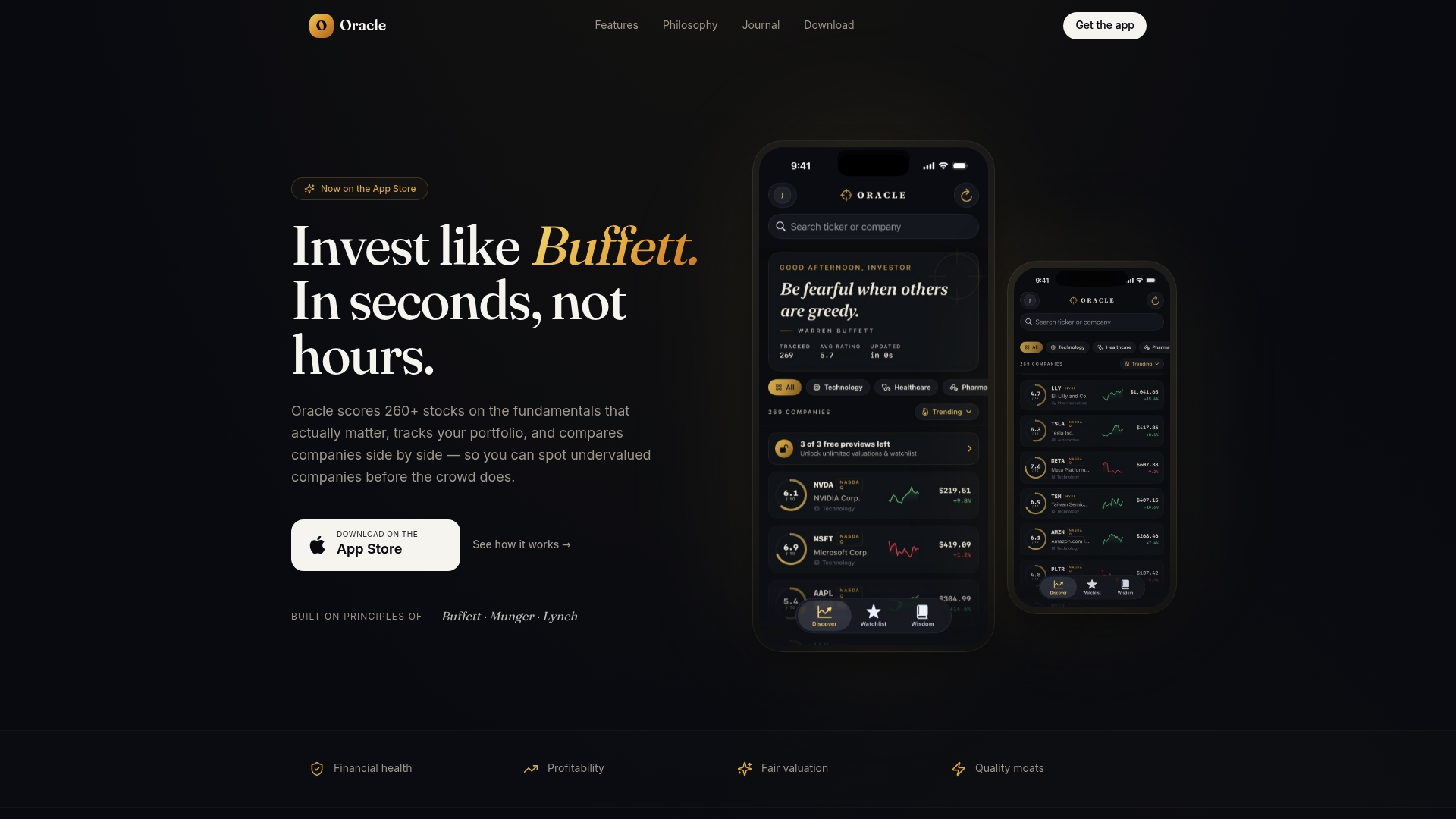
The platform scores over 260 U.S. stocks on profitability, valuation, and financial health, presenting results as a side-by-side comparison rather than a wall of raw data. Portfolio tracking is real-time. The scoring framework is grounded in the investment principles of Buffett, Munger, and Lynch, which means the metrics prioritize long-term business quality over short-term price signals. For investors who have been piecing together fundamentals across multiple Yahoo Finance tabs, Oracleinvestments consolidates that process into a single view.
Start with the free tier to run a few comparisons and see whether the scoring output matches how you already think about stock quality. If it does, the premium tier adds depth without requiring a finance degree to interpret. Visit Oracleinvestments to explore current plan options and try the comparison tool.
This article is general information, not investment advice. Verify current pricing, API terms, and data coverage directly with each platform before subscribing.
Useful sources and further reading
- TradingView — Live charting, multi-asset data, and community trade ideas. Last checked: 2026.
- Oracleinvestments — Fundamentals scoring, portfolio tracking, and instant stock comparisons. Last checked: 2026.
- How to Read a Value Rating · Oracle — Explains Oracle's scoring methodology and how to interpret value ratings quickly. Last checked: 2026.
- Market Hub · OptiqTrades — Live indexes, trending stocks, and community-sourced market stats. Last checked: 2026.
- ESG Data Sources for Finance Professionals · Verdant Institute — Guide to ESG data providers and screening techniques for investors. Last checked: 2026.
- PCMag: Best Personal Finance Apps — Reviewed and ranked personal finance and investment apps, with notes on AI synthesis features. Last checked: 2026.
- Quicken — Budget and account aggregation tool useful as a complement to market research platforms. Last checked: 2026.
Check API documentation and pricing pages directly before committing to any paid tier. Terms and rate limits change without notice.