
What are the best Morningstar alternatives for investors?
Morningstar built its reputation on fund ratings and portfolio analytics, but it is not the only serious option anymore. Three platforms stand out as the strongest alternatives in 2024: Sharesight, Ghostfolio, and Oracleinvestments. Each takes a different angle on portfolio tracking and investment analysis, and the right pick depends almost entirely on what you actually need from a tool.
The table below gives you the core comparison at a glance.
| Platform | Key Features | Ease of Use | Pricing | Portfolio Tracking | Tax Reporting | Data Coverage |
|---|---|---|---|---|---|---|
| Sharesight | Auto-tracking, dividend history, broker sync | Moderate | Free tier; paid from ~$15/mo | Strong | Yes, multi-jurisdiction | Broad, global |
| Ghostfolio | Open-source, self-hosted, privacy-first | Technical | Free (self-hosted); cloud plan available | Good | Basic | Community-driven |
| Oracleinvestments | Stock scoring, fundamentals-based analysis, real-time comparisons | High | App-based; accessible pricing | Real-time | Not primary focus | 260+ scored stocks |
Morningstar's institutional-grade competitors include Bloomberg L.P., Thomson Reuters, and FactSet, but those tools target professional desks, not individual investors. A Bloomberg Terminal runs upward of $26,000 per year. The platforms covered here are built for people managing their own portfolios, not trading floors.

Table of Contents
- How do Sharesight, Ghostfolio, and Oracleinvestments compare?
- How do you move from Morningstar Portfolio Manager to a new platform?
- Which free and open-source tools can replace Morningstar's core features?
- How Oracleinvestments scores stocks and what makes it different
- How do you choose the right Morningstar alternative for your situation?
- Key Takeaways
- The investment tool market has changed more than most investors realize
- Oracleinvestments: built for investors who want clarity, not more data
How do Sharesight, Ghostfolio, and Oracleinvestments compare?
These three platforms share the same broad goal but approach it very differently. Here is what each one actually does well, and where each one falls short.
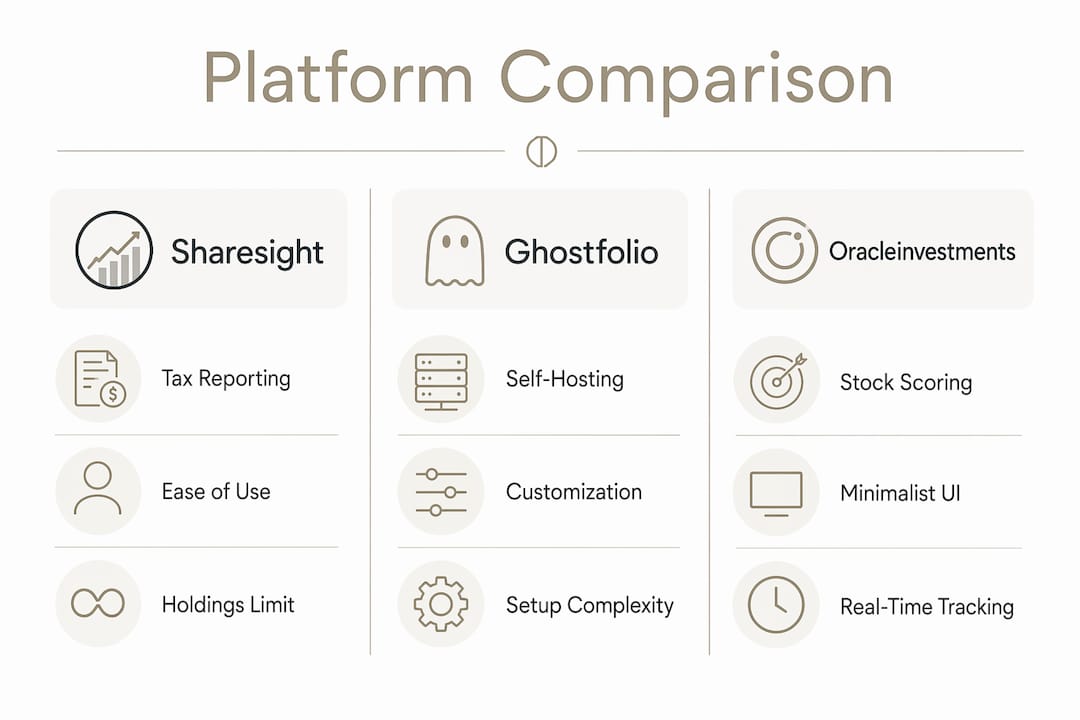
Sharesight
Sharesight's automatic portfolio tracking and tax reporting make it the closest functional replacement for Morningstar Portfolio Manager among retail investors. It syncs with brokers, tracks dividends automatically, and calculates performance across currencies, which matters if you hold international positions.
Key features:
- Automatic broker and brokerage account syncing
- Dividend and corporate action tracking
- Multi-currency performance reporting
- Tax reports for capital gains, income, and foreign investment
- Shareholder return calculations that include dividends, not just price appreciation
The free tier covers up to 10 holdings, which is workable for a starter portfolio. Paid plans unlock unlimited holdings, advanced tax reports, and priority support. The interface is clean but not particularly fast to navigate at first. Expect a short learning curve if you are coming from Morningstar's dashboard.
Ghostfolio
Ghostfolio is open-source portfolio management software designed specifically as a free alternative to Morningstar Portfolio Manager. You can self-host it entirely, which means your financial data never touches a third-party server. That privacy angle is a genuine differentiator.
Key features:
- Full open-source codebase (MIT license)
- Self-hosted or cloud-hosted options
- Investment tracking across stocks, ETFs, and crypto
- Basic performance analytics and allocation views
- Active developer community with regular updates
The trade-off is setup complexity. Self-hosting Ghostfolio requires comfort with Docker or similar tools. If you are not technically inclined, the cloud-hosted version removes that friction, though it introduces a subscription cost. Data coverage depends on community-maintained sources, so niche securities may have gaps.
Oracleinvestments
Oracleinvestments takes a fundamentally different approach. Rather than tracking what you already own, it helps you decide what is worth owning in the first place. The app scores over 260 stocks using financial fundamentals: profitability, valuation, and financial health. You get a clear score for each company, not a wall of raw data to interpret yourself.
Key features:
- Fundamentals-based stock scoring across 260+ companies
- Side-by-side company comparisons in seconds
- Real-time portfolio tracking
- Investment principles drawn from Warren Buffett, Charlie Munger, and Peter Lynch
- Accessible interface built for both new and experienced investors
The scoring methodology is what separates it from the other two. Sharesight and Ghostfolio tell you how your portfolio has performed. Oracleinvestments tells you whether the stocks in it are actually worth holding, based on the same criteria legendary value investors use.
Side-by-side comparison:
| Feature | Sharesight | Ghostfolio | Oracleinvestments |
|---|---|---|---|
| Portfolio tracking | Automatic, broker-synced | Manual/API | Real-time |
| Tax reporting | Full, multi-jurisdiction | Basic | Not primary focus |
| Stock analysis | Limited | Limited | Core feature |
| Open-source | No | Yes | No |
| Pricing | Free tier + paid | Free (self-hosted) | App-based |
| Best for | Tax-conscious investors | Privacy-first, technical users | Fundamentals-driven stock selection |
How do you move from Morningstar Portfolio Manager to a new platform?
Switching platforms is less painful than most investors expect, provided you do it in the right order. The biggest mistake is closing your Morningstar account before you have confirmed your data transferred cleanly.
Step-by-step transition process:
- Export your Morningstar data first. Log into Morningstar Portfolio Manager and export your holdings as a CSV file. Include transaction history, not just current positions, since most platforms need cost basis data to calculate gains accurately.
- Set up your new account before you cancel anything. Create your account on the target platform and familiarize yourself with the interface while Morningstar is still active.
- Import your holdings CSV. Sharesight accepts CSV imports directly. Ghostfolio supports JSON and CSV formats. Oracleinvestments focuses on stock analysis rather than historical transaction import, so you would use it alongside or after establishing your tracking setup.
- Verify cost basis and transaction dates. After import, spot-check five to ten positions against your brokerage statements. Errors in cost basis will distort every tax calculation downstream.
- Reconnect dividend and corporate action history. Sharesight pulls this automatically once broker sync is active. For Ghostfolio, you may need to enter historical dividends manually for older positions.
- Run a parallel period. Keep both platforms active for 30 days. Compare performance figures between them and resolve any discrepancies before fully committing.
Checklist before you cancel Morningstar:
- CSV export of all portfolios downloaded and saved locally
- All holdings verified in the new platform
- Cost basis confirmed against brokerage records
- Tax reports from Morningstar downloaded for prior years
- Watchlists and custom benchmarks recreated
One thing worth knowing: Morningstar's proprietary star ratings and analyst reports do not transfer anywhere. Those are Morningstar's intellectual property. What you are moving is your portfolio data, not their research. If you relied heavily on Morningstar's fund ratings, plan to replace that research layer separately, whether through a screener, a value rating tool, or a combination of free sources.
Which free and open-source tools can replace Morningstar's core features?
No single free platform fully replicates everything Morningstar offers, but combining free tiers from Finviz, Yahoo Finance, and Stock Analysis gets retail investors surprisingly close for most day-to-day research needs.
Free tools worth knowing:
- Yahoo Finance: Widely used for free financial data and basic portfolio tracking. The free tier covers quotes, financials, and news well. It lacks Morningstar's proprietary ratings and the advanced screening tools require upgrading to a paid plan.
- Finviz: A powerful stock screener with a free tier that covers fundamental filters, technical overlays, and sector heat maps. The free version has a 15-minute data delay, but for fundamental research that rarely matters.
- Stock Analysis: Clean interface, solid coverage of income statements, balance sheets, and cash flow going back a decade. Useful for the kind of historical fundamental review Morningstar's premium tier handles.
- Ghostfolio: As covered above, the self-hosted version is completely free. For investors comfortable with a basic technical setup, it delivers genuine portfolio tracking at zero ongoing cost.
- Macrotrends: Deep historical data on financial ratios, margins, and macroeconomic indicators. Not a portfolio tracker, but a strong research complement.
Pros and cons of going free-only:
| Tool | Pros | Cons |
|---|---|---|
| Yahoo Finance | Broad coverage, familiar interface | No proprietary ratings, limited screening |
| Finviz | Powerful screener, visual heat maps | Data delay on free tier, no portfolio tracking |
| Stock Analysis | Clean financials, long history | No portfolio management features |
| Ghostfolio | Full portfolio tracking, private | Technical setup required |
| Macrotrends | Deep historical data | No real-time data, no portfolio tools |
The honest limitation of free tools is that they require you to do the synthesis yourself. Morningstar's value is partly in the interpretation layer: the star ratings, the analyst notes, the risk scores. Free data sources give you the raw numbers; you supply the judgment. That gap is exactly where a tool like Oracleinvestments earns its keep, by scoring stocks against proven fundamentals criteria so you are not starting from a blank spreadsheet.
Pro Tip: Pair live market data from a real-time index tracker with a free screener like Finviz to cover both macro context and individual stock filtering without paying for a premium subscription.
How Oracleinvestments scores stocks and what makes it different
Most investment apps show you data. Oracleinvestments tells you what to do with it. The distinction sounds small until you have spent an hour staring at a balance sheet trying to decide if a company's debt load is acceptable or alarming.
The app's scoring system evaluates each stock across three core dimensions: profitability (return on equity, margins, earnings consistency), valuation (price-to-earnings, price-to-book, free cash flow yield), and financial health (debt levels, current ratio, interest coverage). Each company gets a composite score that lets you compare two businesses side by side in seconds rather than tabs.
What Oracleinvestments delivers:
- Scores for 260+ stocks based on financial fundamentals
- Instant side-by-side company comparisons
- Real-time portfolio tracking integrated into the same interface
- Investment principles from Warren Buffett, Charlie Munger, and Peter Lynch embedded in the scoring logic
- Accessible design that works for first-time investors and experienced portfolio managers alike
The legendary investor angle is not decoration. The scoring criteria reflect the actual filters those investors have described publicly over decades: durable competitive advantages, conservative balance sheets, consistent earnings, and prices that leave a margin of safety. Learning to avoid common value investing mistakes becomes easier when the tool itself is built around those principles.
The app's dark, minimalist interface keeps the focus on the numbers rather than the noise. There are no banner ads, no distracting news tickers, no social sentiment feeds pushing you toward momentum trades. That restraint is a design choice, and it reflects a clear point of view about what serious investing actually requires.
How do you choose the right Morningstar alternative for your situation?
The right tool depends on what you actually use Morningstar for. Investors who primarily used it for fund ratings and analyst reports need something different from investors who used it mainly for portfolio tracking and tax reporting.
Key criteria to evaluate:
- Data depth: How many securities does the platform cover? Does it include ETFs, mutual funds, and international stocks, or primarily US equities?
- Portfolio tracking: Does it sync automatically with your broker, or do you enter trades manually? Manual entry is fine for small portfolios; it becomes a burden at 30+ positions.
- Tax reporting: If you file taxes on capital gains, you need a platform that calculates cost basis correctly and generates reports your accountant can use. Sharesight is the strongest option here.
- Stock analysis quality: Raw data is not the same as analysis. Look for platforms that provide context, not just numbers.
- Pricing: Free tiers are useful for testing, but check what they actually unlock. Some platforms gate the most useful features behind expensive annual plans.
- Mobile access: If you check your portfolio on your phone, confirm the mobile app is genuinely functional, not just a stripped-down web view.
Trade-offs to weigh:
- Simplicity vs. comprehensiveness: Ghostfolio gives you full control but demands more from you. Oracleinvestments simplifies the analysis layer but covers a defined stock universe. Sharesight covers the tracking and tax side thoroughly but does not help you evaluate individual stocks.
- Privacy vs. convenience: Self-hosting Ghostfolio keeps your data entirely private. Cloud-based platforms are easier but involve trusting a third party with your financial information.
- Cost vs. capability: Free tools require more manual effort and synthesis. Paid tools save time but add recurring costs.
Pro Tip: Sophisticated investors often combine a specialized screener with a comprehensive data provider to get broader coverage than any single subscription offers. Consider pairing Oracleinvestments for stock selection with Sharesight for portfolio tracking and tax reporting.
For investors who want AI-driven signals layered on top of their research process, AI-based trading tools can complement the fundamental analysis approach without replacing it.
Key Takeaways
The strongest Morningstar alternatives each cover a different part of the investing workflow: Sharesight leads on tax reporting, Ghostfolio leads on privacy and cost, and Oracleinvestments leads on fundamentals-based stock analysis.
| Point | Details |
|---|---|
| No single free tool matches Morningstar fully | Combining Finviz, Yahoo Finance, and Stock Analysis covers most retail research needs at no cost. |
| Sharesight leads on tax reporting | Automatic broker sync and multi-jurisdiction tax reports make it the top pick for tax-conscious investors. |
| Ghostfolio suits privacy-first investors | The self-hosted open-source version costs nothing and keeps your financial data off third-party servers. |
| Transition requires careful data export | Export your full transaction history from Morningstar before canceling, and verify cost basis in the new platform. |
| Oracleinvestments | Scores 260+ stocks on profitability, valuation, and financial health, applying legendary investor principles to simplify stock selection. |
The investment tool market has changed more than most investors realize
The conventional wisdom says Morningstar is the gold standard for individual investors and everything else is a compromise. That framing made sense a decade ago. It does not hold up as cleanly now.
What has actually changed is the separation of functions. Morningstar built an integrated platform where ratings, portfolio tracking, and research lived together. The newer generation of tools has unbundled those functions, and in most cases, the specialized tools are better at their specific job than Morningstar's all-in-one approach.
Sharesight's tax reporting is more thorough than what Morningstar Portfolio Manager offered most retail users. Ghostfolio's privacy model is something Morningstar never attempted. And Oracleinvestments' fundamentals scoring gives individual investors a structured analytical framework that previously required either a Bloomberg subscription or building your own spreadsheet model from scratch.
The part that gets underestimated is the cost of cognitive overhead. Morningstar gives you a lot of data and a lot of ratings. But ratings are someone else's judgment, and they are not always transparent about the methodology. A tool that shows you the underlying fundamentals and lets you apply a consistent framework, the way Oracleinvestments does with its Buffett-and-Lynch-informed scoring, builds better investing instincts over time than one that just hands you a star count.
The investors who will get the most from this generation of tools are the ones willing to combine two or three platforms rather than looking for a single replacement. Use Oracleinvestments to identify what is worth buying. Use Sharesight to track what you own and handle your taxes. Use a free screener to stay current on the broader market. That combination costs less than a Morningstar premium subscription and covers more ground.
Oracleinvestments: built for investors who want clarity, not more data
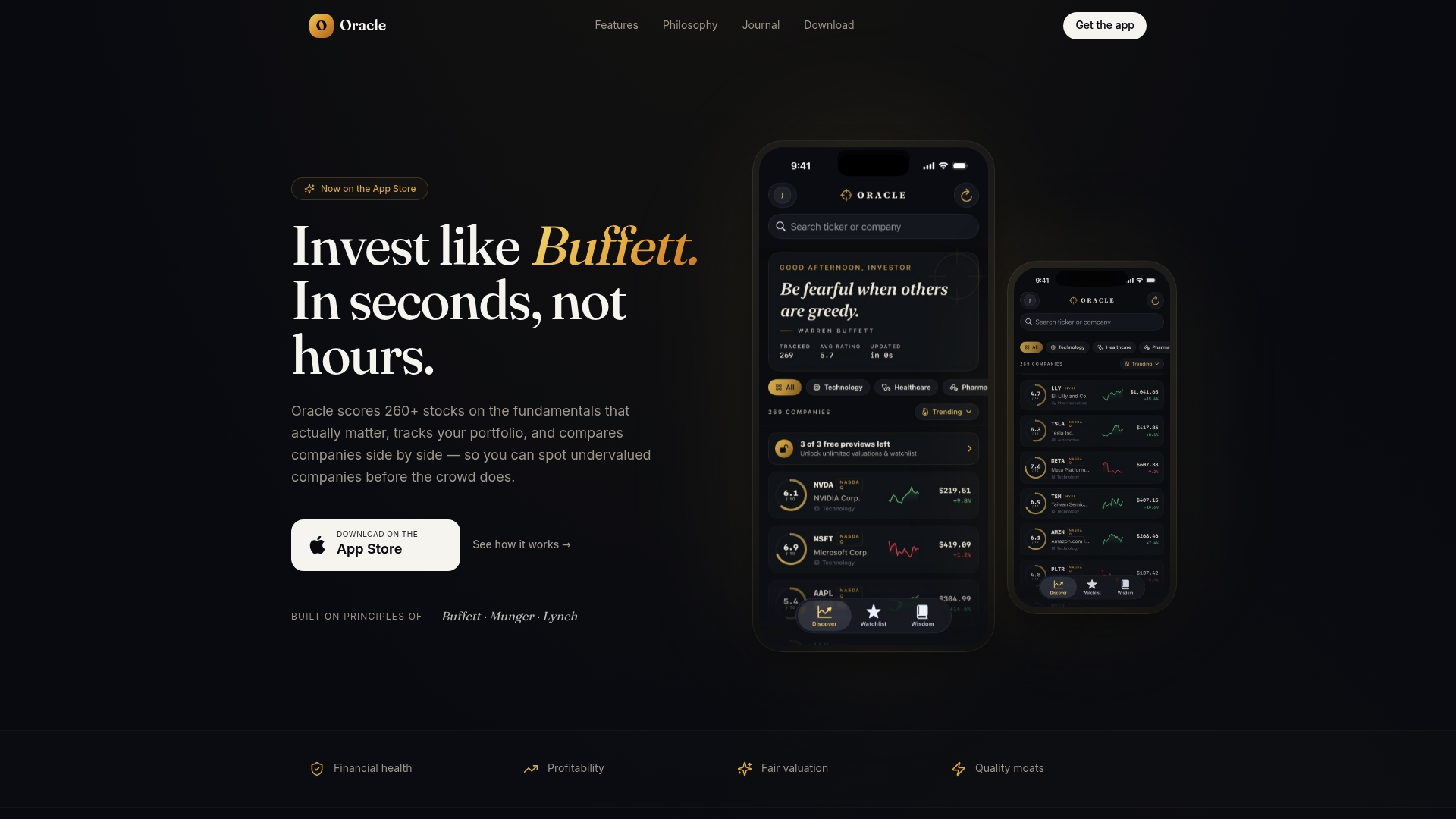
Most investment tools give you more information than you know what to do with. Oracleinvestments does the opposite. It takes the financial fundamentals that Warren Buffett, Charlie Munger, and Peter Lynch have described publicly for decades, applies them systematically to 260+ stocks, and hands you a score you can act on.
The app covers real-time portfolio tracking alongside the stock scoring, so you are not switching between platforms to see what you own and whether it is worth keeping. The side-by-side comparison feature lets you evaluate two companies against each other in seconds, using the same criteria a serious value investor would apply manually over hours.
If you came to this article because Morningstar's pricing no longer feels justified, or because you want a tool that actually helps you think about stock quality rather than just tracking price movements, Oracleinvestments is worth a serious look. Visit oracleinvestments.net to see the scoring methodology and explore the stock universe it covers.